Facts
The petitioner was initially engaged as a Trained Graduate Teacher (Arts) on contract under the Scheduled Caste (IRDP) category, and his services were regularized by office order dated 22.06.2015.
Source reference: para. 2A complaint was subsequently made alleging that he had obtained appointment on the basis of a false Scheduled Caste (IRDP) certificate, despite belonging to the General Category.
Source reference: para. 2The respondents sought his explanation, directed him to appear with supporting documents, and considered his written reply.
Source reference: para. 9Without initiating a disciplinary inquiry under the CCS (CCA) Rules, the Director of School Education terminated his services on 03.05.2025 by relying on Condition No. 14 of the appointment order.
Source reference: paras. 2, 3, 9The petitioner challenged the termination and sought reinstatement with consequential benefits.
Source reference: para. 1Issues
Whether the petitioner’s services could be terminated on allegations of obtaining appointment through a false caste certificate without conducting the inquiry mandated by Article 311(2) of the Constitution of India and Rule 14 of the CCS (CCA) Rules?
Source reference: paras. 5, 7–9Whether reliance on Condition No. 14 of the appointment order could lawfully substitute the mandatory disciplinary procedure applicable to a regular government servant?
Source reference: para. 9Whether the respondents could be permitted to initiate fresh proceedings in accordance with law after the termination order was quashed?
Source reference: para. 10Law Applied
Article 311(2) of the Constitution requires that a person holding a civil post cannot be dismissed or removed except after an inquiry in which the charges are communicated and a reasonable opportunity of hearing is provided, subject to the constitutional exceptions specified therein.
Source reference: para. 6Under Rule 11 of the CCS (CCA) Rules, dismissal from service constitutes a major penalty.
Source reference: para. 7Rules 14 and 15 prescribe the mandatory procedure for imposing a major penalty, including framing and serving charges, consideration of the employee’s response, conduct of a formal inquiry where necessary, furnishing of the inquiry report, and consideration of the employee’s objections before the disciplinary authority passes a final order.
Source reference: paras. 7–8Once an employee is appointed to government service, termination or removal must be governed by the applicable service rules and constitutional safeguards; an appointment-order condition cannot override the mandatory requirements of Article 311 and Rules 14–15.
Source reference: para. 9Reasoning
The Court confined its consideration to the legality of the termination procedure and expressly declined to determine whether the petitioner had in fact secured appointment as a Scheduled Caste candidate or whether the caste certificate was fabricated.
Source reference: para. 5The allegations, if established, involved misconduct warranting dismissal or removal, which is a major penalty under Rule 11 and therefore required compliance with Rules 14 and 15.
Source reference: para. 7The respondents merely sought explanations and thereafter passed the termination order; they did not serve a formal charge-sheet, appoint an Inquiry Officer, conduct a disciplinary inquiry, furnish an inquiry report, or invite objections to that report.
Source reference: para. 9Consequently, the procedure adopted violated Article 311(2) and Rules 14–15.
Source reference: para. 9The respondents could not avoid these safeguards by invoking Condition No. 14 of the appointment order, since statutory service protections governed the petitioner’s termination after regularization.
Source reference: para. 9Holding
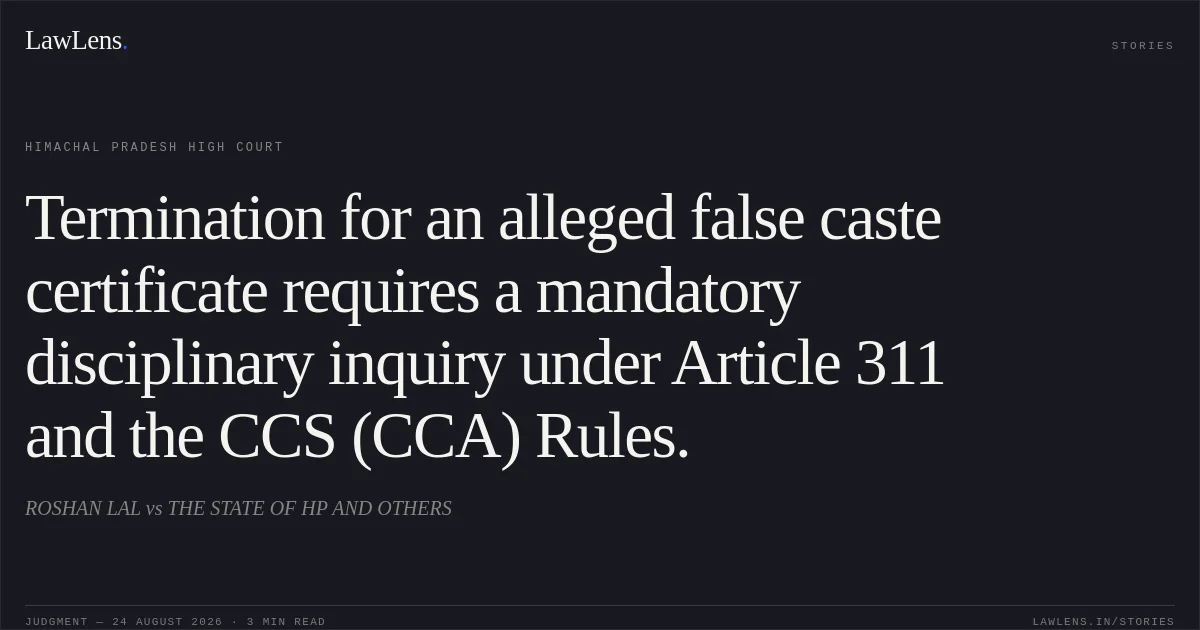
The Court held that the petitioner’s termination without following the mandatory procedure under Article 311(2) of the Constitution and Rules 14–15 of the CCS (CCA) Rules was legally unsustainable.
The office order dated 03.05.2025 was quashed and set aside, and the consequences were directed to follow.
Source reference: para. 10Since the petition was allowed on procedural grounds, the respondents were granted liberty to proceed against the petitioner afresh, in accordance with law, regarding the allegations that had led to the termination order.
Source reference: para. 10Original Court PDF
ROSHAN LALvsTHE STATE OF HP AND OTHERS
Click to open original judgment
Original judgment, available to read, download and summarize on LawLens.in