Facts
The petitioner was appointed as a Field Assistant on 19 February 2016 after a recruitment process advertised in newspapers.
Source reference: p. 2His name was subsequently included in promotional panels for Surveyor, and he completed eight years of service in February 2024.
Source reference: p. 4The respondents later alleged that his appointment had been made against a roster turn reserved for a destitute widow belonging to the Most Backward Classes/Denotified Communities (MBC/DNC).
Source reference: p. 2After an earlier show-cause notice was set aside with a direction to hold an enquiry, the respondents terminated him on 23 April 2024.
Source reference: p. 2, p. 3The petitioner challenged that order, contending that he had made no misrepresentation and that the respondents had not shown the availability of an eligible woman candidate for the reserved turn.
Source reference: p. 3, p. 4Issues
1. Whether the petitioner’s appointment against the MBC (NP)(W)(DW) roster turn could be treated as invalid when the respondents had not established the availability of an eligible destitute widow or other eligible woman candidate in the relevant category.
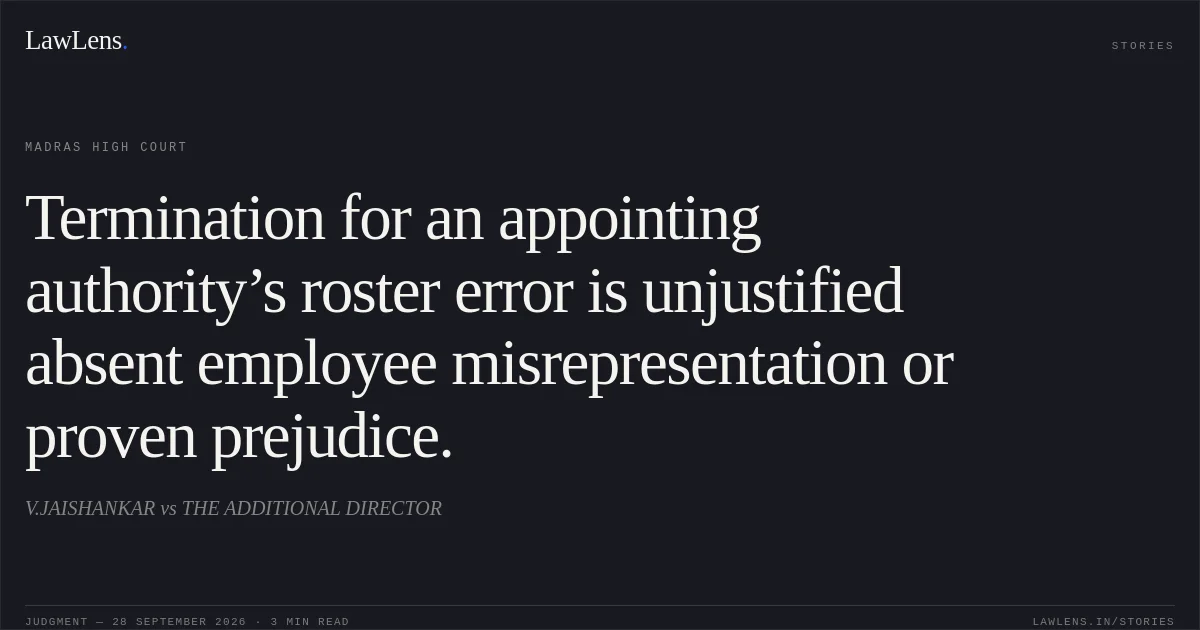
Source reference: p. 6, p. 7, p. 9, p. 10, p. 112. Whether the petitioner’s termination after more than eight years of service, for an alleged roster error attributable to the appointing authority and without any allegation of misrepresentation by the petitioner, was justified.
Source reference: p. 7, p. 8Law Applied
Section 26(2) of the Tamil Nadu Government Servants (Conditions of Service) Act, 2016 provides that, where no suitable and qualified destitute widow is available, the relevant turn is to go to a woman of the respective category who is not a destitute widow; Section 26(5) provides that, if no qualified and suitable woman candidate in the respective category is available for the women’s turn, it may go to a male candidate of that category.
Source reference: p. 6, p. 7In Rajesh Kumar Daria v. Rajasthan Public Service Commission, (2007) 8 SCC 785, the Supreme Court explained that horizontal reservation operates within vertical categories: women selected on merit count toward the women’s quota, and adjustment is required only if there is a shortfall.
Source reference: p. 8, p. 9, p. 10The Court also relied on Article 21 in assessing the fairness of terminating the petitioner after prolonged service for an error attributed to the appointing authority.
Source reference: p. 8Reasoning
The Court found that the respondents had not produced evidence showing that an eligible destitute widow or MBC woman was available for the relevant roster turn, nor had they alleged that the petitioner obtained appointment through misrepresentation or collusion.
Source reference: p. 6, p. 7, p. 8, p. 10, p. 11Applying Section 26(5), it held that, absent proof of an eligible woman candidate, the petitioner’s appointment could not be faulted on the stated basis, though it might at most be regarded as irregular.
Source reference: p. 7The respondents’ argument that the vacancy should instead have been kept as a backlog vacancy did not persuade the Court in the circumstances of this case.
Source reference: p. 7It further concluded that terminating the petitioner after eight years for the appointing authority’s roster error, without evidence that his appointment displaced an eligible woman candidate, was unjustified and implicated his Article 21 interests.
Source reference: p. 7, p. 8, p. 10, p. 11Holding
The Court allowed the writ petition and set aside the termination order dated 23 April 2024.
It directed the respondents to reinstate the petitioner in his original post within eight weeks of receiving the order.
Source reference: p. 11The period of termination is to count only for continuity of service; the petitioner is not entitled to monetary benefits for that period under the principle of “no work, no pay”.
Source reference: p. 11Acts & Sections Cited
1 provisions across 1 statute referred to in this judgment. Each provision opens on LawLens.
Tamil Nadu Government Servants (Conditions of Service) Act, 20161
Original Court PDF
V.JAISHANKARvsTHE ADDITIONAL DIRECTOR
Click to open original judgment
Original judgment, available to read, download and summarize on LawLens.in