Facts
The petitioner was appointed as an Aanganbadi Sevika on January 28, 2000, at Centre No. 2, Mallah Toli, Buxar
Source reference: para. 2Following inspections on October 22, 2019, and November 8, 2019, several irregularities were alleged, including the petitioner’s absence, low child attendance (12 out of 40), poor food quality, lack of hygiene, and inadequate drinking water and lavatory facilities
Source reference: para. 3Consequently, the District Programme Officer (DPO), Buxar, terminated her services via order dated November 11, 2019
Source reference: para. 2The petitioner’s appeal to the District Magistrate was dismissed on November 13, 2020
Source reference: para. 4She challenged these orders, contending that the penalty of termination exceeded the punishment prescribed for first-time misconduct under the relevant government guidelines
Source reference: para. 5Issues
1. Whether the termination of the petitioner’s service was disproportionate to the alleged misconduct as per the departmental guidelines
Source reference: para. 52. Whether the respondent authorities exceeded their jurisdiction by imposing a penalty not prescribed for first-time offences under the Aanganbadi Kendra Sanchalan Evam Dand Hetu Margdarshika
Source reference: para. 13Law Applied
The court applied the guidelines regulating the conduct and punishment of Aanganbadi employees, specifically the Aanganbadi Kendra Sanchalan Evam Dand Hetu Margdarshika issued via Letter No. 170 dated January 20, 2017
Source reference: para. 7-8Under Clauses (k), (g), and (gh) of these guidelines, the prescribed punishment for a first-time instance of absence from duty, low student attendance (less than 50%), or failure to maintain hygiene/food standards is a "warning" (Chetavni)
Source reference: para. 11-12Termination (Chayan Mukti) is only contemplated upon repeated misconduct or failure to improve after prior warnings
Source reference: para. 11Reasoning
The court examined the nature of the irregularities attributed to the petitioner—absence, low attendance, and poor infrastructure/hygiene—and categorized them under the relevant clauses of the 2017 Guidelines
Source reference: para. 10-11Upon reviewing the supplementary counter-affidavit filed by the State, it was admitted that the guidelines were in force from January 20, 2017
Source reference: para. 8The court found that because these were the first documented instances of misconduct by the petitioner, the authorities were legally mandated to issue a warning rather than direct termination
Source reference: para. 13The court reasoned that by jumping to the harshest penalty (termination) for a first-time offence, the DPO and the District Magistrate acted beyond the scope of their delegated authority and ignored the graduated penalty structure mandated by the State’s own policy
Source reference: para. 13-14Holding
The court allowed the writ petition, holding that the termination orders were ultra vires the applicable guidelines
The High Court set aside the DPO’s order dated November 11, 2019, and the District Magistrate’s appellate order dated November 13, 2020
Source reference: para. 14The court directed the respondents to reinstate the petitioner in service forthwith, while reserving the right of the authorities to pass fresh orders strictly in accordance with the warning procedures prescribed in the guidelines
Source reference: para. 14-15Acts & Sections Cited
4 provisions across 1 statute referred to in this judgment. Linked provisions open on LawLens.
Aanganbadi Kendra Sanchalan evam Dand Hetu Margdarshika [2017]4
Original Court PDF
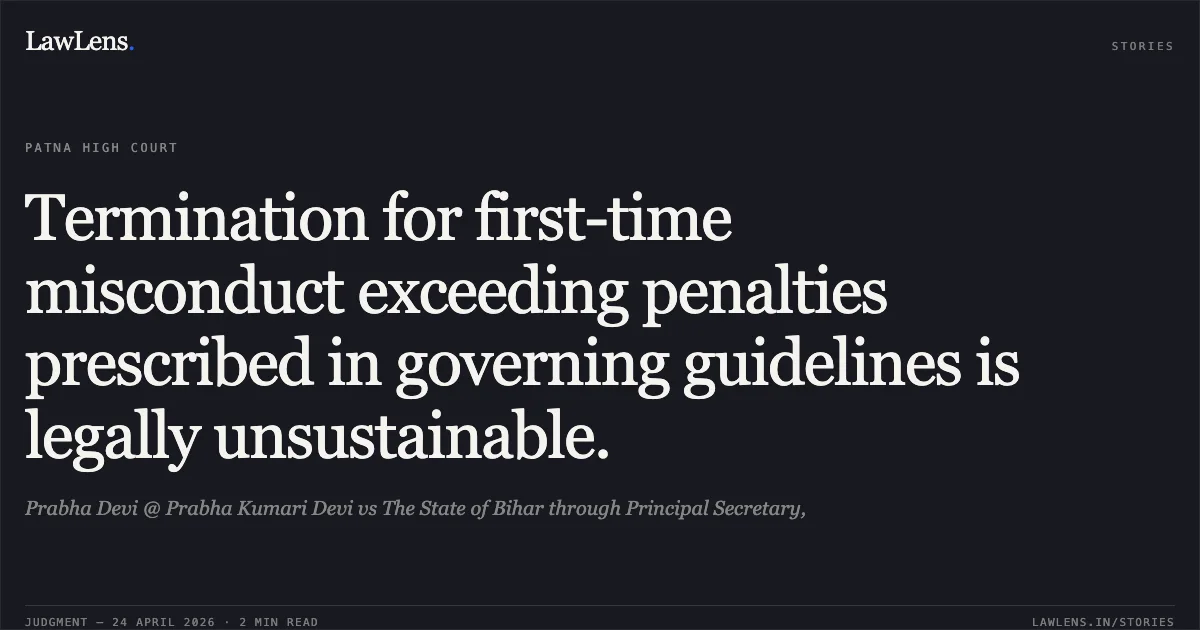
Prabha Devi @ Prabha Kumari DevivsThe State of Bihar through Principal Secretary,
Click to open original judgment
Original judgment, available to read, download and summarize on LawLens.in


