Facts
The Respondent/Workman was appointed as a Medical Sales Representative (MSR) in 1985 and confirmed in 1986
Source reference: p.2In September 1995, the Petitioner/Management "froze" the Workman's duties without explanation
Source reference: p.3Subsequently, a transfer order to Ratlam was issued while an industrial dispute regarding transfer policies was pending before the Industrial Tribunal, Mumbai
Source reference: p.3The Workman requested the transfer be kept in abeyance; however, the Management rejected this and terminated his services on 01.11.1995 via a discharge simpliciter clause, providing one month's salary in lieu of notice
Source reference: p.3-4No domestic enquiry or show-cause notice preceded the termination
Source reference: p.3Following a decade of litigation that reached the Supreme Court, the matter was referred to the Labour Court under Section 10 of the ID Act
Source reference: p.4-5The Labour Court set aside the termination, ordering reinstatement with 25% back wages
Source reference: p.5Issues
1. Whether the respondent qualifies as a ‘workman’ within the meaning of Section 2(s) of the Industrial Disputes Act, 1947, and whether the reference was maintainable?
Source reference: p.9, para. 292. Whether the termination of the respondent, founded on alleged misconduct (non-compliance with transfer), was illegal, unjustified, or disproportionate?
Source reference: p.9, para. 293. Whether the findings of the Labour Court suffer from perversity or jurisdictional error warranting interference under Article 227?
Source reference: p.9, para. 29Law Applied
Section 2(s) of the Industrial Disputes Act (ID Act) defining "workman" and Section 6(2) of the Sales Promotion Employees (Conditions of Service) Act, 1976 (SPE Act), which deems sales promotion employees to be workmen
Source reference: p.13Reliance on H.R. Adyanthaya v. Sandoz (India) Ltd. regarding the status of medical representatives
Source reference: p.13Reliance on D.K. Yadav v. J.M.A. Industries concerning the necessity of natural justice in terminations affecting livelihood
Source reference: p.17Principle from Novartis India Ltd. v. State of West Bengal, which established that discharge cannot be used as a substitute for punishment when misconduct (like non-joining after transfer) is the foundation of the action
Source reference: p.18Reasoning
The court first dismissed the challenge to the Workman's status, noting that under the amended SPE Act (1987), MSRs are deemed workmen, and the Petitioner was estopped from raising this belatedly
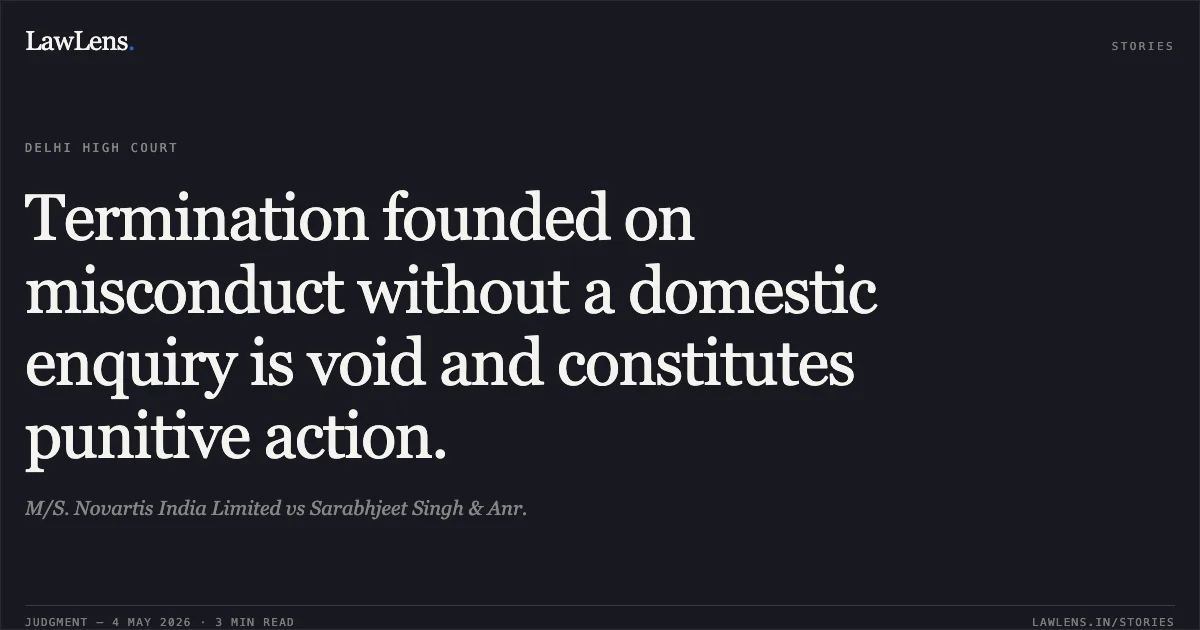
Source reference: p.12-13On the merits, the court determined that the termination was not a "discharge simpliciter" but "punitive" because the management’s own pleadings cited "impunity" and "defiance" as the reasons for termination
Source reference: p.15-16The absence of a charge-sheet or domestic enquiry violated the principles of natural justice
Source reference: p.17Regarding the transfer, the court found the Workman acted under a bona fide belief that the pending Mumbai reference afforded him protection
Source reference: p.21The court held that while transfer is a management prerogative, the "precipitous" termination within 18 days of rejecting a representation—without an enquiry—was disproportionate under Section 11-A of the ID Act
Source reference: p.18, 23Holding
The High Court dismissed the petition and upheld the Labour Court’s Award with modifications due to the Workman's superannuation
The court held that the termination was illegal and unjustified
Source reference: p.26The court ordered that: (i) the Workman be deemed to have continued in service until superannuation for all retirement benefits; (ii) no back wages are due for 1995–2010; (iii) 25% back wages are due for 2010–2015; and (iv) full wages from the date of the Award (2015) until the actual date of superannuation must be paid. All retiral dues must be released within twelve weeks.
Source reference: p.26-27Acts & Sections Cited
7 provisions across 2 statutes referred to in this judgment. Linked provisions open on LawLens.
Industrial Disputes Act, 19476
Sales Promotion Employees (Conditions Of Service) Act, 19761
Original Court PDF
M/S. Novartis India LimitedvsSarabhjeet Singh & Anr.
Click to open original judgment
Original judgment, available to read, download and summarize on LawLens.in