Facts
The petitioners, engaged as Gramin Dak Sevaks, challenged orders dated 3 July 2026 by which the Central Administrative Tribunal, Patna Bench, dismissed their respective original applications, namely OA No. 050/00400/2019 and OA No. 050/00319/2019.
Source reference: p.2Their services had earlier been terminated by orders dated 20 December 2018, apparently on the ground of irregularities in the engagement process.
Source reference: p.5Before the High Court, the petitioners relied upon the CAT’s judgment dated 20 October 2021 in OA No. 050/01081/2018, which held that termination based on alleged irregularities in engagement was required to comply with Rule 4 of the Gramin Dak Sevaks (Conduct & Engagement) Rules, 2011, including an opportunity of hearing.
Source reference: pp.2–4The Union of India’s challenge to that decision in CWJC No. 6501 of 2022, Union of India v. Kumari Anamika Ray, was dismissed by a Coordinate Bench of the High Court on 17 August 2022.
Source reference: p.4Issues
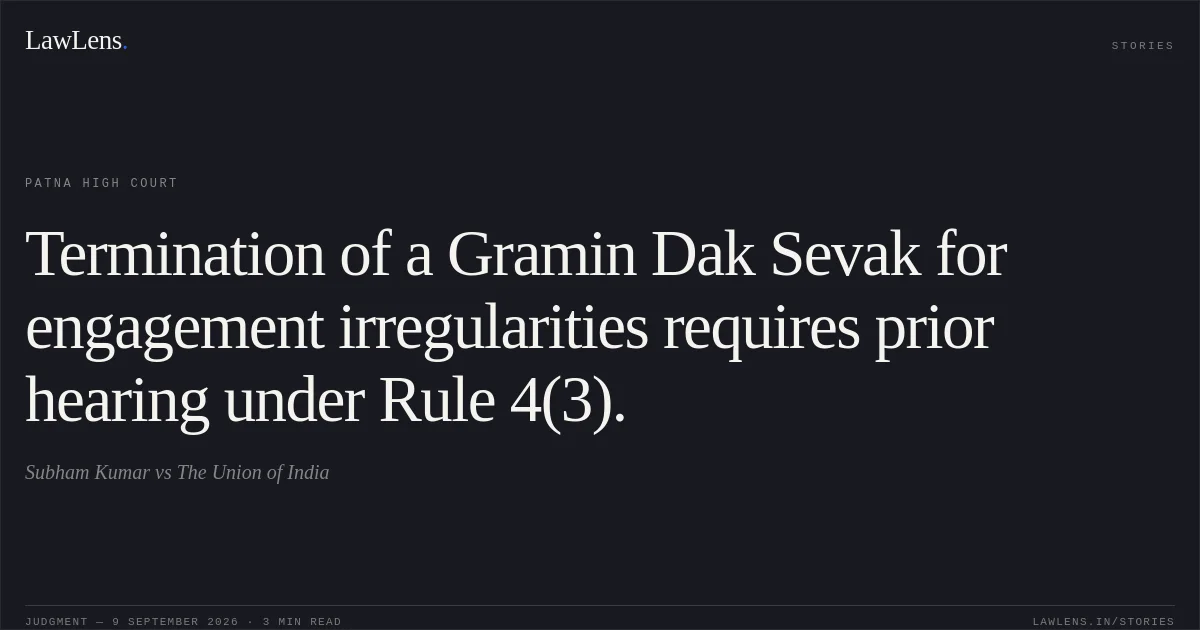
Whether the petitioners’ termination orders dated 20 December 2018 could be sustained without following the procedure prescribed under Rule 4(3) of the GDS (Conduct & Engagement) Rules, 2011, where the alleged basis of termination was irregularity in the engagement process?
Source reference: pp.2–5Whether the CAT’s orders dated 3 July 2026 dismissing the petitioners’ original applications were liable to be set aside in view of the decision in Kumari Anamika Ray?
Source reference: pp.2–5What consequential relief should be granted upon quashing the termination orders, particularly concerning reinstatement, back wages and further departmental proceedings?
Source reference: pp.5–6Law Applied
The Court applied Rules 4 and 8 of the Gramin Dak Sevaks (Conduct & Engagement) Rules, 2011.
Source reference: pp.2–4Rule 8 permits termination of a GDS who has not completed three years of continuous service by giving one month’s notice or payment in lieu of notice; however, where termination is founded on alleged illegality or material irregularity in the engagement process, Rule 4 requires the competent superior authority to examine the engagement and, under Rule 4(3), provide the affected person an opportunity of being heard before passing an appropriate order.
Source reference: pp.2–4The Court relied upon the CAT’s decision in Kumari Anamika Ray, which held that termination for alleged irregularities in recruitment cannot be sustained merely by invoking Rule 8 without complying with the procedural safeguards under Rule 4.
Source reference: pp.2–4The High Court’s dismissal of the Union of India’s challenge to that decision in CWJC No. 6501 of 2022 further supported application of that principle to the present cases.
Source reference: p.4Reasoning
The Court treated the real basis of the petitioners’ termination as alleged irregularity in their engagement, rather than incompetence, unsatisfactory performance or misconduct in service.
Source reference: pp.2–4Accordingly, Rule 4, and not Rule 8 alone, governed the decision-making process.
Source reference: pp.2–4Since the petitioners had not been afforded an opportunity under Rule 4(3) before their termination, the termination orders could not be legally sustained.
Source reference: pp.2–4The respondents were unable to distinguish the present cases from Kumari Anamika Ray and expressly accepted that the matters could be reconsidered by the department.
Source reference: p.5Following that precedent, the Court set aside both the CAT’s orders and the termination orders, while preserving the respondents’ authority to initiate Rule 4(3) proceedings and pass a reasoned and speaking order after hearing the petitioners.
Source reference: pp.5–6Holding
The High Court allowed both writ petitions and set aside the CAT’s orders dated 3 July 2026 in OA Nos. 050/00400/2019 and 050/00319/2019.
The termination orders dated 20 December 2018 were quashed, and the respondents were directed to restore the petitioners to service.
Source reference: p.5The respondents were granted liberty to proceed under Rule 4(3) of the GDS (Conduct & Engagement) Rules, 2011, after providing the petitioners an opportunity of hearing and thereafter passing a reasoned and speaking order regarding their engagement or termination.
Source reference: p.5The petitioners’ entitlement to back wages and consequential benefits was made subject to the outcome of those proceedings.
Source reference: p.5However, if the respondents failed to initiate and pursue the Rule 4(3) proceedings within nine months from 8 September 2026, the petitioners would become entitled to back wages and consequential benefits resulting from the quashing of their termination orders.
Source reference: pp.5–6Original Court PDF
Subham KumarvsThe Union of India
Click to open original judgment
Original judgment, available to read, download and summarize on LawLens.in