Facts
The applicant was appointed as an Assistant Central Intelligence Officer Grade-II/Executive in the Intelligence Bureau on January 16, 2023, following a competitive selection process.
Source reference: para. 2While he was serving his two-year probation period, the respondents terminated his services via an order dated February 15, 2024, by invoking Rule 5(1) of the CCS (Temporary Service) Rules, 1965.
Source reference: para. 2, 8Although the termination was presented as an "order simpliciter" (without assigned reasons), the Tribunal lifted the corporate veil and examined internal departmental files.
Source reference: para. 2-3These records revealed that the termination was specifically prompted by allegations that the applicant facilitated illegal immigration at IGI Airport, engaged in corruption with other officers, and possessed disproportionate assets.
Source reference: para. 3-4The applicant’s subsequent appeal was rejected on October 23, 2024.
Source reference: para. 2Issues
1. Whether the services of a Government employee on probation can be summarily terminated via an order simpliciter under Rule 5(1) of the CCS (Temporary Service) Rules, 1965, when the actual foundation of the order is specific allegations of misconduct.
Source reference: para. 1, 13Law Applied
The court primarily applied Rule 5(1) of the Central Civil Services (Temporary Service) Rules, 1965, regarding the termination of temporary employees.
Source reference: para. 1It relied on the established legal distinction between "termination simpliciter" (based on an assessment of suitability) and "punitive termination" (founded on misconduct).
Source reference: para. 10The Tribunal cited its own precedents in Sheetal v. Government of NCTD and Rinku Kumar Ors. v. Government of NCTD, which empower the judiciary to "lift the veil" to ascertain the true nature of a termination.
Source reference: para. 11It further applied the principle from The District Manager, TASMAC Ltd. Anr. v. S. Kottaisamy, asserting that where termination is founded on disputed allegations, the principles of natural justice mandate a proper departmental inquiry.
Source reference: para. 12Reasoning
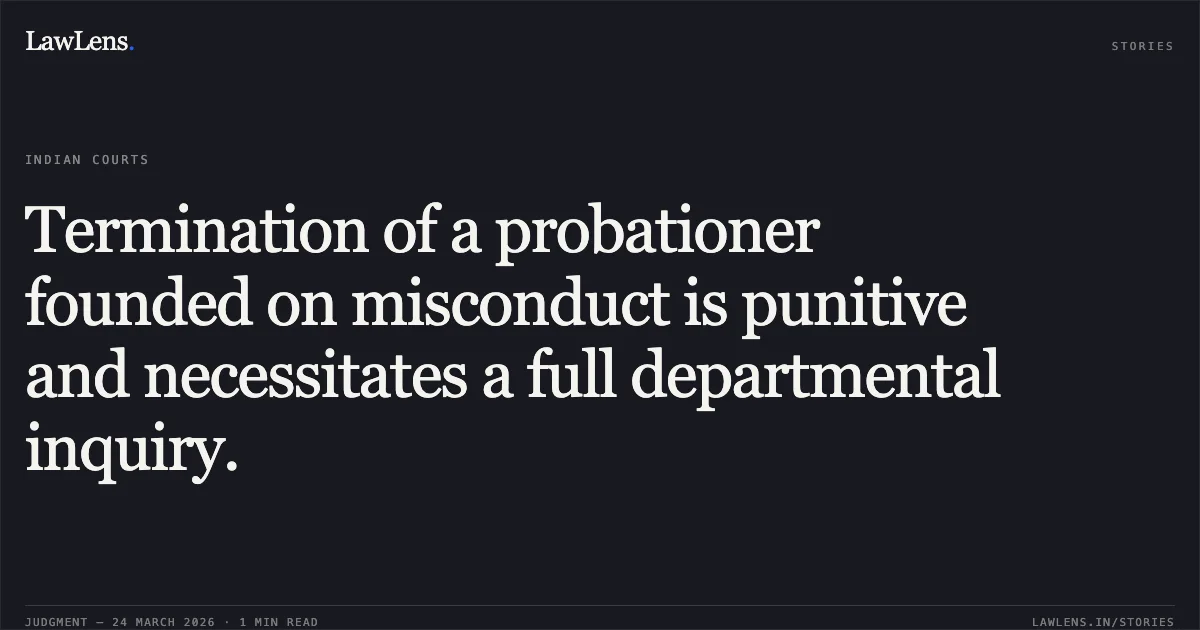
The Tribunal found that while the impugned order was couched in innocuous language, the "foundation" of the action was clearly the adverse reports of misconduct rather than a general assessment of the applicant's suitability for the post.
Source reference: para. 13The Tribunal reasoned that once a termination is founded upon allegations of misconduct—as evidenced by the internal files detailing illegal immigration clearance and UPI transactions—it ceases to be a simple discharge and becomes punitive and stigmatic.
Source reference: para. 11, 13Consequently, the respondents could not bypass the procedure prescribed under disciplinary rules.
Source reference: para. 13By failing to conduct a formal inquiry and denying the applicant an opportunity to defend himself against the specific allegations, the respondents violated the principles of natural justice and rendered the termination legally unsustainable.
Source reference: para. 14Holding
The Tribunal quashed and set aside the termination order dated February 15, 2024, and the appellate order dated October 23, 2024.
It held that the termination was punitive and required a full-fledged inquiry.
Source reference: para. 13-14The respondents were directed to reinstate the applicant forthwith with all consequential benefits, to be complied with within four weeks.
Source reference: para. 15(ii)-(iv)However, the Tribunal granted the respondents liberty to initiate fresh disciplinary proceedings against the applicant in accordance with the law.
Source reference: para. 15(v)No order was made as to costs.
Source reference: para. 16Acts & Sections Cited
1 provisions across 1 statute referred to in this judgment. Each provision opens on LawLens.
Administrative Tribunals Act, 19851
Original Court PDF
DeepakvsUNION OF INDIA
Click to open original judgment
Original judgment, available to read, download and summarize on LawLens.in