Facts
The petitioner was appointed as a Lower Division Clerk (Assistant Grade-III) on a contractual basis in 1996 by a State Government Undertaking
Source reference: para. 2He rendered continuous service for 28 years through periodic extensions, with the state eventually transitioning such appointments to an "auto-renewal" mode via Circulars dated 05.06.2018 and 22.07.2023 to ensure tenure security
Source reference: para. 3Despite working beyond March 2024, the petitioner received only partial salary for late 2023 and no salary from April to July 2024
Source reference: para. 4On 01.08.2024, the respondents abruptly discontinued his services by removing his name from the attendance register without a formal termination order or notice
Source reference: para. 1, 4The respondents justified the action based on internal note sheets alleging negligence in meeting targets for financial assistance schemes
Source reference: para. 7-8Issues
1. Whether the abrupt discontinuation of the petitioner’s contractual service and the withholding of his salary were legally sustainable or constituted arbitrary state action.
Source reference: para. 92. Whether the non-payment of salary for services rendered constitutes "begar" in violation of constitutional protections.
Source reference: para. 13Law Applied
The court primarily relied on the State Government Circulars dated 05.06.2018 and 22.07.2023, which established an auto-renewal mechanism for contractual employees to prevent administrative arbitrariness
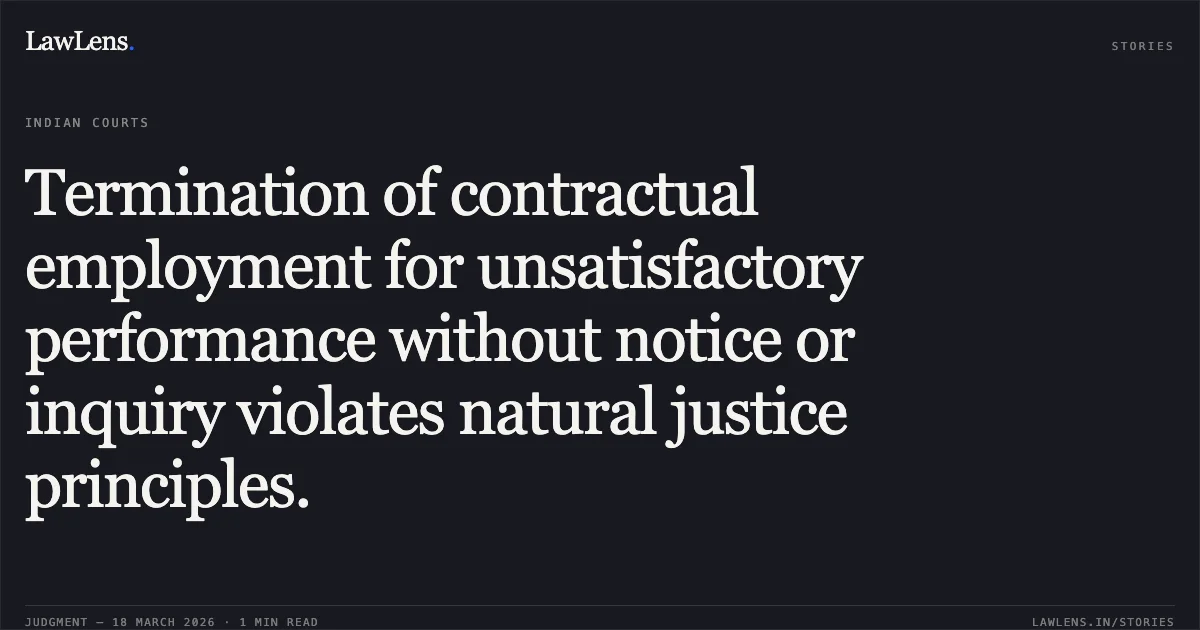
Source reference: para. 3, 11It applied the principle from Swati Priyadarshini v. State of M.P. & Others [2024 SCC OnLine SC 2139], which holds that a contractual employee cannot be discontinued based on allegations of unsatisfactory performance or stigma without adhering to the principles of natural justice
Source reference: para. 6, 12Furthermore, the court invoked Article 23 of the Constitution of India, which prohibits "begar" (forced labor without payment), and Articles 14 and 16 regarding the right to equality and protection against arbitrary state action
Source reference: para. 5, 13Reasoning
The court found the respondents' defense of "dissatisfaction" and "negligence" lacked substantive evidence, noting that internal note sheets do not suffice if they are not communicated to the employee or followed by an opportunity to respond
Source reference: para. 10By failing to issue a formal order or notice after 28 years of unblemished service, the respondents violated the "auto-renewal" mandate of their own circulars
Source reference: para. 11-12The court determined that the removal was a "textbook example of arbitrary state action" because it bypassed the bare minimum requirements of fair play
Source reference: para. 12Regarding the unpaid wages, the court reasoned that extracting work without full remuneration directly offends Article 23 of the Constitution, as an employee cannot be deprived of pay for services actually rendered
Source reference: para. 13Holding
The court allowed the petition, holding that the discontinuation was illegal and arbitrary
It quashed the action dated 01.08.2024 and issued a writ of mandamus directing the respondents to: (a) forthwith reinstate the petitioner with 50% back wages from the date of removal; (b) release all arrears of salary for the period worked between December 2023 and July 2024; and (c) complete the entire exercise, including payment of benefits, within 60 days.
Source reference: para. 14(a)-(e)No order as to costs was made
Source reference: para. 15Original Court PDF
Shailedra MehtavsDepartment Of Tribal Affairs
Click to open original judgment
Original judgment, available to read, download and summarize on LawLens.in