Facts
The petitioner was appointed as a Gram Rojgar Sahayak in Gram Panchayat Hamirpur on October 26, 2012
Source reference: para. 2On July 9, 2014, her services were terminated via an order passed by the Secretary of the Gram Panchayat
Source reference: para. 2The termination was based on allegations of dereliction of duty, failure to issue e-muster rolls, absence from headquarters, and relocating to Bhopal post-marriage
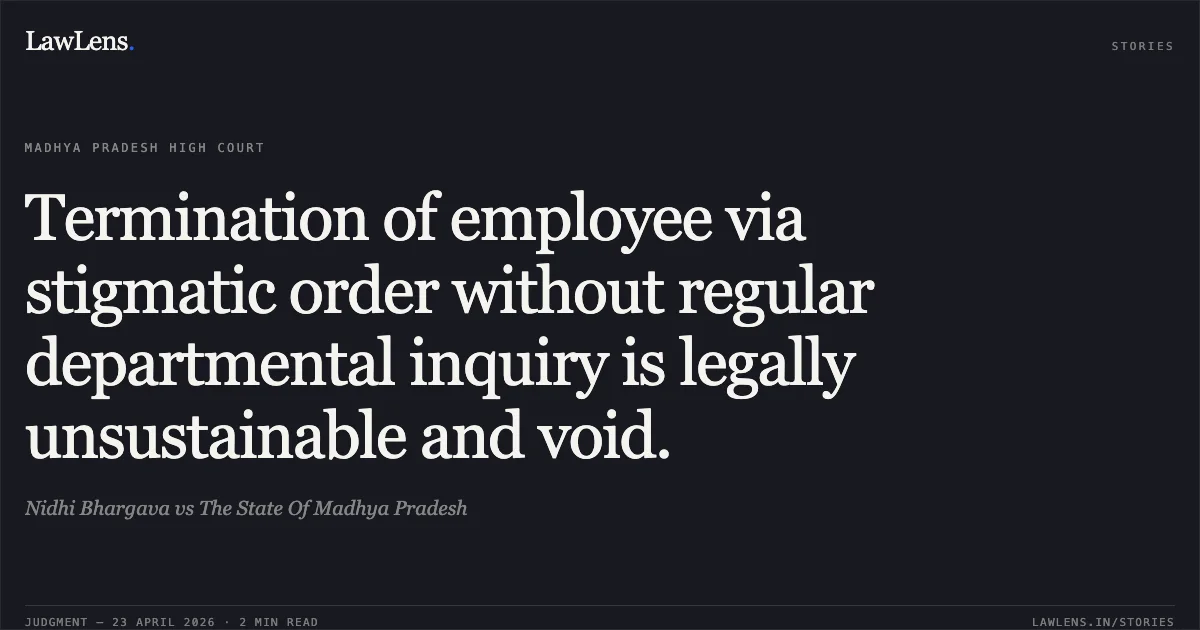
Source reference: para. 5The order was issued following a recommendation by the C.E.O., Zila Panchayat, Guna, but without conducting a regular departmental inquiry, issuing a charge sheet, or providing a personal hearing, despite the stigmatic nature of the allegations
Source reference: para. 2The petitioner challenged the order under Article 226 of the Constitution, seeking reinstatement and consequential benefits
Source reference: para. 1Issues
1. Whether the impugned termination order was a speaking order and satisfied the requirements of quasi-judicial decision-making.
Source reference: para. 6-72. Whether the Secretary of the Gram Panchayat was the competent disciplinary authority to terminate the petitioner’s services.
Source reference: para. 123. Whether a stigmatic termination order could be legally passed against a contractual/temporary employee without conducting a regular departmental inquiry in accordance with the principles of natural justice.
Source reference: para. 13-15Law Applied
The court applied the principle that quasi-judicial and administrative orders affecting rights must be "speaking orders" containing valid reasons, as established in M/s Kranti Associates Pvt. Ltd. v. Masood Ahmed Khan
Source reference: para. 2, 11State of Punjab v. Bandip Singh
Source reference: para. 9Regarding employment law, the court relied on the doctrine that a "stigmatic" termination requires a full departmental inquiry even for temporary employees, citing Rahul Tripathi v. Rajeev Gandhi Shiksha Mission and Malkhan Singh Malviya v. State of M.P.
Source reference: para. 14Furthermore, it applied the definition of "reasonable opportunity" (right to deny guilt, cross-examine witnesses, and represent against punishment) as summarized in Khem Chand v. Union of India
Source reference: para. 14Reasoning
The court found that the termination order was non-speaking and unreasoned, violating the necessity for quasi-judicial authorities to demonstrate an objective consideration of facts
Source reference: para. 7, 11It noted that the Secretary of the Gram Panchayat lacked the competence to terminate the petitioner, as the Gram Panchayat itself is the Disciplinary Authority and no formal resolution was passed by the body
Source reference: para. 12Critically, the court observed that the allegations in the order (e.g., misconduct and dereliction of duty) were "stigmatic," meaning they carry negative consequences for future employment
Source reference: para. 15Applying established precedents, the court reasoned that such an order cannot be passed merely on a show-cause notice; it necessitates a regular departmental inquiry, including the appointment of an Inquiry Officer and the opportunity to cross-examine witnesses, which were entirely absent in this case
Source reference: para. 13-17Holding
The court allowed the petition and quashed the impugned order dated July 9, 2014
It held that the termination was unsustainable due to the lack of competence of the issuing authority and the failure to conduct a mandatory departmental inquiry for a stigmatic dismissal
Source reference: para. 12, 15The respondents were directed to reinstate the petitioner forthwith with all consequential benefits and seniority, though back wages were denied on the principle of “no work no pay”. The court granted the respondents liberty to initiate fresh proceedings against the petitioner in accordance with the law if deemed necessary
Source reference: para. 21Acts & Sections Cited
1 provisions across 1 statute referred to in this judgment. Linked provisions open on LawLens.
M.P. Panchayat Service (Discipline and Appeal) Rules, 19991
Original Court PDF
Nidhi BhargavavsThe State Of Madhya Pradesh
Click to open original judgment
Original judgment, available to read, download and summarize on LawLens.in