01Facts
The matter originated from a reference by a Trial Court involving a 16-year-old minor victim of sexual assault (registered under Crime No. 85/2026) seeking medical termination of pregnancy (MTP).
¶ 1, 4An ultrasound dated April 27, 2026, estimated the pregnancy at 26 weeks and 5 days, which progressed to approximately 31 weeks and 2 days by the date of the High Court order.
¶ 3A Medical Board at District Hospital, Mandla, examined the petitioner on May 12, 2026, finding a live, viable fetus and noting the petitioner’s low hemoglobin (7.5 gm/dl). The Board opined that MTP was not possible at this advanced stage.
¶ 4Under the High Court’s SOP dated February 20, 2025, cases of sexual assault survivors exceeding 24 weeks of pregnancy must be referred to the High Court.
¶ 202Issues
i.1. Whether the court can permit the medical termination of a pregnancy exceeding 24 weeks when the Medical Board has opined that the fetus is viable and termination is not medically advisable?
¶ 5, 7ii.2. Whether the lack of fetal abnormalities or immediate danger to the life of the pregnant woman precludes the exercise of jurisdiction to order MTP beyond the statutory limit?
¶ 5, 603Law Applied
The court applied the Medical Termination of Pregnancy (MTP) Act, specifically Section 3(2-B) and Section 5, which restrict termination beyond 24 weeks to cases involving substantial fetal abnormalities or where it is immediately necessary to save the life of the pregnant woman.
¶ 6The court relied heavily on the precedent of X v. Union of India & Another (2024) 12 SCC 453, which clarified that for pregnancies beyond 24 weeks, the outer temporal limit is lifted only for life-saving measures or fetal malformation.
¶ 6The court applied the principle that courts should be averse to directing doctors to stop a fetal heartbeat in cases of viable fetuses near full term.
¶ 6, 704Reasoning
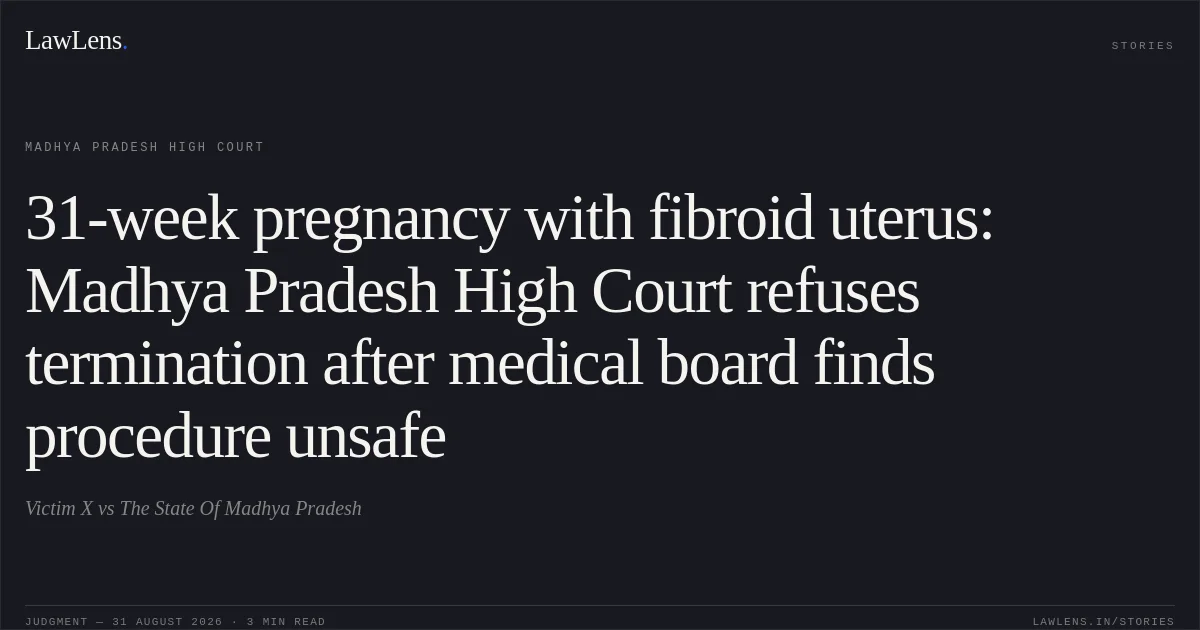
The court observed that the pregnancy had reached 31 weeks and 2 days, significantly exceeding the 24-week statutory threshold for standard MTP.
¶ 3, 5Applying the criteria in X v. Union of India, the court noted that termination at this stage is only permissible if the mother's life is at risk or the fetus has substantial abnormalities.
¶ 5In this instance, the Medical Board provided a categorical opinion against termination, citing that the fetus was viable and the mother had low hemoglobin, making the procedure unsafe.
¶ 4, 7The court reasoned that since no fetal abnormalities were present and the mother's life was not in immediate danger, it lacked the grounds to intervene.
¶ 5The court emphasized that at 31 weeks, termination would necessitate stopping the heartbeat of a nearly fully-developed fetus, an action the judiciary is reluctant to mandate.
¶ 6, 705Holding
The court answered the issues in the negative and dismissed the petition, declining permission for medical termination of the pregnancy.
¶ 7, 9The court held that given the 31-week gestation and the Medical Board’s adverse report, MTP could not be authorized.
¶ 7The court directed that if a live birth occurs, the State must provide full care and protection for the child.
¶ 8It granted the petitioner liberty to file a fresh petition for directions regarding foster care or the child's welfare and ordered the Trial Court to report the birth to the High Court.
¶ 8Original Court PDF
Prosecutrix XvsThe State Of Madhya Pradesh
Click to open original judgment
Original judgment, available to read, download and summarize on LawLens.in