Facts
Respondent No. 1 was appointed as Assistant General Manager (Networking) on probation at Vijaya Bank (now Bank of Baroda) on 05.01.2004
Source reference: para. 2-3During probation, he was suspended on 15.01.2005 for allegedly attempting to unauthorizedly remove confidential tender documents
Source reference: para. 3His probation was extended twice due to "unsatisfactory performance"
Source reference: para. 3-4On 12.04.2005, the Bank revoked the suspension but reserved the right to initiate disciplinary proceedings, which were never actually commenced
Source reference: para. 4On 05.11.2005, the Bank terminated his services under Regulation 16(3)(a) of the Vijaya Bank (Officers’) Regulations, 1982, citing unsatisfactory performance
Source reference: para. 5The High Court of Calcutta quashed the termination, holding it was based on irrelevant considerations
Source reference: para. 1, 6Issues
1. Whether the termination of a probationer’s service, ostensibly for "unsatisfactory performance" under Regulation 16(3)(a), was a termination simpliciter or a punitive action founded on alleged misconduct
Source reference: para. 19, 412. Whether the Bank's reliance on uncommunicated memos and inconsistent performance reports to terminate a probationer violates the principles of administrative law and natural justice
Source reference: para. 11, 36, 44Law Applied
The Court applied Regulation 16(3)(a) of the Vijaya Bank (Officers’) Regulations, 1982, regarding the termination of direct appointees on probation
Source reference: para. 19It relied on the doctrine established in Dipti Prakash Banerjee v. Satyendra Nath Bose National Centre for Basic Sciences, which distinguishes between "motive" and "foundation" for terminating a probationer, holding that if a simple order of termination is founded on findings of misconduct without a regular enquiry, it is bad in law
Source reference: para. 15, 37The Court also applied principles from Sarita Choudhary v. High Court of M.P. and Mathew P. Thomas v. Kerala State Civil Supply Corpn. Ltd., stating that courts must look behind the "facade" of a termination simpliciter to determine if misconduct was the real basis for the order.
Source reference: para. 24, 42Reasoning
The Court observed that while the Bank claimed "unsatisfactory performance," the internal office note dated 05.11.2005 revealed that the Bank initially intended to initiate major penalty proceedings for misconduct (theft of files) but chose the "easier" path of termination under Regulation 16(3)(a) to bypass a formal enquiry
Source reference: para. 39-40, 45The Court scrutinized the three memos used to justify the termination: the first (23.07.2005) was contradicted by a high-praise letter from the Central Board of Direct Taxes; the second (14.09.2005) attributed delays to the employee that were actually caused by SBI’s technical faults; and the third (31.10.2005) was never communicated to the respondent, violating natural justice
Source reference: para. 32, 34, 36Consequently, the Court found the alleged misconduct was the "foundation," not just the motive, making the termination punitive rather than a routine discharge
Source reference: para. 41, 43Holding
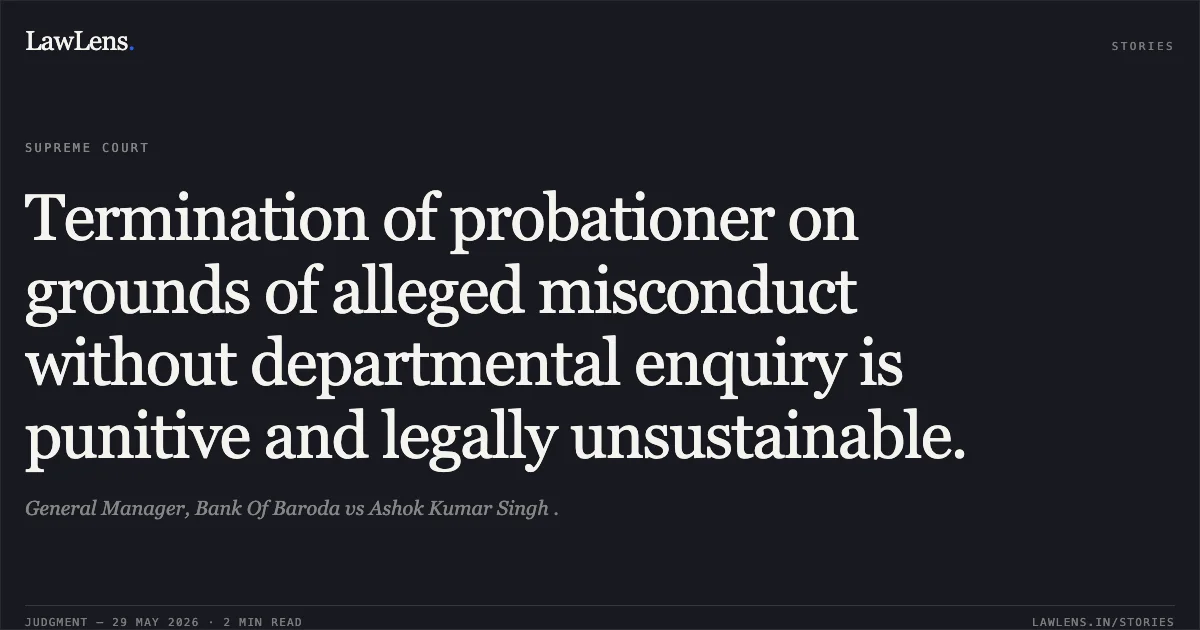
The Court held that an employer cannot use "unsatisfactory performance" as a disguise to bypass disciplinary proceedings when the real foundation of the termination is alleged misconduct
The Court dismissed the Bank's appeal and upheld the High Court's decision to quash the termination; ordered that Respondent No. 1 is entitled to 50% backwages from the date of termination until his date of superannuation, including all consequential benefits notionally, to be settled by Bank of Baroda within three months
Source reference: para. 46, 47, 48Acts & Sections Cited
1 provisions across 1 statute referred to in this judgment. Linked provisions open on LawLens.
Vijaya Bank (Officers) Service Regulations, 19821
Original Court PDF
General Manager, Bank Of BarodavsAshok Kumar Singh .
Click to open original judgment
Original judgment, available to read, download and summarize on LawLens.in