Facts
The petitioner was selected as an Anganvadi Sevika in 2007 at Centre No. 204 in Mokama.
Source reference: para. 3Following a surprise inspection on 12.07.2012, the District Programme Officer (DPO) issued a show-cause notice on 11.08.2012, directing the petitioner to appear on 27.08.2012.
Source reference: para. 3The petitioner alleged that no hearing occurred on the scheduled date due to the DPO’s transfer, and no subsequent notice was issued.
Source reference: para. 3Despite this, the DPO passed an order on 25.09.2012 terminating her services, alleging she had refused to accept further notices.
Source reference: para. 3Her statutory appeal was dismissed by the Collector, Patna, on 17.05.2013.
Source reference: para. 4During the pendency of the matter, Respondent No. 5 was appointed to the position in 2016.
Source reference: para. 11The petitioner sought the quashing of the termination and appellate orders, reinstatement, back wages, and reimbursement of rent paid for the Anganvadi premises.
Source reference: para. 2Issues
1. Whether the termination of the petitioner’s services as Anganvadi Sevika was conducted in violation of the principles of natural justice due to the lack of a personal hearing.
Source reference: para. 6, 152. Whether the appellate order passed by the Collector, Patna, was legally sustainable given the alleged lack of application of mind to the grounds of appeal.
Source reference: para. 4, 15Law Applied
The Court applied the fundamental principles of Administrative Law regarding natural justice (Audi Alteram Partem), asserting that an adjudicatory body cannot base a decision on material unless the affected party has been given an opportunity to respond to it.
Source reference: para. 7It relied on Ranju Kumari v. State of Bihar Ors. (2023 (2) BLJ 144), which held that removal from service without a hearing after a show-cause reply is a violation of natural justice.
Source reference: para. 7The Court cited Kranti Associates Private Limited v. Masood Ahmed Khan (2010) 9 SCC 496, emphasizing the mandatory requirement for quasi-judicial authorities to record cogent and clear reasons for their decisions.
Source reference: para. 8It also referenced Krishnadatt Awasthy v. State of Madhya Pradesh (2025 (7) SCC 545) to underscore that a gross violation of procedural fairness renders a decision invalid.
Source reference: para. 9Reasoning
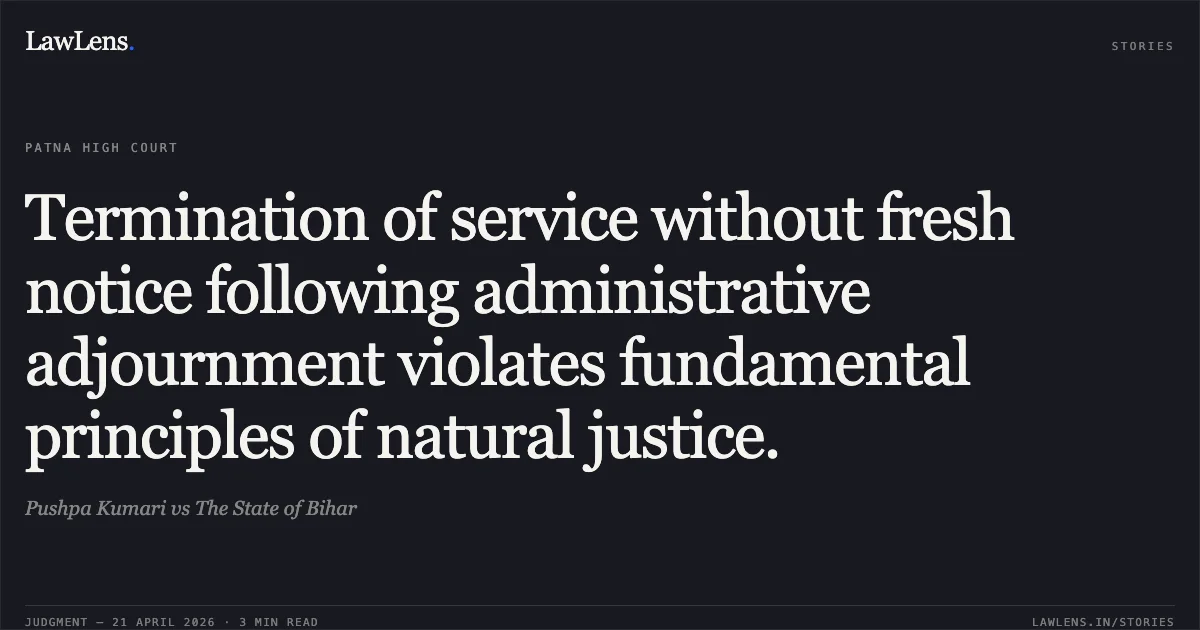
The Court observed that while an initial notice was issued, the respondents failed to deny the petitioner’s claim that no hearing took place on 27.08.2012 due to the DPO’s transfer.
Source reference: para. 15The records confirmed that no subsequent notice or date was fixed for the petitioner to present her case.
Source reference: para. 15The DPO’s reliance on the CDPO’s oral submission—that the petitioner had refused notice—was deemed insufficient to satisfy the requirements of a fair hearing.
Source reference: para. 15The Court found that the DPO proceeded to "relieve" the petitioner without allowing her to place her case.
Source reference: para. 15Regarding the appellate process, the Court held that the District Magistrate/Collector affirmed the termination on mechanical grounds, failing to address the specific grievances raised in the memo of appeal.
Source reference: para. 15The Court concluded that the process was procedurally vitiated and violated the established legal doctrines requiring reasoned administrative orders.
Source reference: para. 16Holding
The Court allowed the writ petition and set aside the DPO’s termination order dated 25.09.2012 and the Collector’s appellate order dated 10.06.2013.
The Court directed the respondent authorities to take necessary steps for the petitioner’s reinstatement.
Source reference: para. 17It further ordered the payment of salary for the period the petitioner worked (11.10.2012 to 01.12.2012) and the reimbursement of rent expenses incurred by the petitioner for the Anganvadi premises.
Source reference: para. 17All pending applications were disposed of accordingly.
Source reference: para. 19Original Court PDF
Pushpa KumarivsThe State of Bihar
Click to open original judgment
Original judgment, available to read, download and summarize on LawLens.in