Facts
The petitioner, an Assistant at the Rehabilitation Council of India (RCI) since 1999, was accused of sexual harassment by three female colleagues on 17.04.2009 for allegedly printing a pornographic image on a shared printer
Source reference: p.1-2He was suspended and the matter was referred to a Sexual Harassment Committee under the CCS (CCA) Rules
Source reference: p.2On 24.11.2009, the Committee found him guilty
Source reference: p.2Consequently, the Disciplinary Authority removed him from service on 13.01.2010, and his appeal was dismissed on 09.04.2010
Source reference: p.2The petitioner challenged these orders on the grounds of procedural irregularities, specifically the non-furnishing of the complaint and denial of cross-examination
Source reference: p.2Issues
1. Whether the non-furnishing of the complaint and relevant documents to the delinquent employee violates the CCS (CCA) Rules and principles of natural justice?
Source reference: p.2 / para. 4, 102. Whether the denial of the right to orally cross-examine witnesses during a sexual harassment inquiry vitiates the disciplinary proceedings?
Source reference: p.2 / para. 4, 103. Whether the petitioner is entitled to reinstatement and back wages upon the setting aside of a termination order on procedural grounds?
Source reference: p.4-5 / para. 11-12Law Applied
The court primarily applied Rule 14 of the Central Civil Services (Classification, Control and Appeal) Rules, 1965, specifically Rule 14(14) regarding the production of evidence and Rule 14(17) regarding the right to cross-examine witnesses
Source reference: p.2, 4The court relied on Prof. Bidyug Chakraborty v. Delhi University, which established that annexures to an inquiry report are integral and their non-supply amounts to non-supply of the report itself
Source reference: p.3The court further cited Aureliano Fernandes v. State of Goa regarding procedural fairness
Source reference: p.2Deepali Gundu Surwase v. Kranti Junior Adhyapak Mahavidyalaya, which clarifies that while reinstatement is the norm for wrongful termination, back wages are discretionary and not absolute
Source reference: p.5Reasoning
The court found that the inquiry was fundamentally flawed as the petitioner was never provided with the actual complaint or the underlying documents used to find him guilty
Source reference: p.4Applying the precedent from Prof. Bidyug Chakraborty, the court reasoned that the failure to provide these materials constituted a gross violation of natural justice
Source reference: p.3-4Furthermore, the court observed that the Committee’s requirement for the petitioner to submit written questions instead of conducting a verbal cross-examination did not satisfy the legal requirements of Rule 14(17)
Source reference: p.4The court highlighted that verbal cross-examination is an essential right that cannot be substituted by written queries
Source reference: p.4Since the procedural breaches were clear and the incident dated back seventeen years (2009), the court determined that ordering a fresh inquiry was impractical
Source reference: p.5Holding
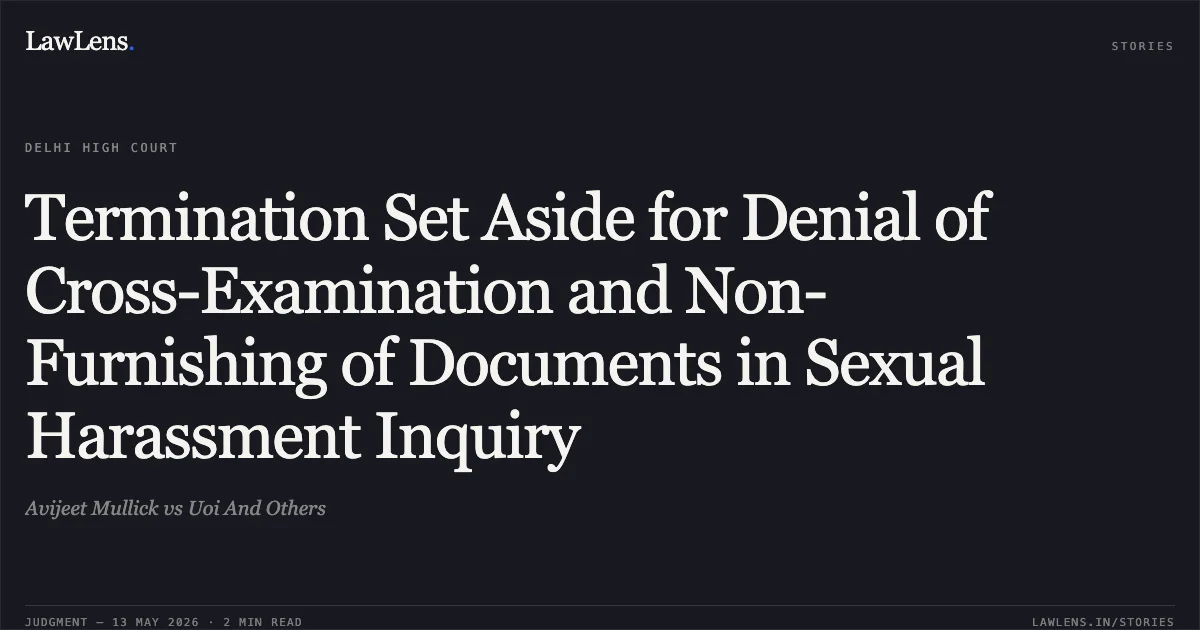
The court allowed the writ petition and set aside the termination order dated 13.01.2010 and the appellate order dated 09.04.2010
The Court held that the denial of cross-examination and non-furnishing of documents violated the mandatory provisions of Rule 14 of the CCS (CCA) Rules
Source reference: p.4The respondent was directed to reinstate the petitioner within sixty days. However, the court denied the claim for back wages, noting that the petitioner failed to prove he was not gainfully employed during the period of termination and that the relief is discretionary
Source reference: p.5Original Court PDF
Avijeet MullickvsUoi And Others
Click to open original judgment
Original judgment, available to read, download and summarize on LawLens.in