Facts
The appellant was appointed as a Clerk in Gorakhpur Kshetriya Gramin Bank on 4 June 1981 and joined on 22 July 1981. His one-year probation was extended by six months on 20 July 1982.
Source reference: para. 3The Bank terminated his services with immediate effect on 11 March 1983 under Regulation 10 of the Gorakhpur Kshetriya Gramin Bank (Staff) Service Regulations, 1980, by paying one month’s salary in lieu of notice.
Source reference: para. 3The appellant’s civil suit challenging the termination was initially decreed, but the decree was reversed in appeal; his second appeal was dismissed on 10 May 2000, with liberty to pursue remedies under the Industrial Disputes Act or Article 226 of the Constitution.
Source reference: para. 4His writ petition was dismissed on 19 May 2004 on the ground that he was a probationer whose services could be terminated simpliciter. The present special appeal challenged that dismissal.
Source reference: paras. 5, 8Issues
Whether the appellant stood automatically or impliedly confirmed in service upon expiry of the maximum permissible probationary period, despite the absence of an express confirmation order?
Source reference: paras. 10–16Whether Regulation 10(2)(a) of the 1980 Regulations, empowering the Bank to terminate an employee’s service by giving one month’s notice or pay in lieu thereof, was unconstitutional as conferring arbitrary and unguided power?
Source reference: paras. 17–23Whether the declaration that Regulation 10(2) was unconstitutional operated retrospectively so as to invalidate the termination order dated 11 March 1983?
Source reference: paras. 19–22What relief should be granted, having regard to the appellant’s age, superannuation, prolonged litigation and the passage of time?
Source reference: paras. 24–28Law Applied
Regulation 8(2) of the 1980 Regulations prescribed one year’s probation for an employee, extendable by a maximum of six months, while Regulation 9 dealt with confirmation upon satisfactory completion of probation.
Source reference: para. 9Relying on M.K. Agarwal v. Gurgaon Gramin Bank, 1987 Supp SCC 643, the Court held that where probation is subject to a fixed maximum period and the employee is neither discharged nor expressly confirmed by its expiry, confirmation may be implied.
Source reference: para. 12Regulation 10(2)(a), being materially identical to the provision invalidated in M.K. Agarwal, was held to confer arbitrary and unguided termination power, contrary to Article 14; the Court also followed Rudra Kumar Pal v. Chairman, Gorakhpur Kshetriya Gramin Bank, which had declared the corresponding Regulation 10 unconstitutional.
Source reference: paras. 17–18Under Article 13(2), a post-Constitution law violating Part III is void ab initio and unenforceable; the Court relied on Central Bureau of Investigation v. R.R. Kishore, (2023) 15 SCC 339, including the principles that an unconstitutional law is non est and that such a declaration ordinarily operates retrospectively.
Source reference: paras. 21–22Relief of back wages is not automatic, but may be moulded according to the employee’s conduct, intervening employment, circumstances and the equities of the case.
Source reference: paras. 26–27Reasoning
The appellant’s maximum probationary period expired on 19 January 1983. Since Regulation 8(2) limited probation to one year plus a further six months, and the Bank neither discharged him before expiry nor validly confirmed or otherwise dealt with his service at that point, the principle in M.K. Agarwal required that he be treated as impliedly confirmed and therefore as a permanent employee when the termination order was issued on 11 March 1983.
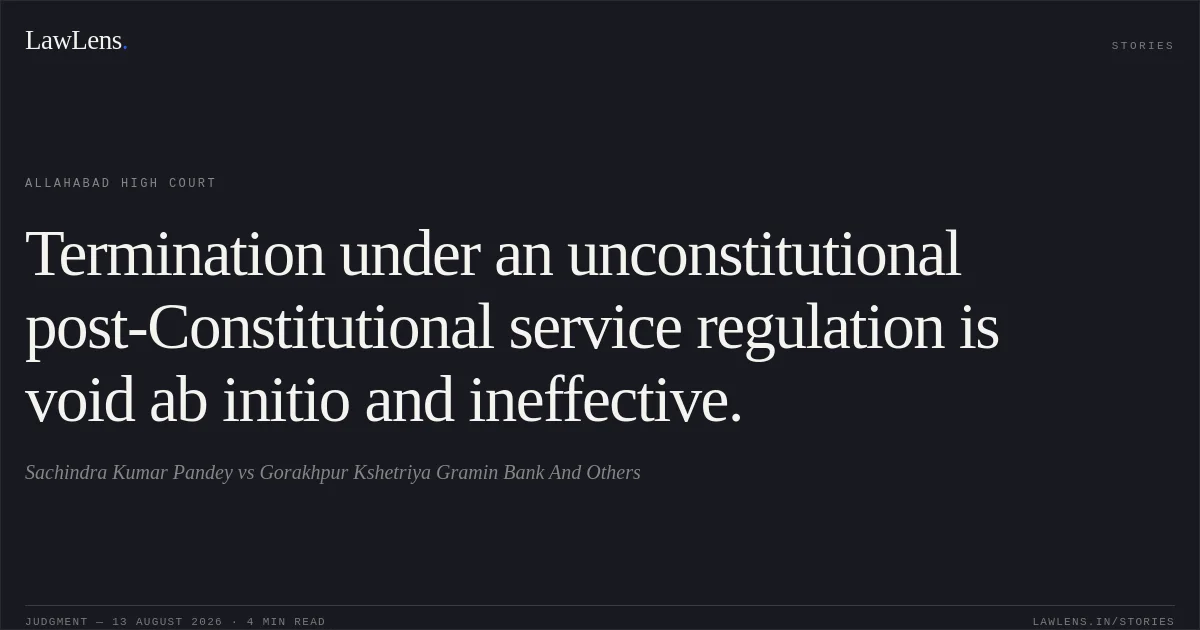
Source reference: paras. 12, 16The termination was nevertheless purportedly made under Regulation 10(2)(a), which gave the Bank an unrestricted power to terminate service by notice or payment in lieu thereof. Applying Article 14 and the ratio of M.K. Agarwal, the Court held that the provision was arbitrary and unconstitutional; Rudra Kumar Pal had already declared the corresponding provision of the same Regulations invalid in proceedings involving the Bank.
Source reference: paras. 17–18The fact that the termination preceded the declaration in Rudra Kumar Pal did not save it, because the declaration of invalidity of a post-Constitution provision violating fundamental rights operated retrospectively and rendered the provision void from inception.
Source reference: paras. 20–22Although reinstatement would ordinarily follow, the appellant had reached approximately seventy years of age and could not practically be reinstated. Considering his prompt and diligent pursuit of remedies, but also his limited actual service and the extraordinary passage of time, the Court considered 50% back wages and consequential retiral benefits to be an equitable relief.
Source reference: paras. 24–27Holding
The special appeal was allowed and the Single Judge’s judgment was set aside.
The termination order dated 11 March 1983 was quashed as having been founded on an unconstitutional and arbitrary Regulation 10(2)(a).
Source reference: paras. 22–23, 28The Court directed the Uttar Pradesh Gramin Bank and its concerned officers to pay the appellant 50% of his back wages from 11 March 1983 until the date of his superannuation, together with all consequential post-retiral and superannuation benefits, to be calculated and paid within one month of receipt of the judgment.
Source reference: para. 28The appeal was allowed with costs quantified at Rs. 10,000.
Source reference: para. 28Acts & Sections Cited
2 provisions across 2 statutes referred to in this judgment. Linked provisions open on LawLens.
Industrial Disputes Act, 19471
Bombay Prohibition Act, 19491
Original Court PDF
Sachindra Kumar PandeyvsGorakhpur Kshetriya Gramin Bank And Others
Click to open original judgment
Original judgment, available to read, download and summarize on LawLens.in