Facts
The Respondent (landlord) filed a suit for eviction and recovery of rent against the Appellant (tenant) regarding property 316-B, Sarita Vihar, New Delhi
Source reference: para. 2A rent agreement was executed in 2016 at ₹7,000/month, later enhanced to ₹8,500/month
Source reference: para. 3The Respondent alleged defaults in rent from June 2019 and document theft by the Appellant’s purported husband
Source reference: para. 4-8Summons were served via WhatsApp and affixation, but the Appellant failed to appear and was proceeded ex-parte
Source reference: para. 12-13The Trial Court (ASCJ) decreed the suit on 01.10.2021
Source reference: para. 15The Appellant’s subsequent application under Order 9 Rule 13 CPC to set aside the decree was dismissed on 01.03.2023
Source reference: para. 16The First Appellate Court upheld this dismissal on 02.08.2024
Source reference: para. 18Notably, after being evicted through a court bailiff, the Appellant allegedly broke back into the premises and resumed illegal occupation
Source reference: para. 31, 51Issues
1. Whether the judgment was void for lack of territorial jurisdiction as the property was in District South-East but the suit was tried in District South?
Source reference: para. 20, 382. Whether there was a failure of due service of summons upon the Appellant?
Source reference: para. 24, 433. Whether the mis-description of the Appellant’s name and marital status/husband's identity affected the validity of the decree?
Source reference: para. 21-23, 45-48Law Applied
The Court applied Section 21(1) of the Code of Civil Procedure (CPC), 1908, which mandates that objections to the "place of suing" must be raised at the earliest opportunity in the court of first instance, or they are waived unless a failure of justice is proven
Source reference: para. 27, 39It relied on Pathumma v. Kuntalan Kutty (1981) 3 SCC 589 and K.P. Ranga Rao v. K.V. Venkatesham (2015) 13 SCC 514, which establish that territorial jurisdiction objections cannot be raised at the appellate or execution stage
Source reference: para. 27, 40-41The Court also applied Section 100 of the CPC, which restricts Regular Second Appeals only to cases involving a "substantial question of law"
Source reference: para. 1, 54Reasoning
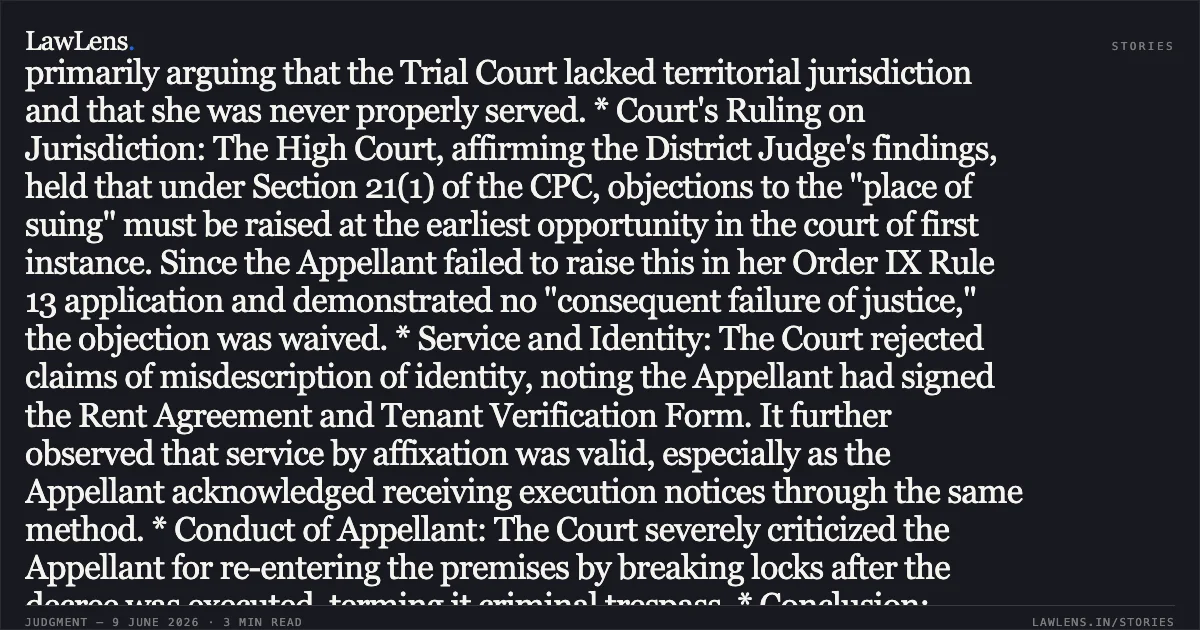
The Court rejected the jurisdictional challenge, noting the Appellant failed to raise it in the Trial Court or even in the Order 9 Rule 13 application; thus, per Section 21 CPC, the objection was barred
Source reference: para. 42Regarding service, the Court found the Appellant had been duly served by affixation—the same method through which she received execution notices—and noted the dismissal of her Order 9 Rule 13 appeal had attained finality
Source reference: para. 43-44On the merits, the Court held that mis-description of her name (Arti Sharma vs. Arti Tiwari) or her husband's identity (Alok Thakur) was irrelevant because her status as a tenant under the 2016 Rent Agreement and Tenant Verification Form was clearly established
Source reference: para. 47-49Payment records (NEFT) confirmed the involvement of Alok Thakur in the tenancy
Source reference: para. 46Finally, the Court viewed the Appellant's re-entry into the premises after formal eviction as criminal trespass, negating any claim to equitable relief
Source reference: para. 51-52Holding
The Court found no substantial question of law as the challenges were purely factual and had been concurrent findings of the lower courts
It held that the relationship of landlord-tenant was established and the rate of rent exceeded ₹3,500, exempting it from rent control protection
Source reference: para. 49, 53The High Court dismissed the Regular Second Appeal and all pending applications, upholding the eviction decree and criticizing the Appellant's illegal conduct in re-entering the property
Source reference: para. 55-56Acts & Sections Cited
4 provisions across 1 statute referred to in this judgment. Each provision opens on LawLens.
Code of Civil Procedure, 19084
Original Court PDF
Arti Sharma Alias Arti & Anr.vsKanta Kame
Click to open original judgment
Original judgment, available to read, download and summarize on LawLens.in


