Facts
The petitioner challenged the University’s orders dated 28 May 2026 and 18 September 2026 concerning the appointment of Student Advisors, and sought to stop such appointments in Madhya Pradesh
Source reference: para. 1He alleged that the appointments lacked statutory authority and that the appointees did not meet applicable qualification and infrastructure requirements; he also relied on information received under the RTI Act and stated that his representation to the authorities had yielded no result
Source reference: paras. 2–5The University is situated at Chitrakoot, District Satna.
Source reference: paras. 6–8The Court found that the petitioner had identified no material part of the cause of action arising within the territorial jurisdiction of the Gwalior Bench.
Source reference: paras. 6–8Issues
Whether the Gwalior Bench had territorial jurisdiction under Article 226(2) of the Constitution to entertain the petition challenging the University’s actions
Source reference: paras. 7–9, 14Whether the Court should examine the merits of the petitioner’s challenges to the Student Advisor appointments
Source reference: para. 15Law Applied
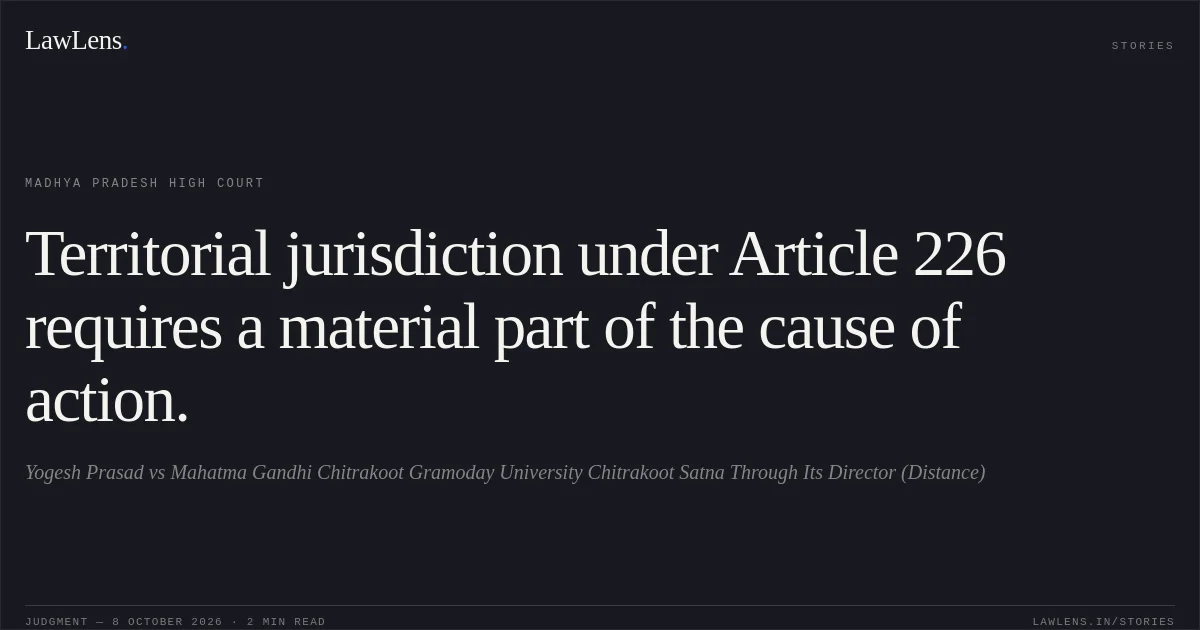
Article 226(2) of the Constitution permits a High Court to exercise writ jurisdiction where the cause of action arises wholly or in part within its territorial jurisdiction; the relevant facts must be material, essential, or integral to the cause of action.
Source reference: paras. 9, 12In Oil and Natural Gas Commission v. Utpal Kumar Basu, (1994) 4 SCC 711, and Kusum Ingots & Alloys Ltd. v. Union of India, (2004) 6 SCC 254, the Supreme Court held that pleaded facts must have a nexus with the dispute and the relief claimed.
Source reference: paras. 10–11Alchemist Ltd. v. State Bank of Sikkim, (2007) 11 SCC 335, confirms that even a small fraction of the cause of action may confer jurisdiction, provided it is a material, essential, or integral part.
Source reference: paras. 11–12The Court also relied on the Full Bench decision in Nakul Deo Singh v. Commandant, 1999 SCC OnLine Ker 366, for the proposition that receipt of an order or communication within a court’s territory, by itself, does not create a part of the cause of action there.
Source reference: para. 13Reasoning
The dispute concerned appointments made by the University at Chitrakoot, Satna, and the orders challenged were actions of that University.
Source reference: paras. 6–8, 14The petitioner did not identify any material or integral fact connecting the dispute to the Gwalior Bench’s territorial jurisdiction.
Source reference: paras. 9–14Applying Article 226(2) and the cited precedents, the Court concluded that the petitioner’s choice to approach the Gwalior Bench could not confer jurisdiction.
Source reference: paras. 9–14Because territorial jurisdiction was lacking, the Court found it unnecessary to consider the merits of the allegations concerning the appointments.
Source reference: para. 15Holding
The Court held that the petition was not maintainable before the Gwalior Bench for want of territorial jurisdiction and dismissed it on that ground.
The petitioner was left at liberty to approach the appropriate court having territorial jurisdiction, in accordance with law.
Source reference: paras. 16–17The Court expressly stated that it had made no determination on the merits of the grievance.
Source reference: paras. 16–17Original Court PDF
Yogesh PrasadvsMahatma Gandhi Chitrakoot Gramoday University Chitrakoot Satna Through Its Director (Distance)
Click to open original judgment
Original judgment, available to read, download and summarize on LawLens.in