Facts
The parties’ marriage was dissolved through a National Lok Adalat settlement on 11 December 2021, which placed their minor daughter in the mother’s custody until puberty or the mother’s remarriage, whichever occurred earlier.
Source reference: para. 2.1After remarriage, the mother moved with the child to Srinagar in 2024, where the child had since resided and attended school.
Source reference: paras. 2.3, 11The father sought custody before the Principal District Judge, Anantnag. The mother objected that Anantnag lacked territorial jurisdiction under Section 9 of the Guardians and Wards Act, 1890. The trial court dismissed the petition on that ground, and the father appealed under Section 47 of the Act.
Source reference: paras. 1, 2.2–2.4Issues
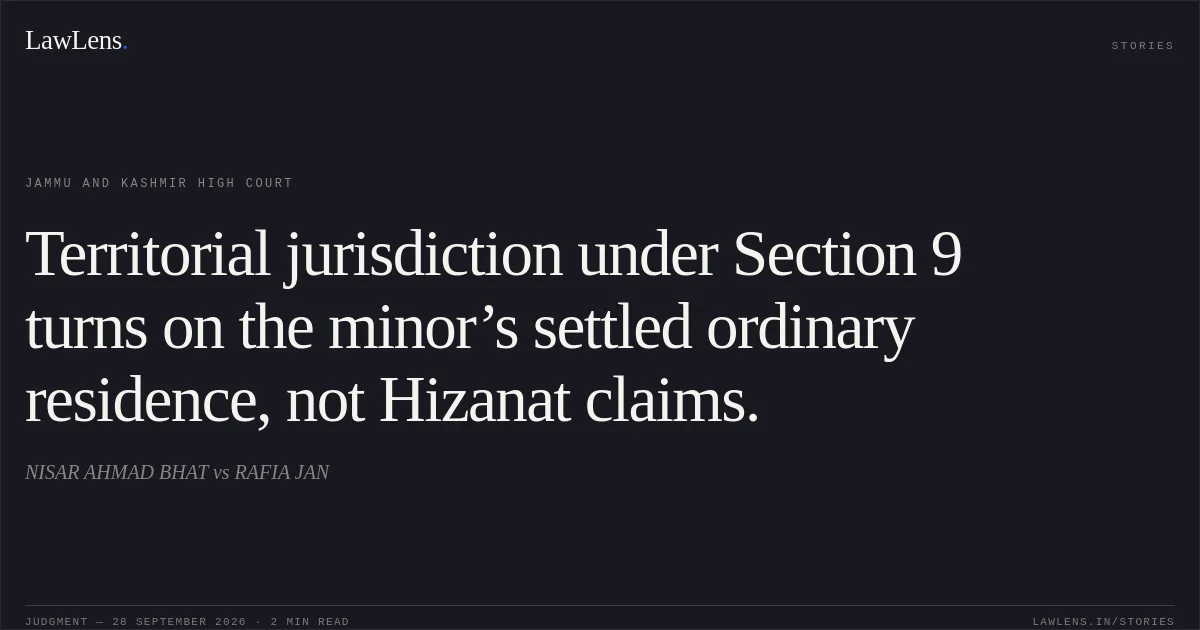
1. Whether Anantnag was the competent forum under Section 9(1) of the Guardians and Wards Act, 1890, when the child had moved to and settled in Srinagar with her mother.
Source reference: paras. 6–112. Whether the mother’s remarriage and the asserted resulting loss of her right to *hizanat* required the child’s custody or ordinary residence to be treated as that of another person for deciding territorial jurisdiction.
Source reference: paras. 12, 22Law Applied
Section 9(1) of the Guardians and Wards Act, 1890 requires an application concerning the guardianship of a minor’s person to be made to the District Court having jurisdiction where the minor “ordinarily resides”.
Source reference: para. 6Under *Ruchi Majoo v. Sanjeev Majoo*, the minor’s ordinary residence is the jurisdictional test; whether it exists at a particular place is primarily a question of fact, or a mixed question of law and fact, turning on intention and the circumstances.
Source reference: para. 7A recent removal may be disregarded when determining ordinary residence, but the new place may become the ordinary residence once the minor has settled there for a reasonably long period.
Source reference: para. 10, quoting *Smti Usma Sultana v. Fakar Uddin Ahmed*In custody matters, the child’s welfare is paramount and overrides parental rights, personal-law rules, or parental agreements; welfare includes physical and moral well-being.
Source reference: paras. 16–21Reasoning
The child’s move to Srinagar occurred in 2024, several years after the parties’ marriage was dissolved, and she had lived and attended school there for a considerable period. The court therefore treated Srinagar as her settled ordinary residence, rather than as a recent or tactical removal intended to defeat Anantnag’s jurisdiction.
Source reference: para. 11The father’s argument that the mother’s remarriage ended her *hizanat* right concerned the merits of custody, not the jurisdictional inquiry under Section 9. Any custody determination would have to be made by the competent court with the child’s welfare as the paramount consideration.
Source reference: paras. 12, 20–22Holding
The High Court held that the child ordinarily resided in Srinagar and that the Anantnag trial court had rightly dismissed the father’s custody petition for want of territorial jurisdiction.
It found no illegality or impropriety in the impugned order and dismissed the appeal in limine.
Source reference: paras. 22–23Acts & Sections Cited
2 provisions across 1 statute referred to in this judgment. Each provision opens on LawLens.
Guardians and Wards Act, 18902
Original Court PDF
NISAR AHMAD BHATvsRAFIA JAN
Click to open original judgment
Original judgment, available to read, download and summarize on LawLens.in