Facts
The Respondent (Plaintiff) filed a suit seeking a declaration of ownership of agricultural lands based on a Will dated 20.04.2018 executed by late K. Raghunath
Source reference: para 4The Plaintiff admitted in the plaint that he funded the purchase of these properties in Raghunath's name because he was legally barred from purchasing agricultural land under the Karnataka Land Reforms Act
Source reference: para 5.1, 26.1The Appellants (Defendants), who are the legal heirs of the deceased, moved an application under Order VII Rule 11 CPC for rejection of the plaint, arguing the suit was barred by the Prohibition of Benami Property Transactions Act, 1988 ("Benami Act") and that the Plaintiff was an accused in the murder of the testator
Source reference: para 4.2, 5.9The Trial Court rejected the plaint
Source reference: para 4.3the High Court reversed this, restoring the suit
Source reference: para 4.4Issues
1. Whether the 2016 Amendments to the Benami Act operate retrospectively regarding the procedural and machinery provisions for confiscation.
Source reference: para 22.152. Whether an employer-employee relationship constitutes a "fiduciary capacity" to exempt a transaction from the Benami Act.
Source reference: para 24.63. Whether the disqualification of a murderer under Section 25 of the Hindu Succession Act, 1956, applies to testamentary succession (Wills).
Source reference: para 25.54. Whether a plaint can be rejected under Order VII Rule 11 CPC when "clever drafting" is used to obscure a statutory bar.
Source reference: para 9.3, 29(vii)Law Applied
The Court applied Order VII Rule 11 and Order XIV Rule 2 of the CPC regarding the rejection of plaints and preliminary issues
Source reference: para 8.1, 10.5It interpreted Sections 2(9), 3, 4, and 27 of the Benami Act (as amended in 2016), noting that while penal provisions are prospective, curative and procedural provisions are retrospective
Source reference: para 18.1, 22.15The "Mischief Rule" from Heydon’s Case was applied to interpret the 2016 amendments
Source reference: para 22.4The Court further applied Section 25 of the Hindu Succession Act, 1956, and the equitable maxim nullus commodum capere potest de injuria sua propria (no man can take advantage of his own wrong)
Source reference: para 25.1, 25.7Reasoning
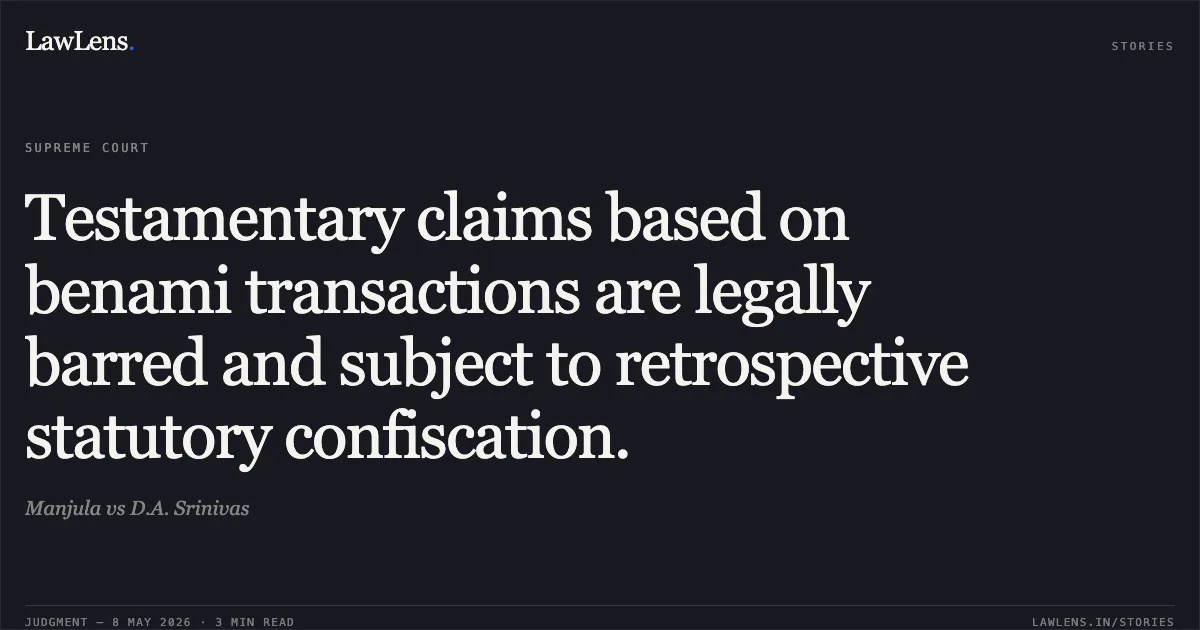
The Court found that although the Plaintiff couched the suit as a testamentary claim, the "meaningful reading" of the plaint revealed an admission of a prohibited benami transaction intended to circumvent land reform laws
Source reference: para 28.3, 26.2The Court clarified that the 2016 amendments are retrospective regarding adjudication and confiscation because they are procedural and curative
Source reference: para 22.15It rejected the Plaintiff's claim of a "fiduciary relationship," ruling that an employer-employee link is commercial and does not fit the restricted statutory exceptions under Section 2(9)
Source reference: para 23.8, 24.8Regarding Section 25 of the Hindu Succession Act, the Court held that the bar on murderers inheriting property is a matter of public policy applying to both intestate and testamentary succession; thus, the Plaintiff's alleged involvement in the testator's murder (suppressed in the pleadings) was a material fact that hit the root of the case
Source reference: para 25.5, 25.13Holding
The Supreme Court set aside the High Court’s judgment and restored the Trial Court's order rejecting the plaint
The Court held that the transaction was benami and the suit was barred by law
Source reference: para 28.4Consequently, because the transaction was judicially determined to be benami, the properties were declared liable to confiscation
Source reference: para 29(x)The Court directed the Central Government to appoint an Administrator and take over the suit properties within eight weeks. It concluded that "human ingenuity" cannot be used to disguise illegal transactions and that the judicial process will not protect rights founded on prohibited acts
Source reference: para 31, 30, 30.1Acts & Sections Cited
8 provisions across 2 statutes referred to in this judgment. Each provision opens on LawLens.
Code of Civil Procedure, 19087
Companies Act, 20131
Original Court PDF
ManjulavsD.A. Srinivas
Click to open original judgment
Original judgment, available to read, download and summarize on LawLens.in