Facts
The appellants filed an application under Section 278 of the Indian Succession Act for the grant of Letters of Administration regarding the Will of late Mr. Ralph Seymour Shove.
Source reference: para. 1The Trial Court (Additional District Judge, Tenth Court at Alipore) dismissed the suit (Original Suit No. 03 of 2011) primarily because of an unexplained delay in filing the application after the testator's death.
Source reference: para. 2The appellants contended that the delay occurred because the original Will could not be traced, though a registered certified copy was produced.
Source reference: paras. 3-4Since the attesting witnesses are deceased, the appellants sought to prove the Will via circumstantial evidence, including a witness with direct knowledge and bank records showing the original Will was destroyed in a locker.
Source reference: para. 5Notably, the respondent, who initially objected, expressed willingness to support the Will during the hearing.
Source reference: para. 6Issues
1. Whether the Trial Court erred in dismissing the application for Letters of Administration solely on the ground of delay without adjudicating on the merits or the genuineness of the Will.
Source reference: paras. 2, 82. Whether a Will can be proved through circumstantial evidence in the event that the original attesting witnesses are no longer alive.
Source reference: paras. 8, 12Law Applied
The court primarily applied Section 278 of the Indian Succession Act concerning the grant of Letters of Administration.
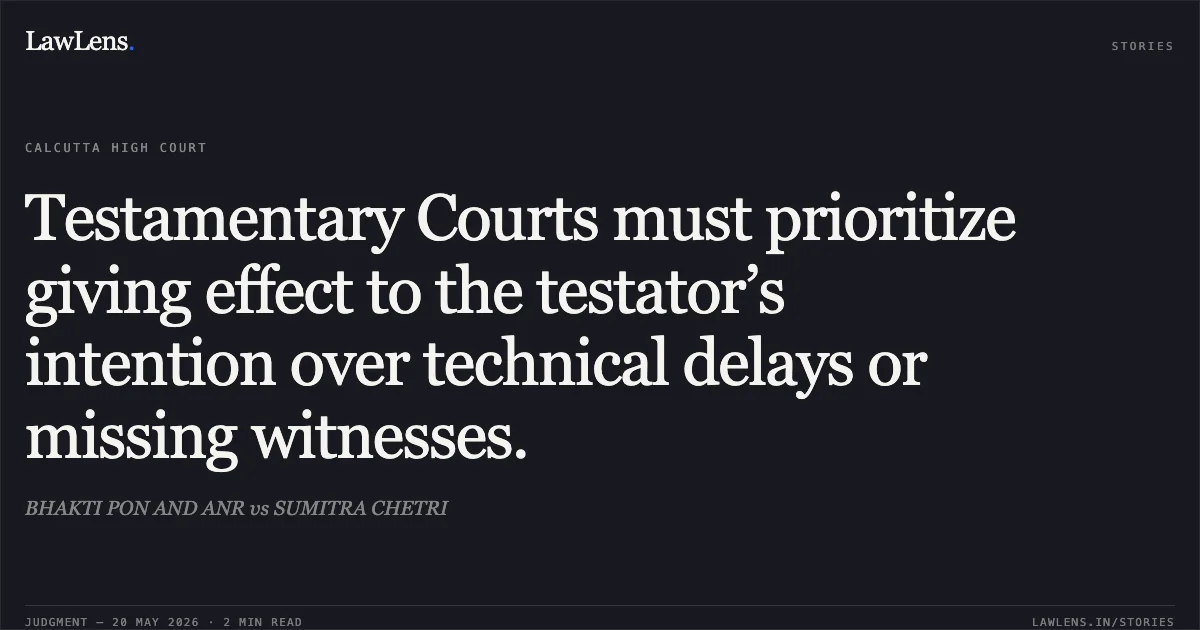
Source reference: para. 2It emphasized the "paramount consideration" in testamentary matters, which is to give effect to the last wishes of the testator.
Source reference: para. 9The court relied on the established principle that a testamentary court is a "court of judicial conscience," where the approach should not be "fault-finding" but rather an effort to determine if the Will was genuine and execution was proper.
Source reference: para. 10Where attesting witnesses are deceased, a Will may be proved by other available modes, including circumstantial evidence.
Source reference: para. 8, 12Reasoning
The High Court observed that the Trial Court’s judgment was "cryptic" as it failed to enter into the merits of the case.
Source reference: para. 8The Court reasoned that a procedural delay in filing should not override the duty of the testamentary court to ascertain the genuineness of the testator's last desire.
Source reference: paras. 9-10The Court found that the appellants should have been permitted to adduce evidence—circumstantial or otherwise—to prove the Will’s execution, especially since the original witnesses were dead and the respondent had ceased to oppose the grant.
Source reference: paras. 6, 8, 12By dismissing the suit on a technicality of delay, the lower court failed to fulfill its role as a court of judicial conscience.
Source reference: para. 10Holding
The High Court allowed the appeal (FA 225 of 2025), setting aside the judgment and decree dated September 9, 2024.
The matter was remanded to the Additional District Judge, Tenth Court at Alipore, for re-adjudication on merits, granting appellants opportunity to adduce circumstantial evidence.
Source reference: para. 12Applications CAN 1 of 2025 and CAN 2 of 2025 were disposed of with liberty to renew the prayers before the testamentary court and no order as to costs was made.
Source reference: paras. 13-15Acts & Sections Cited
1 provisions across 1 statute referred to in this judgment. Each provision opens on LawLens.
Indian Succession Act, 19251
Original Court PDF
BHAKTI PON AND ANRvsSUMITRA CHETRI
Click to open original judgment
Original judgment, available to read, download and summarize on LawLens.in