Facts
The appellant was convicted under Section 302 of the IPC for the murder of his wife on 16.09.2017 at Bokpara Tea Estate
Source reference: p. 5The prosecution case rested primarily on the testimony of PW-5 (an ASI of Police), who witnessed the appellant hacking the victim with a dao (machete)
Source reference: p. 8PW-2 (a Homeguard) corroborated this by testifying he saw the appellant holding a blood-stained dao immediately after hearing a hue and cry
Source reference: p. 6The appellant challenged the conviction on several grounds: the lack of independent/private witnesses despite the incident occurring in a public area, the failure to send the weapon to the Forensic Science Laboratory (FSL), and the absence of a written Section 161 Cr.PC statement for PW-2
Source reference: p. 3-4Issues
1. Whether the uncorroborated testimony of a police officer (PW-5) can form the sole basis for conviction
Source reference: p. 92. Whether the failure to send the murder weapon for FSL examination is fatal to the prosecution's case
Source reference: p. 113. Whether the absence of a written statement under Section 161 Cr.PC for a witness vitiates the trial
Source reference: p. 11-12Law Applied
The court applied Section 302 of the IPC regarding the punishment for murder
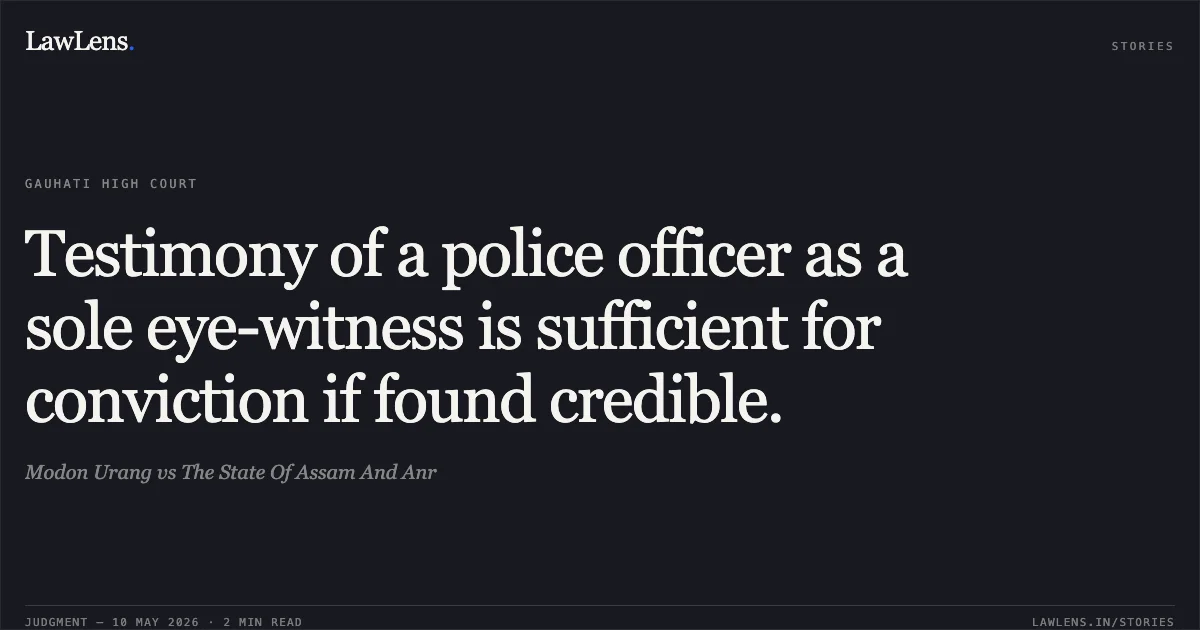
Source reference: p. 2It relied on Govindaraju @ Govinda v. State (2012) and Girja Prasad v. State of M.P. (2007) to establish that a police officer’s testimony is reliable and can form the sole basis of conviction if found trustworthy
Source reference: p. 9-10Regarding the status of a "chance witness," the court cited Sarvesh Narain Shukla v. Daroga Singh (2007), holding such evidence admissible if credible
Source reference: p. 10Procedurally, the court applied Sections 161 and 162 of the Cr.PC, noting that reducing a witness's statement to writing is directory, not mandatory
Source reference: p. 11Finally, the court integrated Section 357A Cr.PC regarding victim compensation
Source reference: p. 12Reasoning
The court found the testimony of PW-5 to be highly credible, noting that he was on official law and order duty during a "bonus day" at the tea garden, which explained his presence (negating the negative connotation of a "chance witness")
Source reference: p. 8, 10The bench observed no evidence of enmity or motive for PW-5 to falsely implicate the appellant
Source reference: p. 11This eye-witness account was corroborated by PW-2, who apprehended the appellant with the blood-stained weapon, and the medical evidence (PW-3), which confirmed death by heavy sharp-cutting injuries
Source reference: p. 6-8, 11The court dismissed the FSL argument, ruling that ocular evidence from an eye-witness overrides the procedural lapse of not obtaining a forensic report
Source reference: p. 11Regarding the Section 161 Cr.PC statement, the court clarified that the law allows for oral examination and does not mandate a written record to validate a witness’s testimony in court
Source reference: p. 12Holding
The Gauhati High Court found no infirmity in the trial court's judgment and dismissed the appeal, upholding the conviction and life sentence under Section 302 IPC
The court held that the prosecution proved the guilt beyond reasonable doubt through credible eye-witness testimony
Source reference: p. 12Additionally, the court recommended that the Assam State Legal Services Authority evaluate providing compensation under Section 357A Cr.PC to the appellant’s three deaf and dumb children
Source reference: p. 12-13Acts & Sections Cited
1 provisions across 1 statute referred to in this judgment. Each provision opens on LawLens.
Indian Penal Code, 18601
Original Court PDF
Modon UrangvsThe State Of Assam And Anr
Click to open original judgment
Original judgment, available to read, download and summarize on LawLens.in