Facts
The Appellant was convicted by the Trial Court on 21.08.2025 under Section 6 read with Section 18 of the POCSO Act for the sexual assault of a seven-year-old girl.
Source reference: p. 1The prosecution alleged that on 20.06.2022, the Appellant, a milkman, entered the victim's residence during her parents' absence and committed indecent acts and threats.
Source reference: p. 1-2The defense challenged the conviction on grounds of inconsistencies in the informant's (PW-1) testimony, lack of medical injuries, and failure to prove the chain of custody for electronic evidence (a pen drive).
Source reference: p. 2-4Issues
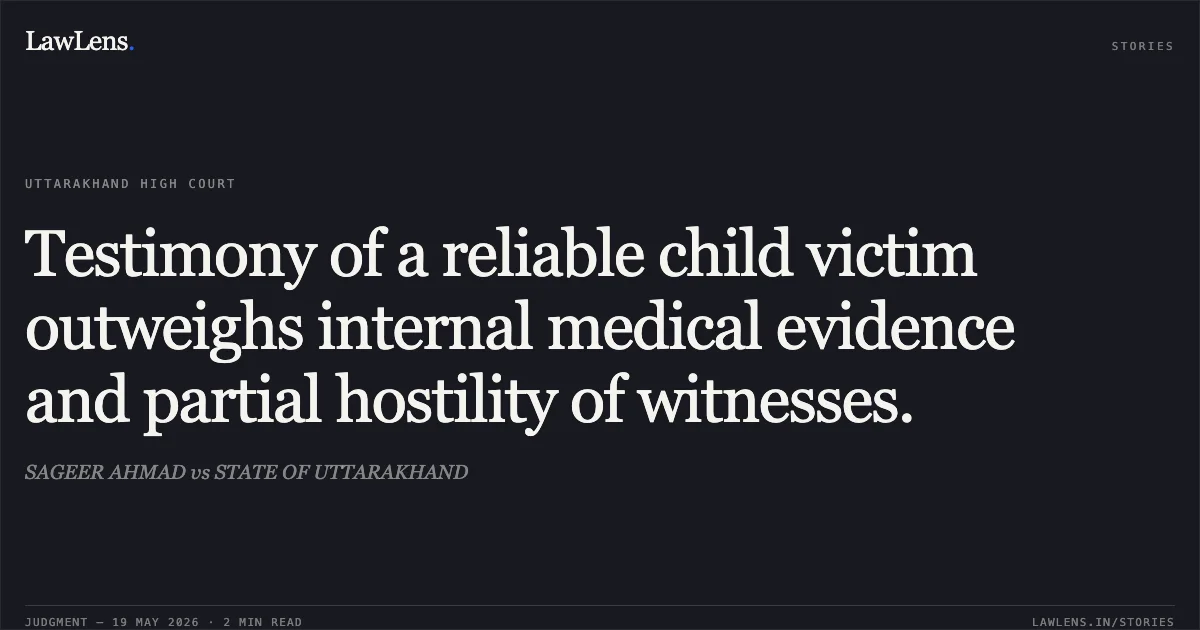
1. Whether the testimony of a child victim can form the sole basis of conviction under the POCSO Act despite minor inconsistencies and lack of medical corroboration.
Source reference: para. 29-302. Whether the partial hostility of the informant (PW-1) and alleged procedural lapses in handling electronic evidence under Section 65-B of the Evidence Act vitiate the prosecution’s case.
Source reference: para. 31-34Law Applied
The Court applied Section 6 (Aggravated penetrative sexual assault) and Section 18 (Attempt) of the POCSO Act.
Source reference: p. 1It relied on the established principle that in sexual offenses, the testimony of a victim of "sterling quality" is sufficient for conviction without corroboration.
Source reference: para. 29It further applied Section 65-B of the Indian Evidence Act regarding the admissibility of electronic records, noting that substantial compliance via certificate is sufficient when supported by oral testimony.
Source reference: para. 11, 34Regarding hostile witnesses, the Court applied the doctrine that partial hostility does not render the entire testimony or the prosecution case unreliable.
Source reference: para. 32Reasoning
The Court reasoned that the 7-year-old victim’s (PW-2) testimony was consistent, attributed specific acts to the Appellant, and was not diminished by her tender age.
Source reference: para. 30The Court dismissed the Appellant's focus on the informant's (PW-1) inconsistencies, noting that as PW-1 was not an eye-witness, his deviations did not affect the core case built on the victim’s testimony.
Source reference: para. 31-32Regarding electronic evidence, the Court found that the pen drive’s contents showing the Appellant’s proximity to the victim corroborated the State's version, and the submission of a Section 65-B certificate satisfied legal requirements.
Source reference: para. 33-34Finally, the Court held that the absence of physical medical injuries is not fatal in POCSO cases, especially when the victim’s oral evidence is credible and inspires confidence.
Source reference: para. 35Holding
The High Court answered both issues in the negative, finding no perversity in the Trial Court's appreciation of evidence.
The Court held that its conviction was based on the fact that the victim’s testimony was reliable and the electronic evidence sufficiently corroborated the charges. The appeal was dismissed, and the judgment dated 21.08.2025, sentencing the Appellant to ten years’ rigorous imprisonment and a fine of Rs. 25,000, was affirmed.
Source reference: p. 8Acts & Sections Cited
2 provisions across 1 statute referred to in this judgment. Each provision opens on LawLens.
Protection of Children from Sexual Offences Act, 20122
Original Court PDF
SAGEER AHMADvsSTATE OF UTTARAKHAND
Click to open original judgment
Original judgment, available to read, download and summarize on LawLens.in