Facts
On February 7, 2012, at 10:30 PM, the deceased (Veer Singh) was allegedly taken from his home by the appellants and assaulted with lathis and dandas, leading to his death
Source reference: p.2-3The First Information Report (FIR) was lodged by his cousin, Sumer Singh (PW-1), on February 8, 2012, at 7:30 AM, with a delay of nine hours
Source reference: p.3, 8The prosecution presented nine witnesses, including PW-1, PW-2 (Prabha Bai), and PW-7 (Harivansh) as eyewitnesses
Source reference: p.4-5The Trial Court (Sessions Judge, Chitrakoot) convicted the appellants under Sections 147, 302/149, 201, and 120B of the IPC
Source reference: p.2, 5The appellants challenged this conviction, citing material contradictions in testimony and the doubtful presence of eyewitnesses
Source reference: p.6Issues
1. Whether the prosecution proved the guilt of the accused beyond reasonable doubt based on reliable eyewitness testimony.
Source reference: p.8-112. Whether the conduct of the prosecution witnesses and the delay in lodging the FIR rendered the prosecution's story suspicious.
Source reference: p.8, 213. Whether the Trial Court erred in law by failing to consider the cross-examination of witnesses during evidence appreciation.
Source reference: p.19-20Law Applied
The court primarily applied Section 302 (Murder), Section 149 (Unlawful Assembly), and Section 201 (Disappearance of Evidence) of the IPC
Source reference: p.2It relied on Section 3 of the Indian Evidence Act, 1872, emphasizing that "evidence" encompasses both examination-in-chief and cross-examination
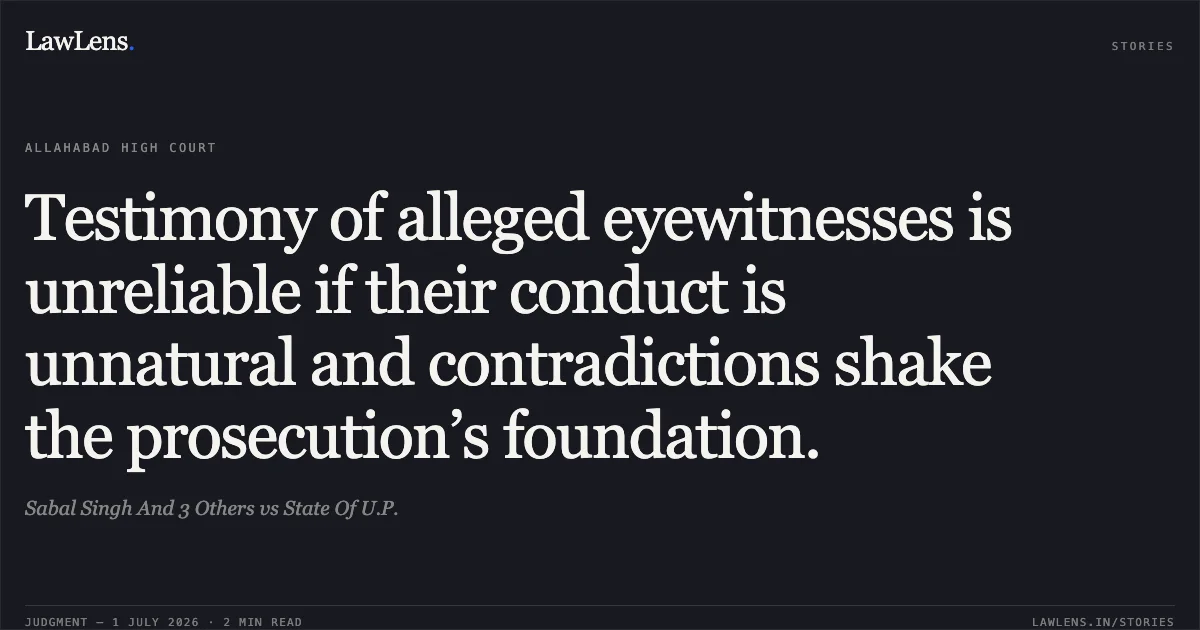
Source reference: p.19Furthermore, it applied the precedent established in Badam Singh v. State of Madhya Pradesh (2003), which dictates that if the conduct of witnesses is unnatural or renders the case incredible, the court may reject their testimony regardless of consistency in their initial statements
Source reference: p.18Reasoning
The Court found that the Trial Court failed to appreciate evidence in its totality, focusing solely on examination-in-chief while ignoring fatal admissions in cross-examination
Source reference: p.19-20PW-1 and PW-2 admitted in cross-examination that they searched for the deceased all night, which contradicted their claim of having seen the assault
Source reference: p.11, 13PW-7 admitted he was not present at the spot and only testified at the behest of the prosecution years later
Source reference: p.15-16The Court observed that the nine-hour delay in the FIR, despite the availability of transport and proximity to the police station, suggested deliberation and concoction
Source reference: p.8-9Additionally, the Investigating Officer (PW-5) confirmed no bloodstains were found at the alleged site of the murder, supporting the probability that the deceased was killed elsewhere and the body was moved
Source reference: p.17The conduct of the relatives—failing to seek medical aid for the deceased—was deemed unnatural and a violation of the "truthfulness" requirement for eyewitnesses
Source reference: p.8, 18Holding
The Court answered the issues in the negative, holding that the prosecution failed to establish a credible chain of events or provide reliable eyewitness testimony
The High Court held that the Trial Court's judgment was perverse as it misread the evidence and ignored major contradictions
Source reference: p.6, 21Consequently, the appeals were allowed, the conviction and sentences dated December 10, 2020, were set aside, and the appellants were acquitted of all charges
Source reference: p.21-22Provisions of Section 437-A Cr.P.C. were directed to be complied with
Source reference: p.22Acts & Sections Cited
7 provisions across 2 statutes referred to in this judgment. Each provision opens on LawLens.
Indian Penal Code, 18604
Code of Criminal Procedure, 19733
Original Court PDF
Sabal Singh And 3 OthersvsState Of U.P.
Click to open original judgment
Original judgment, available to read, download and summarize on LawLens.in