Facts
On March 9, 1996, Jangli Ram was found murdered in his jhuggi in NIA, Phase-I, with a deep cut over his neck.
Source reference: p.2No eyewitnesses were present when police arrived.
Source reference: p.2On March 11, 1996, the prosecution recorded statements from two child witnesses, PW-1 Gudia (3.5 years) and PW-2 Ladli (6 years), who claimed to have seen Respondent No. 1 (Budh Ram) slit the throat of the deceased while Respondent No. 2 (Kamlesh) gagged the victim’s mouth.
Source reference: p.3, p.7The Trial Court acquitted the accused on August 17, 1999, citing material contradictions and unreliable testimonies.
Source reference: p.4-5The State appealed the acquittal. During pendency, Respondent No. 1 died, and proceedings qua him abated.
Source reference: p.5Issues
1. Whether the testimonies of the child witnesses (PW-1 and PW-2) were reliable and consistent enough to sustain a conviction for murder under Section 302/34 IPC.
Source reference: p.12 / para. 322. Whether the conduct of the child witnesses and the delay in recording their statements/arresting the accused created a reasonable doubt in the prosecution's case.
Source reference: p.15-16 / para. 40-43Law Applied
The court applied Section 118 of the Indian Evidence Act, 1872, which establishes that all persons are competent to testify unless prevented by tender years or lack of rational understanding.
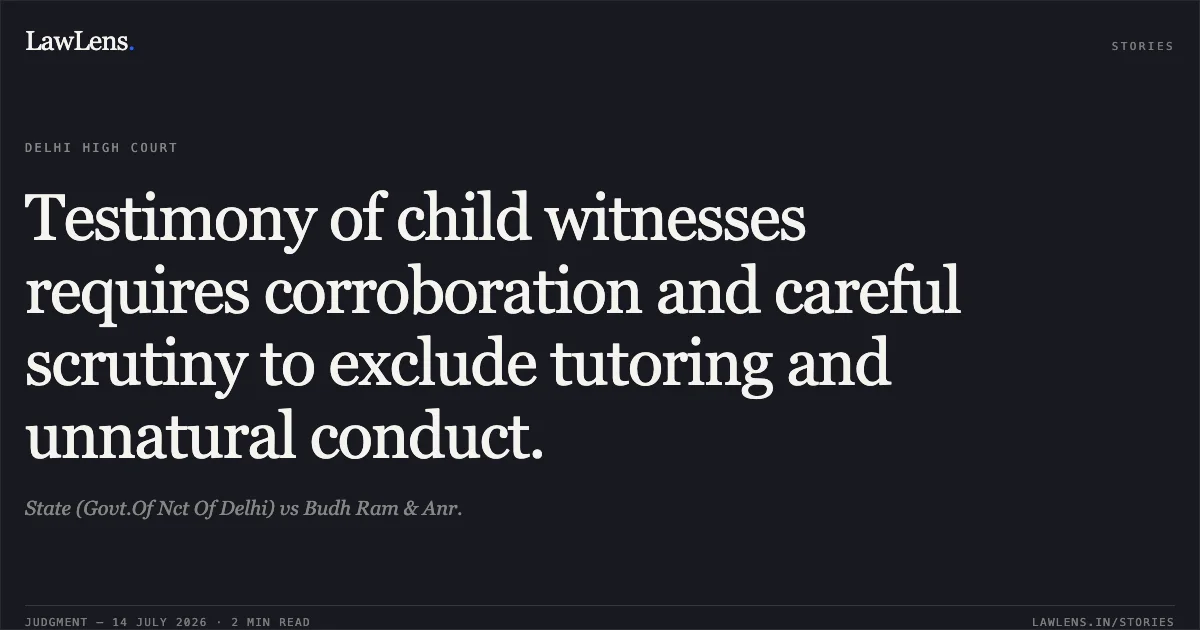
Source reference: p.10It relied on Radhey Shyam v. State of Rajasthan and Pradeep v. State of Haryana, establishing that while a child's testimony is admissible, it must be subjected to close scrutiny to rule out tutoring and typically requires corroboration as a rule of prudence.
Source reference: p.10-11The court applied the principle from Samsul Haque v. State of Assam regarding appeals against acquittal, stating that if two views are possible, the view favorable to the accused must prevail unless the trial court’s judgment is perverse.
Source reference: p.22-23Reasoning
The High Court found the child witnesses' testimonies unreliable due to fundamental contradictions regarding the scene of crime; PW-1 claimed to see the murder through a window, whereas the IO and site plan confirmed the jhuggi had no window.
Source reference: p.13PW-2 provided a version of the injuries (cut to the abdomen) that was directly contradicted by the post-mortem report.
Source reference: p.14The court noted a significant discrepancy in the medical timeline: the post-mortem suggested death occurred around 10:00 AM, while the children claimed to see it in the afternoon.
Source reference: p.16The court found the children's conduct unnatural, as they neither raised an alarm nor showed fear.
Source reference: p.15, p.22The 17-day delay in arresting the respondents despite their identities being known suggested potential tutoring.
Source reference: p.17The court observed that the roles attributed to Respondent No. 2 were improvements not found in the initial Section 161 CrPC statements.
Source reference: p.14Holding
The court answered both issues in the negative, holding that the prosecution failed to prove the guilt of Respondent No. 2 beyond a reasonable doubt.
The court affirmed the Trial Court's judgment, finding no perversity in the acquittal; State's appeal dismissed and Respondent No. 2’s bail bonds remain valid for six months pursuant to Section 481 of the BNSS (formerly Section 437-A CrPC).
Source reference: p.23Acts & Sections Cited
6 provisions across 3 statutes referred to in this judgment. Each provision opens on LawLens.
Indian Penal Code, 18602
Code of Criminal Procedure, 19733
Bharatiya Nagarik Suraksha Sanhita, 20231
Original Court PDF
State (Govt.Of Nct Of Delhi)vsBudh Ram & Anr.
Click to open original judgment
Original judgment, available to read, download and summarize on LawLens.in