Facts
The prosecution alleged that on the night of May 18/19, 1999, Tarsem Singh (appellant) and Gurdeep Kaur (deceased co-accused) murdered four persons—Balvinder Singh, Nasib Kaur, Sukhvinder Kaur, and Sarwan Singh—using a licensed gun and a knife
Source reference: para. 3Initially, Gurdeep Kaur lodged a false FIR alleging dacoity by unknown miscreants; however, investigation revealed an illicit relationship between her and the appellant as the motive
Source reference: paras. 3–5The appellant was arrested on May 24, 1999, leading to the recovery of stolen ornaments, while Gurdeep Kaur led to the recovery of the murder weapons
Source reference: paras. 5–8The trial court convicted the appellant under Sections 302 and 404 of the IPC, sentencing him to life imprisonment
Source reference: para. 16The appellant challenged the conviction primarily on the ground that it rested on the testimonies of child witnesses (PW-4 and PW-5) and that independent witnesses had turned hostile
Source reference: para. 17Issues
1. Whether the testimonies of child witnesses (PW-4 and PW-5) are reliable enough to form the basis of conviction despite their delayed disclosure of the incident
Source reference: para. 19-202. Whether the hostility of independent recovery witnesses and inconsistencies in the testimony of PW-1 (informant's associate) vitiate the prosecution’s case
Source reference: paras. 21, 313. Whether the forensic and medical evidence sufficiently corroborates the ocular account to establish guilt beyond reasonable doubt
Source reference: paras. 33, 41Law Applied
The court primarily applied Section 302 (Murder) and Section 404 (Dishonest misappropriation of property) of the IPC
Source reference: para. 2It relied on Section 118 of the Indian Evidence Act regarding the competency of child witnesses
Source reference: para. 20(a)Section 27 [of the Indian Evidence Act] regarding discoveries made pursuant to an accused's disclosure
Source reference: para. 29The court applied the "Rule of Prudence" for child witnesses as established in State of M.P. v. Ramesh (2011) and Pramila v. State of U.P. (2021), requiring close scrutiny to rule out tutoring
Source reference: para. 20(a)(i-ii)It further utilized the principle from Section 106 of the Evidence Act regarding facts especially within the knowledge of the accused
Source reference: para. 38Reasoning
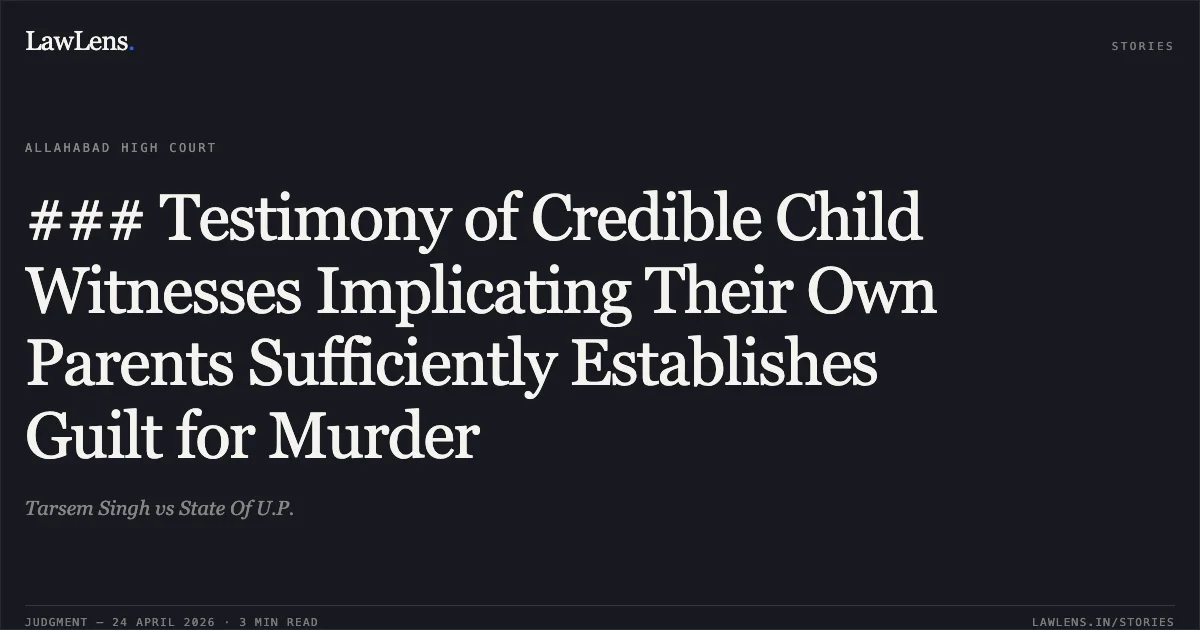
The Court found the testimonies of PW-4 and PW-5 (aged 15 and 12) to be of "sterling quality," noting that the Trial Court conducted a preliminary inquiry into their competence
Source reference: paras. 7, 10, 20The Court reasoned that a child would not falsely implicate their own biological mother (Gurdeep Kaur) in a quadruple murder unless it were true, thereby ruling out tutoring
Source reference: para. 20(c)(i)The delay in disclosure was excused as a natural reaction to the trauma and the death threats issued by the assailants
Source reference: para. 20(b)(i)Regarding the hostility of PW-1 and PW-3, the Court held that their evidence could not be discarded in toto and that the contemporaneous General Diary entry (Ext. Ka-16) exposed PW-1’s attempt to shield the accused
Source reference: paras. 24–27Scientifically, the forensic report (Ext. Ka-41) matched the cartridges at the scene to the licensed gun recovered at the instance of the accused, contradicting the defense's "retaliatory fire" theory
Source reference: paras. 33–34The Court determined that the combination of credible ocular evidence, medical corroboration of firearm and incised wounds, and the appellant’s failure to explain his presence at the scene under Section 313 CrPC formed an unbroken chain of guilt
Source reference: paras. 45–48, 57Holding
The Court answered all issues in the affirmative, holding that child witnesses are competent and reliable if their testimony inspires confidence and survives rigorous scrutiny
The Court affirmed the conviction and sentence passed by the Trial Court under Sections 302 and 404 IPC, dismissing the appeal. The appellant was ordered to continue serving his life imprisonment
Source reference: para. 58, 59Acts & Sections Cited
7 provisions across 1 statute referred to in this judgment. Each provision opens on LawLens.
Indian Penal Code, 18607
Original Court PDF
Tarsem SinghvsState Of U.P.
Click to open original judgment
Original judgment, available to read, download and summarize on LawLens.in