Facts
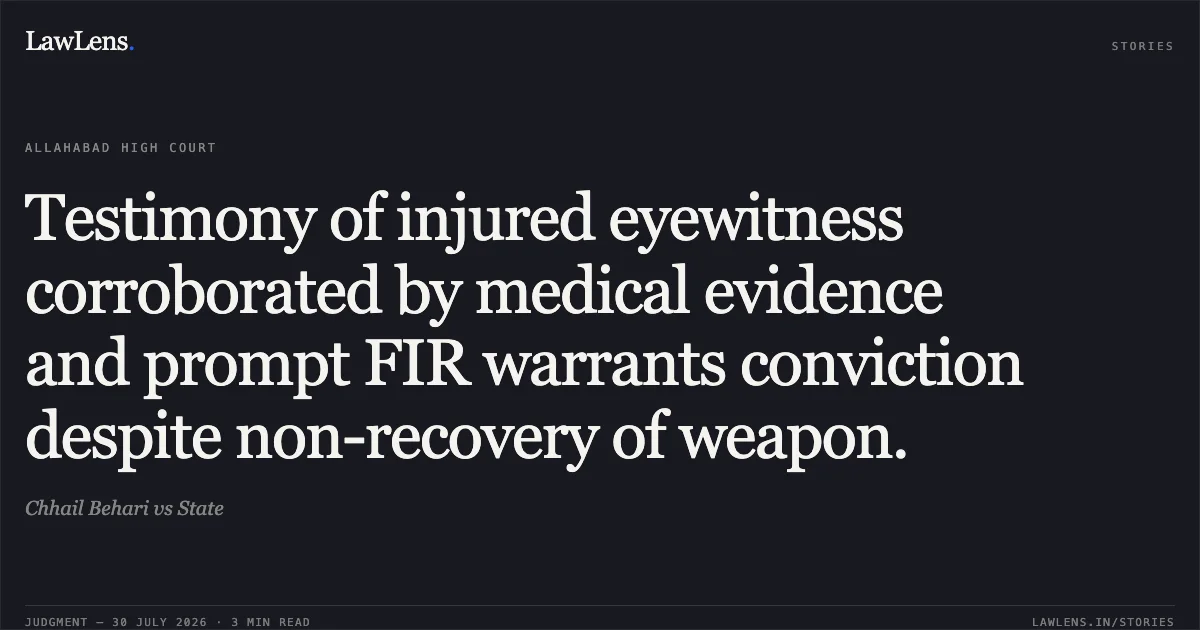
The appellant, Chhail Bihari, was convicted by the trial court under Sections 302 and 307 of the IPC for the murder of Rajesh (alias Mantey) and for causing firearm injuries to Smt. Shyam Pyari.
Source reference: para. 2On the night of 7/8.08.1985, the appellant and two associates entered the informant Ayodhya Prasad’s house. The appellant shot Shyam Pyari in the thigh and struck her with a gun butt, then fatally shot Rajesh in the chest as he lay on a cot.
Source reference: para. 3The informant witnessed the approach from concealment and was later briefed on the internal details by his injured daughter.
Source reference: para. 4The motive was attributed to prior enmity, as the informant had previously testified against the appellant in an Arms Act case.
Source reference: para. 6The appellant challenged the conviction on grounds of delayed/ante-dated FIR, non-recovery of the weapon, and inconsistencies between ocular and medical evidence.
Source reference: para. 16Issues
1. Whether the First Information Report (FIR) was ante-dated and lodged after consultation, thereby vitiating the prosecution case.
Source reference: para. 16(b), 232. Whether the testimony of a single injured eyewitness (PW-3) is sufficient for conviction despite minor medical discrepancies and non-recovery of the weapon.
Source reference: para. 16(f), 25, 323. Whether the non-examination of the treating doctor from the specialty hospital (Bailey Hospital) is fatal to the prosecution.
Source reference: para. 16(e), 32Law Applied
The Court applied Sections 302 (Murder) and 307 (Attempt to Murder) of the Indian Penal Code.
Source reference: para. 2It relied on the principle from Vadivelu Thevar v. State of Madras that the court can convict on the testimony of a single reliable witness.
Source reference: para. 25Regarding injured witnesses, it applied the doctrine that such testimony carries special weight because the witness’s presence is certain and they are unlikely to subserve the real culprit (Abdul Sayeed v. State of M.P.).
Source reference: para. 25Per State of M.P. v. Dayal Sahu, the non-examination of a treating doctor is not fatal if the injury report is otherwise proved and the ocular evidence is inspiring.
Source reference: para. 32Reasoning
The Court found the FIR was prompt (lodged at 12:45 a.m. for a 10:00 p.m. incident), leaving no room for fabrication.
Source reference: para. 23It rejected the "ante-timing" plea, noting the natural sequence from the incident to medical examination.
Source reference: para. 23The Court emphasized that PW-3, as an injured witness, was "wholly reliable"; her presence at the scene was established by her gun-shot wounds, and her testimony was corroborated by the recovery of six empty cartridges at the site.
Source reference: para. 21, 27Medical discrepancies regarding "blackening or tattooing" were dismissed as minor variances that do not override categorical ocular evidence.
Source reference: para. 29The Court held that the non-recovery of the firearm was immaterial given the strong direct evidence.
Source reference: para. 29Finally, it ruled that the non-examination of the Bailey Hospital doctor did not cause prejudice, as the initial injury report was duly proved by the examining Medical Officer (PW-2).
Source reference: para. 32Holding
The Court answered the issues in the negative, holding that the prosecution established the appellant’s guilt beyond reasonable doubt.
The Court affirmed that the testimony of a single injured eyewitness, if reliable, is sufficient for conviction.
Source reference: para. 32The appeal was dismissed, the conviction and sentences under Sections 302 and 307 IPC were affirmed, and the appellant was directed to surrender within four weeks to serve the remainder of his sentence.
Source reference: para. 34-35Acts & Sections Cited
5 provisions across 3 statutes referred to in this judgment. Each provision opens on LawLens.
Indian Penal Code, 18602
Arms Act, 19591
Code of Criminal Procedure, 19732
Original Court PDF
Chhail BeharivsState
Click to open original judgment
Original judgment, available to read, download and summarize on LawLens.in