Facts
The Appellant was convicted by the Sessions Judge, Pithoragarh, for attacking his neighbor, Lalit Singh (PW-1), with a Khukri on 14.10.2021.
Source reference: p. 1-2The assault resulted in multiple lacerations to the head and face, and a severe injury to the right forearm that necessitated amputation below the elbow.
Source reference: p. 2-3, 8The prosecution relied on the testimony of the injured witness (PW-1), medical evidence (PW-8, PW-9), and the recovery of the weapon at the Appellant's instance.
Source reference: p. 5, 15The Trial Court sentenced the Appellant to 10 years R.I. each under Sections 307 and 326 of the IPC, and 3 years under the Arms Act, directing sentences to run consecutively.
Source reference: p. 1The Appellant challenged the conviction citing inconsistencies in witness testimonies and the non-examination of a material witness.
Source reference: p. 10Issues
1. Whether the testimonies of the injured witness and supporting witnesses were sufficient to sustain a conviction despite minor inconsistencies and the non-examination of one witness.
Source reference: p. 11, 152. Whether the sentences awarded for different offenses arising out of the same transaction should run consecutively or concurrently.
Source reference: p. 16Law Applied
The Court primarily applied Sections 307 (Attempt to murder) and 326 (Voluntarily causing grievous hurt by dangerous weapons) of the IPC.
Source reference: p. 1In Balu Sudam Khalde v. State of Maharashtra (2023) and Abdul Sayeed v. State of Madhya Pradesh (2010), it was established that the testimony of an injured witness possesses high evidentiary value and a "built-in guarantee" of presence at the crime scene, and should not be discarded due to minor contradictions.
Source reference: p. 11-14The general rule is that sentences for offenses committed in a single transaction typically run concurrently.
Source reference: p. 16Reasoning
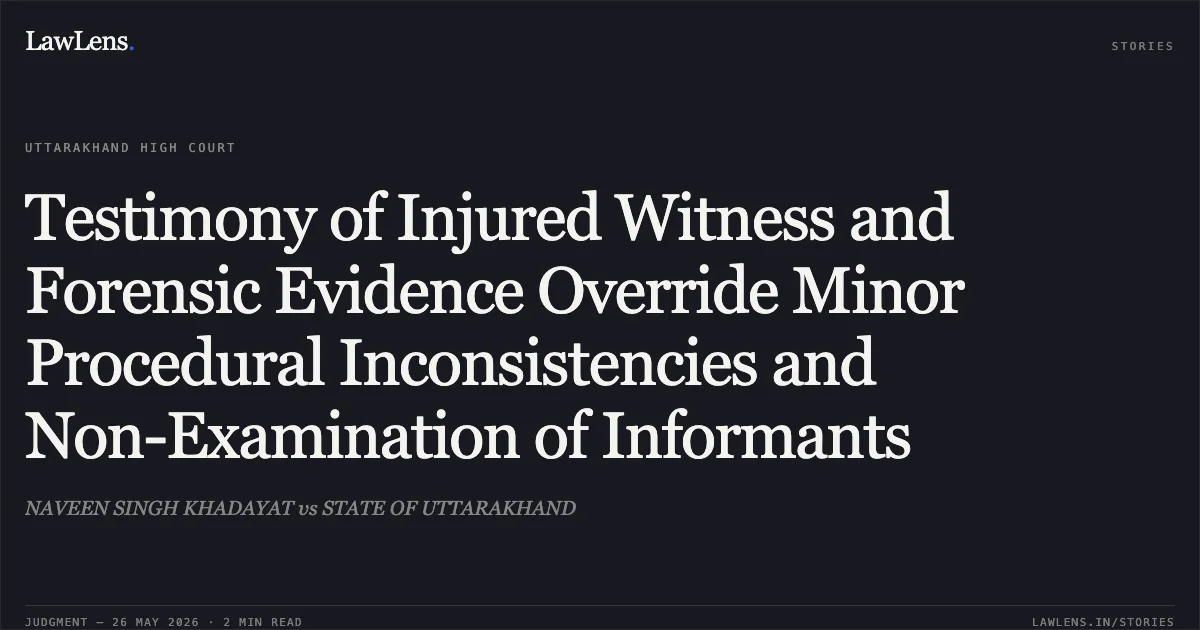
The Court found the testimony of PW-1 to be credible and corroborated by medical evidence (PW-8 and PW-9), which confirmed that the injuries were life-threatening and led to permanent disability.
Source reference: p. 15The Court rejected the defense's plea regarding the non-examination of "Bhawna," ruling that the quality of evidence—specifically the injured victim's direct account—outweighs the quantity of witnesses.
Source reference: p. 15The recovery of the blood-stained Khukri further linked the Appellant to the crime.
Source reference: p. 16While maintaining the conviction, the Court observed that the incident arose from a property dispute (enmity over a cowshed) and that the Appellant had already served over four years.
Source reference: p. 16Noting that the Trial Court provided no specific reason for consecutive sentencing, the High Court determined that concurrent sentencing was more appropriate for offenses arising from the same incident.
Source reference: p. 16Holding
The Court upheld the conviction but partly allowed the appeal by modifying the sentence.
It reduced the sentences under Sections 307 and 326 IPC from 10 years to 7 years R.I. each and ordered that all sentences (including the 3-year term under the Arms Act) shall run concurrently rather than consecutively.
Source reference: p. 17The Appellant was directed to serve out the remainder of the modified sentence.
Source reference: p. 17Acts & Sections Cited
5 provisions across 3 statutes referred to in this judgment. Each provision opens on LawLens.
Indian Penal Code, 18602
Arms Act, 19592
Code of Criminal Procedure, 19731
Original Court PDF
NAVEEN SINGH KHADAYATvsSTATE OF UTTARAKHAND
Click to open original judgment
Original judgment, available to read, download and summarize on LawLens.in