Facts
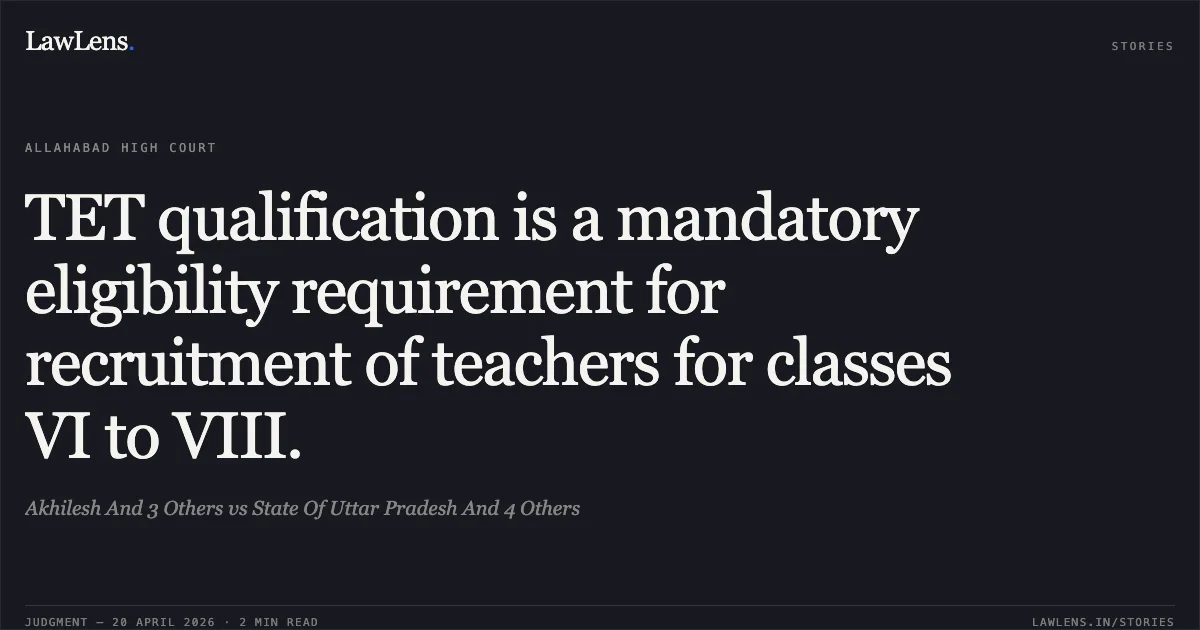
The petitioners challenged the validity of Rule 8 of the Uttar Pradesh Subordinate Educational (Trained Graduate Grade) Service Rules, 1983 (as amended by the 6th amendment dated January 30, 2025).
Source reference: para. 1, 3They contended that the rule is ultra vires Section 23 of the Right of Children to Free and Compulsory Education Act, 2009, because it fails to include the Teacher Eligibility Test (TET) as a mandatory qualification for Assistant Teachers teaching classes VI to VIII.
Source reference: para. 1, 3The State argued that recent amendments were intended to comply with a 2014 NCTE notification regarding classes IX and X, and that no recruitment had been initiated for classes VI to VIII under the impugned rules.
Source reference: para. 5However, the recruitment advertisement dated July 28, 2025, did not specify which classes the recruits would be assigned to teach.
Source reference: para. 6, 7Issues
1. Whether Rule 8 of the Uttar Pradesh Subordinate Educational Service Rules, 1983 is ultra vires Section 23 of the Right of Children to Free and Compulsory Education Act, 2009 by omitting TET as a mandatory qualification for teachers of classes VI to VIII.
Source reference: para. 3, 72. Whether the recruitment advertisement dated July 28, 2025, is legally sustainable without specifying the classes to be taught by the recruits.
Source reference: para. 6, 7Law Applied
The court applied Section 23(1) of the Right of Children to Free and Compulsory Education Act, 2009, which authorizes the National Council for Teacher Education (NCTE) as the academic authority to prescribe minimum qualifications for teachers.
Source reference: para. 2It relied on the NCTE Notification dated August 23, 2010, which mandates passing the Teacher Eligibility Test (TET) for appointment as a teacher for classes VI to VIII.
Source reference: para. 1, 3It further noted the NCTE Notification dated November 12, 2014, which prescribes qualifications for teachers of classes IX and X.
Source reference: para. 5, 6Reasoning
The court found an impermissible "gap" in Rule 8 because it failed to incorporate the mandatory TET qualification required by the NCTE for teachers of classes VI to VIII.
Source reference: para. 7While the State claimed that the rule was amended to align with 2014 NCTE standards for classes IX and X, the court observed that there are 904 institutions in Uttar Pradesh teaching students from classes VI to XII.
Source reference: para. 3, 5Since the recruitment notice dated July 28, 2025, was silent on the specific classes the recruits would teach, there was a risk of appointing teachers for classes VI to VIII who lack the statutory TET qualification.
Source reference: para. 7The court reasoned that since the NCTE mandate is binding under the 2009 Act, Rule 8 must be amended to include TET (pass) as a requisite qualification for the relevant grade.
Source reference: para. 7Holding
The court allowed the writ petitions in part.
It held that Rule 8 must include TET (pass) as a mandatory qualification for teachers appointed to teach classes VI to VIII and directed the State to propose the necessary amendment.
Source reference: para. 7The court directed the Public Service Commission, Uttar Pradesh, to issue a corrigendum clarifying that the recruitment advertisement dated July 28, 2025, relates exclusively to the recruitment of teachers for classes IX and X.
Source reference: para. 7The writ petitions were disposed of with these directions.
Source reference: para. 9Acts & Sections Cited
1 provisions across 1 statute referred to in this judgment. Each provision opens on LawLens.
Right of Children to Free and Compulsory Education Act, 20091
Original Court PDF
Akhilesh And 3 OthersvsState Of Uttar Pradesh And 4 Others
Click to open original judgment
Original judgment, available to read, download and summarize on LawLens.in


