Facts
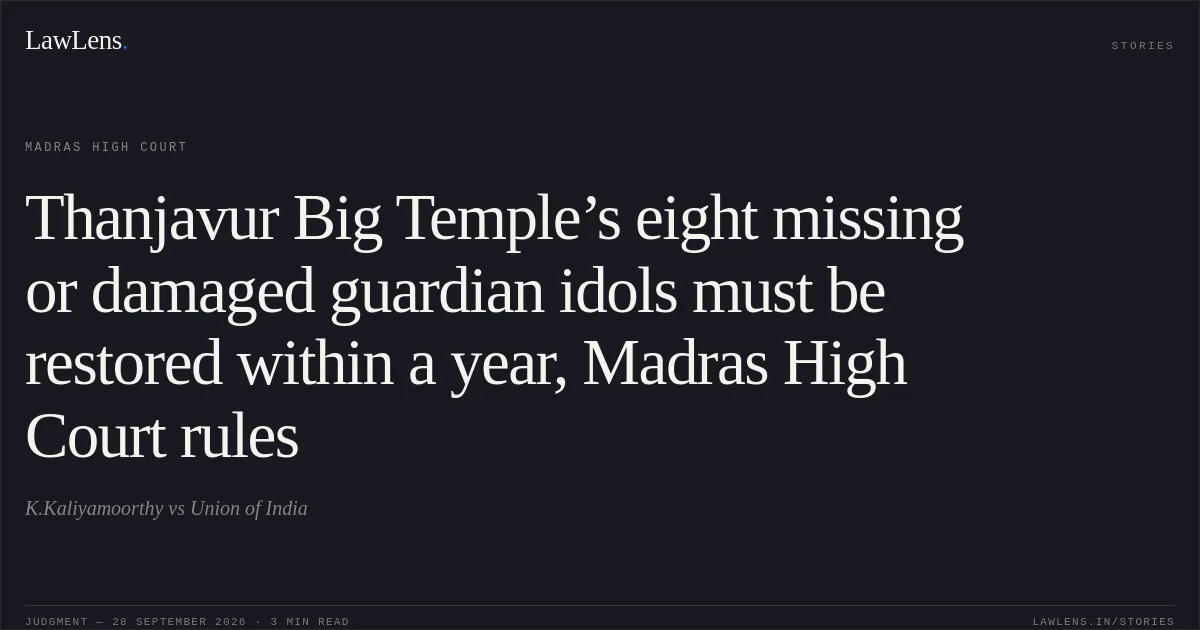
The petitions concerned the eight Dikpalaka shrines at the Sri Brihadeeswarar (Thanjai Peruvudaiyar) Temple, a protected monument and living place of worship.
Source reference: paras. 6, 22–24; pp. 7, 17–24An inspection report recorded that four idols—Agni, Varunan, Vayu and Esanar—were damaged, while the idols of Indiran, Yaman, Nirriti and Kuberan were missing.
Source reference: paras. 6, 22–24; pp. 7, 17–24In 2019, the Archaeological Survey of India (ASI) refused a request to replace the damaged idols and install the missing ones, citing the Ancient Monuments and Archaeological Sites and Remains Act, 1958.
Source reference: paras. 8–9; p. 8The petitioners sought to challenge that refusal and obtain directions for restoration of the idols; two petitions also sought relief concerning the Indra shrine.
Source reference: paras. 2, 5; pp. 6–7The Court considered a 1946 agreement governing preservation of the temple, under which the monument was to remain available for religious worship, while repairs and alterations were subject to specified controls.
Source reference: para. 26; pp. 25–27Issues
Whether the ASI’s refusal to permit replacement of damaged Dikpalaka idols and installation of missing idols was justified under the 1958 Act and the applicable preservation arrangements.
Source reference: paras. 8–9, 27–29; pp. 8, 27–29Whether the Court could direct the relevant authorities to restore the idols, consistently with the temple’s protected-monument status and its continued use for worship.
Source reference: paras. 25–29, 31–33; pp. 25–30Law Applied
The Court considered Section 6(2)(c)(iii) of the Ancient Monuments and Archaeological Sites and Remains Act, 1958, which permits an agreement concerning a protected monument to restrict the owner’s right to destroy, remove, alter or deface it; it held that the relief sought—installing missing idols and replacing damaged ones—was not, in itself, a request to destroy, remove, alter or deface the idols.
Source reference: paras. 28–29; pp. 28–29It relied on Section 39 of the 1958 Act, which saves specified matters done or omitted under the repealed Ancient Monuments Preservation Act, 1904, and Section 6 of the General Clauses Act, 1897, concerning the preservation of accrued rights and obligations upon repeal; on that basis, it held that the 1946 agreement remained effective.
Source reference: paras. 27, 33–34; pp. 27, 30–31The Court also referred to Section 16(2)(b) of the 1958 Act as requiring the District Collector to take necessary action to preserve a protected monument.
Source reference: para. 32; pp. 29–30The agreement provided for preservation under the archaeological authorities’ direction, consultation with the hereditary trustee on repairs, and continued religious worship at the monument.
Source reference: para. 26; pp. 25–27Reasoning
The Court treated idol restoration as distinct from prohibited damage to the protected monument: the requested work was to restore the shrines’ religious use, while the ASI could retain the broken idols for preservation.
Source reference: paras. 29, 31; pp. 28–29It considered the 1946 agreement preserved by the statutory savings provisions, but noted that the agreement also contemplated continued worship at the temple.
Source reference: paras. 26–27, 33–34; pp. 25–27, 30–31In light of the inspection findings, the temple’s status as a living place of worship, and the prior opinion of the temple Sthapathi recommending replacement and installation, the Court found that the damaged idols should not remain in the shrines and the missing deities should be restored, subject to consultation with experts and compliance with Agama principles.
Source reference: paras. 30–31, 35–38; pp. 29–32Holding
The Court allowed the writ petitions and quashed the ASI’s refusal letter, identified in the judgment as dated 3 September 2019.
It directed the District Collector, the HR&CE Joint Commissioner, the hereditary trustee and the ASI Assistant Superintending Archaeologist to take steps to replace the damaged idols of Agni, Varunan, Vayu and Esanar and install the missing idols of Indiran, Yaman, Nirriti and Kuberan. They may obtain fresh expert, Pandit and Sthapathi opinions; preliminary work must begin within three months, and installation and replacement must be completed within twelve months.
Source reference: para. 40; pp. 33–34The Court made no order as to costs and closed the connected bell-related application.
Source reference: paras. 39–40; pp. 33–34Acts & Sections Cited
6 provisions across 4 statutes referred to in this judgment. Each provision opens on LawLens.
Ancient Monuments and Archaeological Sites and Remains Act, 19583
Ancient Monuments Preservation Act, 19041
States Reorganisation Act, 19561
General Clauses Act, 18971
Original Court PDF
K.KaliyamoorthyvsUnion of India
Click to open original judgment
Original judgment, available to read, download and summarize on LawLens.in