Facts
The seven applicants were engaged as daily-wage casual laborers by the Archaeological Survey of India (ASI) at the Sarnath Museum in 2009
Source reference: p. 2They performed duties such as sweeping and cleaning for nearly ten years
Source reference: p. 4The applicants claimed they were entitled to "temporary status" and regularization under the "Casual Labourer (Grant of Temporary Status and Regularization) Scheme, 1993" and subsequent clarifications
Source reference: p. 2-3On April 1, 2018, the respondents orally terminated the applicants’ services, allegedly to replace them with outsourced labor
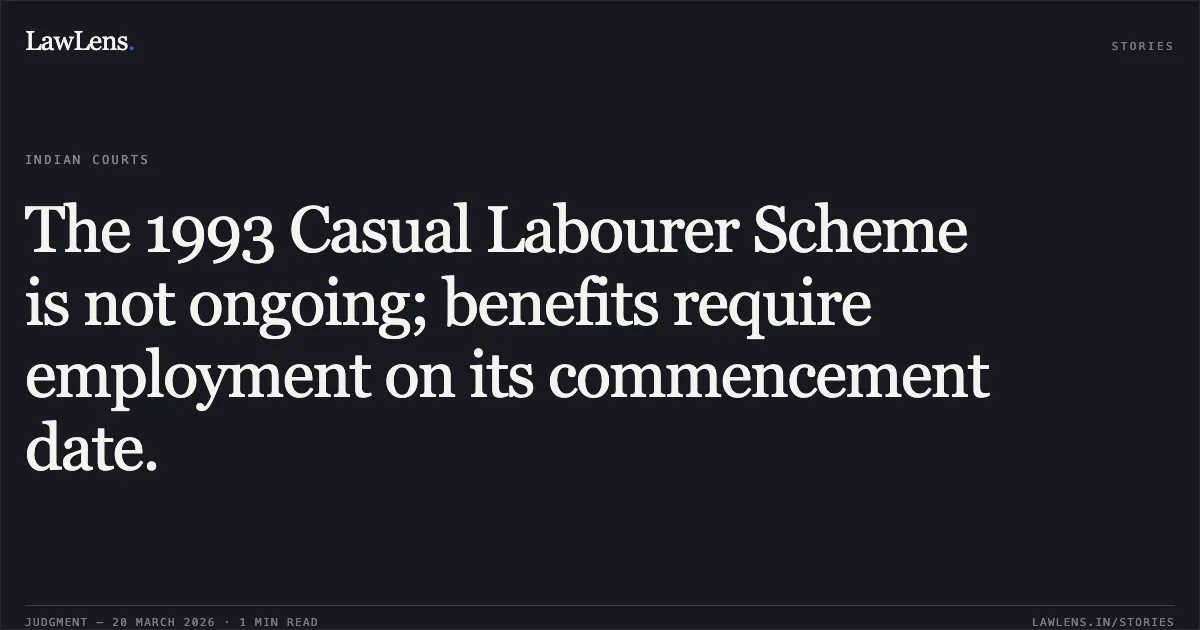
Source reference: p. 3The respondents contested the claim, stating the 1993 Scheme was a one-time measure, not an ongoing one, and that the applicants did not meet the eligibility criteria as they were not in service when the scheme commenced
Source reference: p. 4-5Issues
1. Whether the applicants are entitled to "Temporary Status" and subsequent regularization under the 1993 Scheme despite being engaged in 2009?
Source reference: p. 13-162. Whether the applicants’ continued service for nearly ten years entitles them to regularization under the principles laid down in Secretary, State of Karnataka v. Umadevi?
Source reference: p. 5-63. Whether the respondents' act of disengaging the applicants to transition to an outsourcing model was arbitrary or illegal?
Source reference: p. 3, 17Law Applied
Casual Labourer (Grant of Temporary Status and Regularization) Scheme, 1993, which mandates that temporary status is conferred only upon those in employment on the date of the scheme's issuance (September 10, 1993)
Source reference: p. 14Union of India v. Mohan Pal (2002), which clarified that the 1993 Scheme is not an "ongoing scheme" and cannot be claimed by those engaged after its commencement
Source reference: p. 4-5, 16Secretary, State of Karnataka v. Umadevi (2006), which permits regularization as a one-time measure only for those who completed ten years of continuous service against sanctioned posts as of April 10, 2006, without the protection of court orders
Source reference: p. 5-6Reasoning
The Tribunal found that the applicants failed to meet the statutory and precedential requirements for regularization.
Source reference: p. 16-17Since the applicants were engaged in 2009, they were ineligible for the 1993 Scheme, which the Supreme Court in Mohan Pal explicitly ruled was not an ongoing arrangement
Source reference: p. 16-17the applicants did not satisfy the Umadevi criteria because they had not completed ten years of service by the 2006 cutoff date, having only started in 2009
Source reference: p. 6The Tribunal distinguished this case from other cited precedents (such as the Jaggo case) by noting that the applicants here did not have the benefit of interim stays and did not fulfill the specific continuous service requirements for "temporary status" or "1/30th status" pay
Source reference: p. 11, 17While acknowledging the applicants' long service, the Tribunal held it could not override established policy and Supreme Court mandates regarding the non-ongoing nature of casual labor schemes
Source reference: p. 17Holding
The Tribunal dismissed the Original Application, holding that the applicants had no legal right to regularization or temporary status under the 1993 Scheme or the Umadevi judgment
the Tribunal directed the respondents to engage the applicants on a priority basis whenever such work is available and to pay them wages at par with similarly situated workers in other departmental sites
Source reference: p. 17No order as to costs was made
Source reference: p. 17Original Court PDF
Mukesh PandeyvsArchoelogical Survey Of India
Click to open original judgment
Original judgment, available to read, download and summarize on LawLens.in