Facts
The petitioner, a former Executive Engineer of the Malleshwaram Division, BBMP, was prosecuted in three cases arising from alleged irregularities in road-improvement and asphalting works.
Source reference: pp.5–6, paras.3, 12FIRs were registered pursuant to an investigation by the BBMP Technical Investigation Cell, and charge-sheets were filed before the Prevention of Corruption Act Court before the petitioner’s retirement on 30 July 2017 and before the 2018 amendment to Section 19(1) of the Prevention of Corruption Act, 1988 (“PC Act”).
Source reference: pp.5–6, paras.3, 12The Trial Court took cognizance of the IPC and PC Act offences on 16 February 2018 and 23 May 2018, respectively.
Source reference: p.12, para.12The petitioner initially obtained an order of discharge dated 20 September 2023, but that order was set aside in revision and the matters were remanded for fresh consideration.
Source reference: p.6, para.3On remand, the Trial Court discharged him from the offences under Sections 120B, 409, 465, 468 and 477A of the IPC, but rejected his discharge application concerning Sections 13(1)(c) and 13(1)(d) read with Section 13(2) of the PC Act.
Source reference: p.6, para.3The petitioner challenged the continuation of the PC Act proceedings, contending that sanction under the amended Section 19(1) was mandatory because he had retired and no sanction had been obtained.
Source reference: pp.7–10, paras.4–6Issues
1. Whether the Trial Court erred in rejecting the petitioner’s application for discharge on the ground that sanction under Section 19(1) of the PC Act was not required for a retired public servant.
Source reference: p.13, para.10(i)2. Whether the 2018 amendment to Section 19(1) of the PC Act, which extended the sanction requirement to persons who had retired, applied to the petitioner’s case.
Source reference: p.13, para.10(ii)3. Whether the amendment could benefit the petitioner when cognizance of the offences had already been taken before the amendment came into force on 26 July 2018.
Source reference: p.13, para.10(iii)Law Applied
The Court applied Section 19(1) of the PC Act, as amended with effect from 26 July 2018, under which prior sanction is required for taking cognizance of offences under Sections 7, 11, 13 and 15 against a public servant, including a person who was employed at the time of the alleged offence.
Source reference: pp.13–14, para.11It held that the amended provision operates prospectively in cases where cognizance had already been taken before the amendment and does not reopen such cognizance.
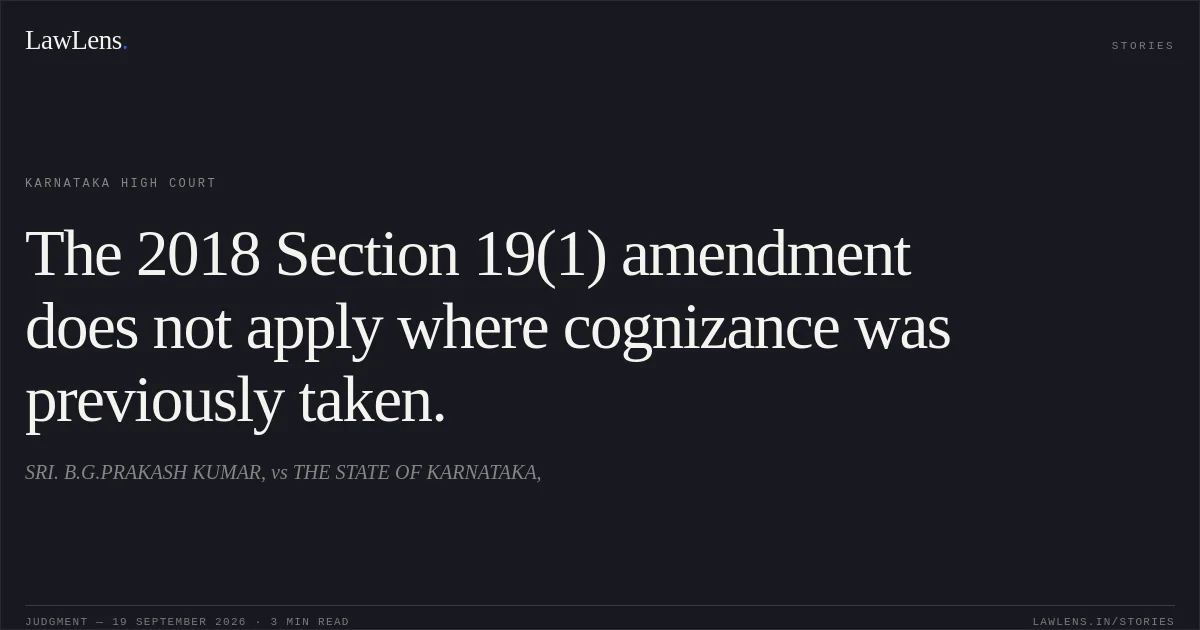
Source reference: pp.23–25, paras.18–20Relying on State of Telangana v. Managipet, (2019) 19 SCC 87, the Court held that the 2018 amendment does not apply to offences and proceedings already instituted before its commencement, and that the absence of sanction is not necessarily a ground for quashing proceedings, particularly since sanction may be produced during trial.
Source reference: pp.18–20, paras.15, 19The Court also relied on S.K. Sinha, Chief Enforcement Officer v. Videocon International Ltd., (2008) 2 SCC 492, regarding the meaning and stage of taking cognizance.
Source reference: pp.10–12, para.7The Court also relied on Hitendra Vishnu Thakur v. State of Maharashtra, (1994) 4 SCC 602, concerning the prospective operation of amendments that create new obligations or disabilities.
Source reference: pp.21–22, para.17Reasoning
The Court found that the petitioner had retired in 2017, but cognizance of the PC Act offences had already been taken in February and May 2018—before Section 19(1) was amended on 26 July 2018.
Source reference: p.15, para.12Although the amended provision would require sanction even for retired public servants in cases where cognizance was yet to be taken after the amendment, it could not retrospectively invalidate cognizance that was validly taken under the law then in force.
Source reference: pp.23–25, paras.18–20The Court distinguished cases where proceedings were initiated without the legally required sanction after the amendment and held that the authorities were not required to obtain sanction for a retired employee in proceedings where cognizance had already been taken before the amendment.
Source reference: pp.16–20, paras.13–19Accordingly, the Trial Court correctly discharged the petitioner from the IPC offences but refused discharge in respect of the PC Act offences.
Source reference: p.25, para.20Holding
The Court answered all three issues against the petitioner.
It held that the 2018 amendment to Section 19(1) of the PC Act did not assist him because cognizance had been taken before 26 July 2018, and no fresh sanction was required merely because he had retired from service.
Source reference: pp.24–25, paras.18–20The Trial Court’s order dated 24 February 2026 was therefore upheld, and all three revision petitions were dismissed.
Source reference: p.26, para.21Acts & Sections Cited
15 provisions across 4 statutes referred to in this judgment. Each provision opens on LawLens.
Code of Criminal Procedure, 19735
Bharatiya Nagarik Suraksha Sanhita, 20232
Prevention of Corruption Act, 19885
Indian Penal Code, 18603
Original Court PDF
SRI. B.G.PRAKASH KUMAR,vsTHE STATE OF KARNATAKA,
Click to open original judgment
Original judgment, available to read, download and summarize on LawLens.in