01Facts
The disputed land, measuring Ac. 16.07 decimals in Mouza-Seriguda, originally belonged to Bidika Jaguli and thereafter devolved upon his three sons, who were members of a Scheduled Tribe and whose names were recorded jointly.
pp. 2–3The vendors applied for permission under Section 3(1) of the Orissa Scheduled Areas Transfer of Immovable Property (By Scheduled Tribes) Regulation, 1956 (“Regulation 2 of 1956”) to sell the land for legal necessity. Permission was granted by the competent authority on 14.09.1995, and the vendors executed a registered sale deed in favour of the petitioner on 06.10.1995 at the rate fixed by the authority.
pp. 2–3Following the 1997 amendment inserting Regulation 3-a(i), the Collector initiated suo motu proceedings in OSATIP Review Petition No. 279 of 2001 on 14.12.2001 and, by order dated 06.06.2003, set aside the earlier permission.
pp. 3–5The petitioner challenged that order under Articles 226 and 227 of the Constitution, contending that the amended provision was prospective and could not be applied to an order passed in 1995.
pp. 3–502Issues
i.1. Whether Regulation 3-a(i), inserted by the 1997 amendment to Regulation 2 of 1956, could be applied to revise an order granting permission passed before the amendment came into force on 27.03.1997.
pp. 7–10 · ¶ 10ii.2. Whether the Collector’s proceeding, though described as a review, was legally exercisable as a revisional proceeding under Regulation 3-a(i).
pp. 10–11 · ¶ 12iii.3. Whether the Collector had jurisdiction to reopen and set aside the permission granted on 14.09.1995.
p. 11 · ¶ 1303Law Applied
The Court applied Regulation 2 of 1956 and Regulation 3-a(i), inserted by Amending Regulation No. 1 of 1997, which permits the competent higher authority to revise an order passed under Regulation 3(1) or 3(2) within five years from the date of that order, after giving the concerned parties a reasonable opportunity of hearing.
p. 9The Court relied on the general principle that an amendment operates prospectively unless retrospective operation is expressly provided or necessarily implied.
pp. 8–9It also relied on Jami Ramesh v. State of Odisha, 2019 (II) OLR 94, where the Division Bench held that an amendment to the Regulation applies prospectively and does not affect transactions completed before its publication.
pp. 8–9The Court further distinguished review from revision: review is ordinarily exercised by the same authority or court that passed the order, whereas revision is exercised by a superior authority; the substance of the Collector’s action, rather than its erroneous description as “review,” determines its legal character.
pp. 10–11Provisions in the judgment · 4
OSATIP Regulation, 1956 Section 3
OSATIP Amendment Regulation, 1996 Section 3A
OSATIP Amendment Regulation, 1997 Section 3B
OSATIP Amendment Regulation, 2000 Section 3B
04Reasoning
The permission and consequent sale were completed in 1995, whereas Regulation 3-a(i) came into force only upon publication of the 1997 amendment on 27.03.1997.
pp. 7–10Although the provision uses the expression “any order,” the Court held that, read in the context of the prospective amendment, it could refer only to orders passed after the amendment and not to pre-amendment orders.
pp. 8–10 · ¶ 11Applying the principle in Jami Ramesh, the Court rejected the argument that the amendment could be prospective while the phrase “any order” operated retrospectively.
pp. 8–10 · ¶ 11The Collector’s proceeding was substantively a revision because it was undertaken by the higher authority, notwithstanding its description as a review.
pp. 10–11 · ¶ 12However, that characterization did not cure the fundamental jurisdictional defect: Regulation 3-a(i) did not authorize the Collector to reopen the 1995 permission.
p. 11 · ¶ 13–14Consequently, the merits of the Collector’s findings—including alleged procedural irregularities in the original permission—did not require examination.
p. 11 · ¶ 13–1405Holding
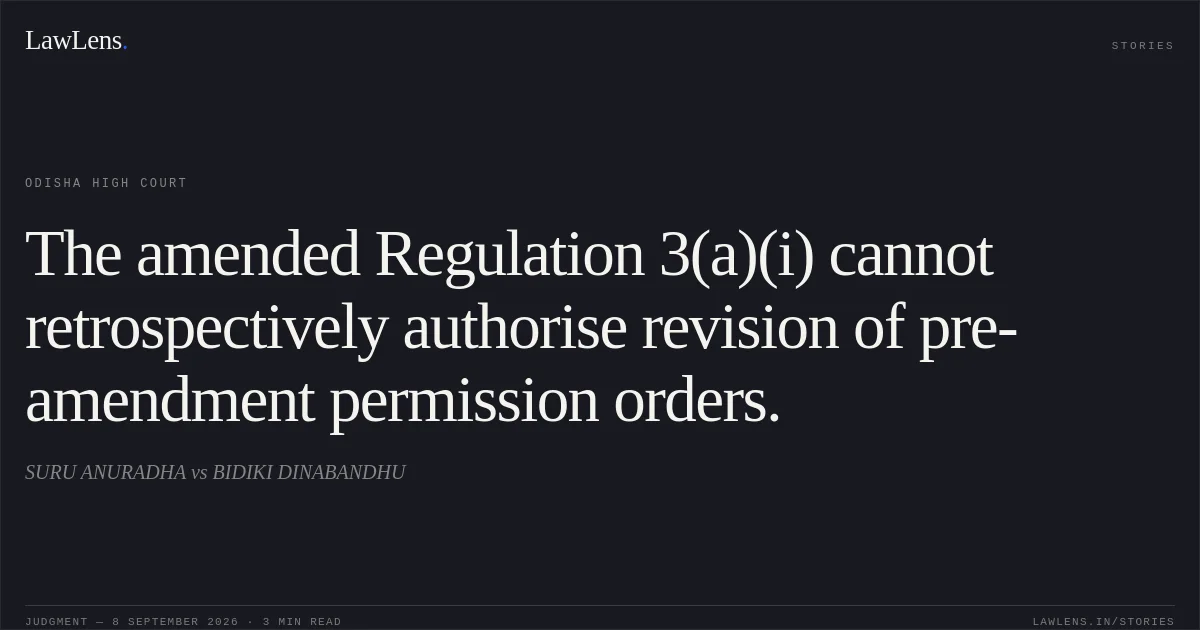
The Court held that Regulation 3-a(i) of Regulation 2 of 1956 was prospective and could not be invoked to revise or reopen the permission granted on 14.09.1995, which preceded the amendment’s commencement on 27.03.1997.
pp. 9–11 · ¶ 13The Collector therefore acted without jurisdiction in setting aside the permission.
pp. 9–11 · ¶ 13The writ petition was allowed, the Collector’s impugned order dated 06.06.2003 was quashed and set aside, and no determination on the correctness of the original permission was considered necessary.
p. 12 · ¶ 14–15Original Court PDF
SURU ANURADHAvsBIDIKI DINABANDHU
Click to open original judgment
Original judgment, available to read, download and summarize on LawLens.in