Facts
The appellant’s 1 MW solar project was allotted under a 2014 RFP, and a PPA was executed with PSPCL in 2015.
Source reference: p. 2–4After the project missed its scheduled commissioning date, the Punjab State Electricity Regulatory Commission refused to extend the date and reduced the tariff by its order dated 14 February 2017.
Source reference: p. 2–4The Commission later allowed the appellant’s review petition and extended the commissioning date; however, APTEL set aside that review order on 28 August 2024, thereby restoring the 2017 order.
Source reference: p. 2–4The appellant filed the present appeal against the 2017 order on 7 July 2025 and sought condonation of delay.
Source reference: p. 2–4The Tribunal separately condoned the delay in refiling
Source reference: p. 2–4Issues
1. Whether the delay in filing the appeal against the Commission’s order dated 14 February 2017 should be reckoned from the date of that order or from 28 August 2024, when APTEL set aside the review order and restored it
Source reference: p. 4–52. Whether the delay, reckoned from 28 August 2024, should be condoned despite the appellant’s explanation being challenged as insufficient by the respondents
Source reference: p. 5–6Law Applied
The Tribunal applied the principle that delay may be condoned where sufficient cause is shown, while considering whether the delay was deliberate or contumacious.
Source reference: p. 5–6It noted its consistent practice of condoning delays of up to one year in filing appeals, ordinarily subject to costs, to avoid denying litigants an opportunity to have a statutory first appeal decided on its merits.
Source reference: p. 5–6The respondents relied on P.K. Ramachandran v. State of Kerala, (1997) 7 SCC 556; Baswaraj v. Special Land Acquisition Officer, (2013) 14 SCC 81; State of Madhya Pradesh v. Ram Kumar Chaudhary, 2024 SCC OnLine SC 3612; and Sushil Kumar Sen v. State of Bihar, (1975) 1 SCC 774, in support of their opposition to condonation.
Source reference: p. 5The Tribunal did not set out or separately apply the specific holdings of those authorities.
Source reference: p. 5Reasoning
The Tribunal reasoned that, while the Commission’s 2017 order was under challenge in the review proceedings, the review order extending the commissioning date remained in force and addressed the appellant’s grievance.
Source reference: p. 4–5The occasion to challenge the 2017 order therefore arose only when APTEL set aside the review order on 28 August 2024.
Source reference: p. 4–5Reckoning from that date, the Tribunal treated the delay as 332 days.
Source reference: p. 5–6Although the respondents argued that the appellant had notice of the judgment and that internal deliberations and legal opinions did not establish sufficient cause, the Tribunal considered that the delay was within one year, was not shown to be deliberate or contumacious, and could be addressed by imposing costs.
Source reference: p. 5–6Holding
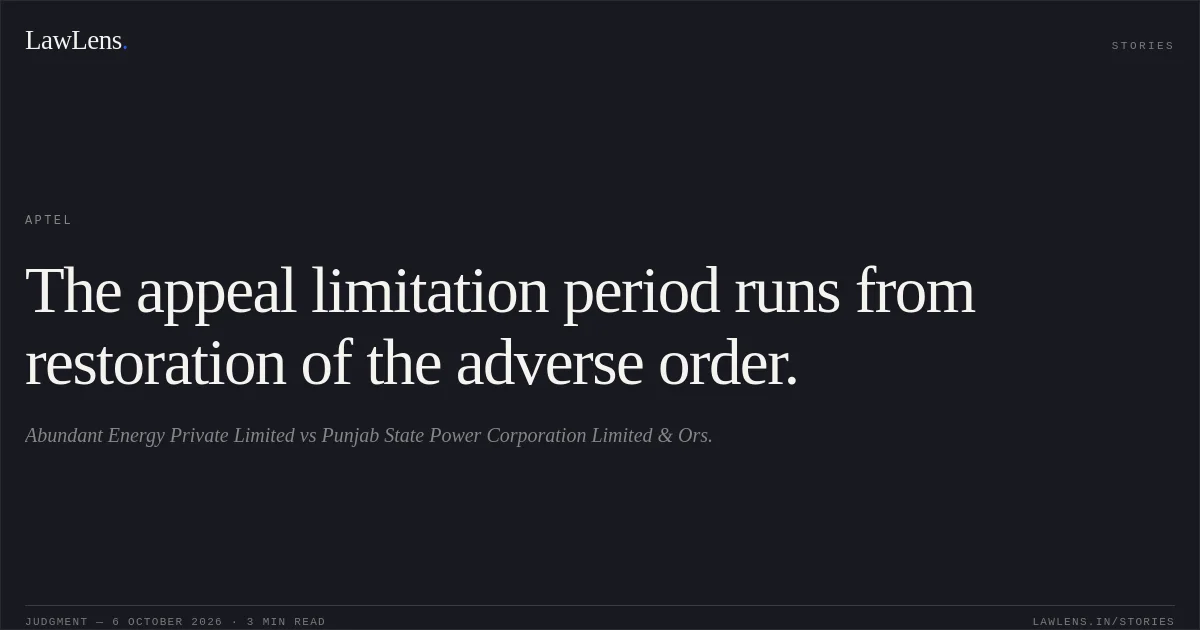
The Tribunal held that the delay in filing the appeal should be reckoned from 28 August 2024 and condoned the 332-day delay, subject to the appellant depositing costs of ₹1.5 lakh with CTUIL within three weeks and filing proof of payment within the following two weeks.
The Tribunal directed that, if the costs were not paid and proof not filed within the stipulated periods, the condonation application would stand dismissed and the appeal rejected.
Source reference: p. 6–7The respondents were directed to file their replies within four weeks, with the appellant’s rejoinder due within two weeks thereafter; the matter was listed for 18 November 2026.
Source reference: p. 6–7Original Court PDF
Abundant Energy Private LimitedvsPunjab State Power Corporation Limited & Ors.
Click to open original judgment
Original judgment, available to read, download and summarize on LawLens.in