Facts
The appellant challenged, under Section 14-A(2) of the Scheduled Castes and the Scheduled Tribes (Prevention of Atrocities) Act, 2015, the order dated 02.07.2026 by which the Special Judge under the SC/ST Atrocities Act, Mandaleshwar, rejected his bail application in SC ATR No. 06/2025.
Source reference: para. 1The case arose from Crime No. 303/2024 registered at Police Station Sanawad, District Khargone, for offences under Sections 103(1), 238(a) and 61(2)(a) of the Bharatiya Nyaya Sanhita, 2023, and Section 3(2)(v) of the SC/ST Act.
Source reference: para. 2According to the prosecution, the main accused, Sheikh Javed, and his associates took the deceased, Kishore Bhau, to Omkareshwar on 27.09.2024 on the pretext of taking his money. The deceased was allegedly blinded with red chilli powder, strangled with a clutch wire, and thereafter his body was taken towards Binjalwada and burnt to conceal his identity. The prosecution further alleged that ₹10 lakhs was looted.
Source reference: paras. 3–4The FIR was initially registered against unidentified persons, but the investigation subsequently implicated the appellant and other accused persons.
Source reference: para. 5The appellant’s earlier bail applications and appeals had been dismissed or withdrawn with liberty to renew the prayer in accordance with law.
Source reference: paras. 6–7Before the High Court, the appellant claimed false implication, absence of incriminating evidence, an alibi, completion of investigation, and responsibility as the sole breadwinner of his family. He also undertook not to abscond or influence prosecution witnesses.
Source reference: paras. 8–10The State and the objector opposed bail on the basis of the gravity and brutal nature of the alleged offence and the destruction of evidence by burning the body.
Source reference: para. 11Issues
1. Whether the Special Judge’s order refusing bail to the appellant suffered from any illegality, impropriety, or incorrectness warranting interference under Section 14-A(2) of the SC/ST Act.
Source reference: para. 122. Whether, considering the gravity of the alleged murder, the manner of commission, the alleged looting, and the destruction of evidence, the appellant was entitled to regular bail during trial.
Source reference: paras. 13–14Law Applied
Section 14-A(2) of the Scheduled Castes and the Scheduled Tribes (Prevention of Atrocities) Act, 2015 provides the statutory basis for an appeal against an order granting or refusing bail, requiring the High Court to examine the legality, propriety, and correctness of the Special Judge’s order.
Source reference: para. 12The Court also considered the offences alleged under Sections 103(1), 238(a), and 61(2)(a) of the Bharatiya Nyaya Sanhita, 2023, and Section 3(2)(v) of the SC/ST Act.
Source reference: para. 2In determining bail, the Court applied the principle that the gravity and seriousness of the allegations, the alleged manner of commission, and the circumstances indicating destruction of evidence are relevant considerations against the grant of bail.
Source reference: paras. 11, 13–14Reasoning
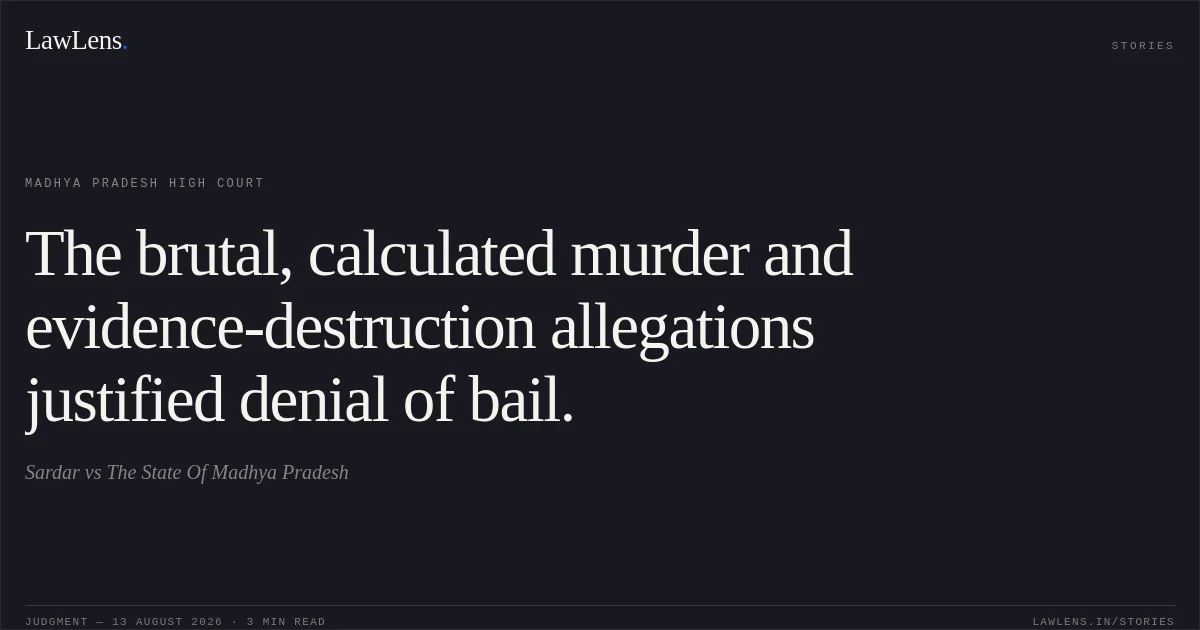
The High Court acknowledged the appellant’s submissions regarding false implication, alibi, absence of pending recovery, and completion of investigation, but found the prosecution allegations to be exceptionally grave.
Source reference: paras. 8–10, 13The alleged offence involved a calculated murder in which the victim was blinded, strangled, and subsequently burnt to destroy evidence, alongside the alleged looting of ₹10 lakhs.
Source reference: paras. 3–4, 13Applying the statutory appellate standard under Section 14-A(2), the Court held that the Special Judge had properly considered the relevant facts and that the refusal of bail disclosed no legal infirmity.
Source reference: paras. 12, 14The seriousness and brutal execution of the alleged crime outweighed the appellant’s personal circumstances and other grounds advanced in support of bail.
Source reference: paras. 13–14Holding
The Court answered the issues against the appellant. It held that the order refusing bail was legally proper and did not warrant appellate interference under Section 14-A(2) of the SC/ST Act.
The criminal appeal was dismissed, and the order dated 02.07.2026 passed by the Special Judge under the SC/ST Atrocities Act, Mandaleshwar, rejecting IA No. 06/2026 in SC ATR No. 06/2025, was affirmed.
Source reference: para. 15Acts & Sections Cited
3 provisions across 1 statute referred to in this judgment. Each provision opens on LawLens.
Bharatiya Nyaya Sanhita, 20233
Original Court PDF
SardarvsThe State Of Madhya Pradesh
Click to open original judgment
Original judgment, available to read, download and summarize on LawLens.in