Facts
The Respondent-Union filed a complaint (ULP No. 146/2019) under the MRTU & PULP Act, 1971, challenging disciplinary proceedings initiated by the Appellant-employer against certain employees
Source reference: para. 3The Appellant filed an objection (Exhibit C/8) contending that the employees were not "workmen" under Section 2(s) of the Industrial Disputes (ID) Act, 1947, rendering the complaint non-maintainable
Source reference: para. 3The Industrial Court initially rejected the objection and refused to frame a preliminary issue
Source reference: para. 3On challenge, the High Court directed the Industrial Court to frame a preliminary issue but phrased it in a manner that appeared to cast the burden of proof on the employer to prove the employees were covered by the ID Act
Source reference: para. 4The employer appealed, arguing this inversion of the burden of proof was legally erroneous
Source reference: para. 5Issues
1. Whether the High Court erred in its phrasing of the preliminary issue by ostensibly casting the burden of proof on the employer to establish the status of the employees as "workmen"
Source reference: para. 62. Whether the disciplinary proceedings initiated by the employer could continue pending the adjudication of the preliminary issue
Source reference: para. 13Law Applied
the principle of Ei incumbit probation qui dicit, non qui negat (the burden of proof lies on the one who asserts, not on the one who denies), as embodied in Section 104 of the Bharatiya Sakshya Adhiniyam, 2023 (formerly Section 101 of the Indian Evidence Act, 1872)
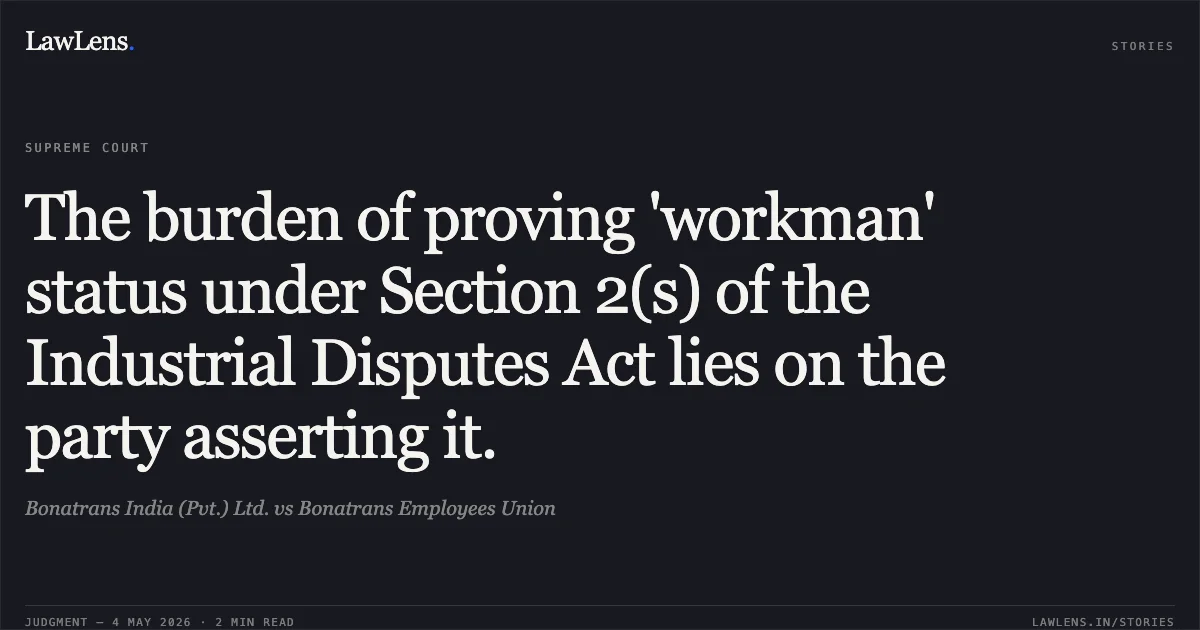
Source reference: para. 7In industrial law, when an employer challenges the status of a complainant, the burden lies on the claimant/Union to prove they meet the definition of a "workman" under Section 2(s) of the Industrial Disputes Act, 1947, to invoke the jurisdiction of the Industrial Court
Source reference: para. 8-9Reasoning
The Supreme Court observed that while the High Court’s phrasing in paragraph 11(a) was imprecise and "ostensibly incorrect," it was a result of inadvertent phrasing rather than a misunderstanding of law
Source reference: para. 6, 9The Court noted that the Union had itself agreed to have the status decided as a preliminary issue
Source reference: para. 9The Court clarified that since the Union asserts the right to relief under labor statutes, it is the Union’s cardinal responsibility to prove the jurisdictional fact—that the employees are indeed "workmen"
Source reference: para. 8If the Union fails to discharge this burden, the complaint must be dismissed for lack of jurisdiction
Source reference: para. 8Consequently, the Court found it necessary to modify the phrasing of the issue to correctly reflect that the burden of proof lies on the "complainant-union"
Source reference: para. 11Holding
The Supreme Court allowed the appeals in part, modifying the High Court's order to correctly frame the issue: "Whether the complainant-union proves that the employees... are covered by the definition of workman under Section 2(s) of the ID Act?"
The Court directed the Industrial Court to decide this as a preliminary issue by October 31, 2026
Source reference: para. 12the employer may conclude the enquiries; however, final orders can only be passed immediately if the preliminary issue is decided against the Union. If decided in favor of the Union, the employer must seek permission from the Industrial Court before passing final disciplinary orders
Source reference: para. 13Acts & Sections Cited
1 provisions across 1 statute referred to in this judgment. Each provision opens on LawLens.
Bharatiya Sakshya Adhiniyam, 20231
Original Court PDF
Bonatrans India (Pvt.) Ltd.vsBonatrans Employees Union
Click to open original judgment
Original judgment, available to read, download and summarize on LawLens.in