Facts
Manoj Kumar, son of the appellant Kailash Rai, sustained injuries during an incident at Gokal Puri, Delhi, on 7 September 2009 and died at GTB Hospital on 8 September 2009.
Source reference: paras. 2–4The respondents were prosecuted under Sections 302/34 IPC and were acquitted by the Trial Court on 23 March 2012 due to material contradictions in the prosecution evidence, doubts regarding the investigation and recoveries, and the absence of reliable eyewitness testimony.
Source reference: paras. 6–7The appellant, father of the deceased, preferred the present appeal against acquittal. During the pendency of the appeal, he twice stated that he did not wish to pursue it.
Source reference: paras. 8–10The respondents nevertheless questioned its maintainability, contending that the complainant was the deceased’s brother and not the appellant.
Source reference: para. 11Issues
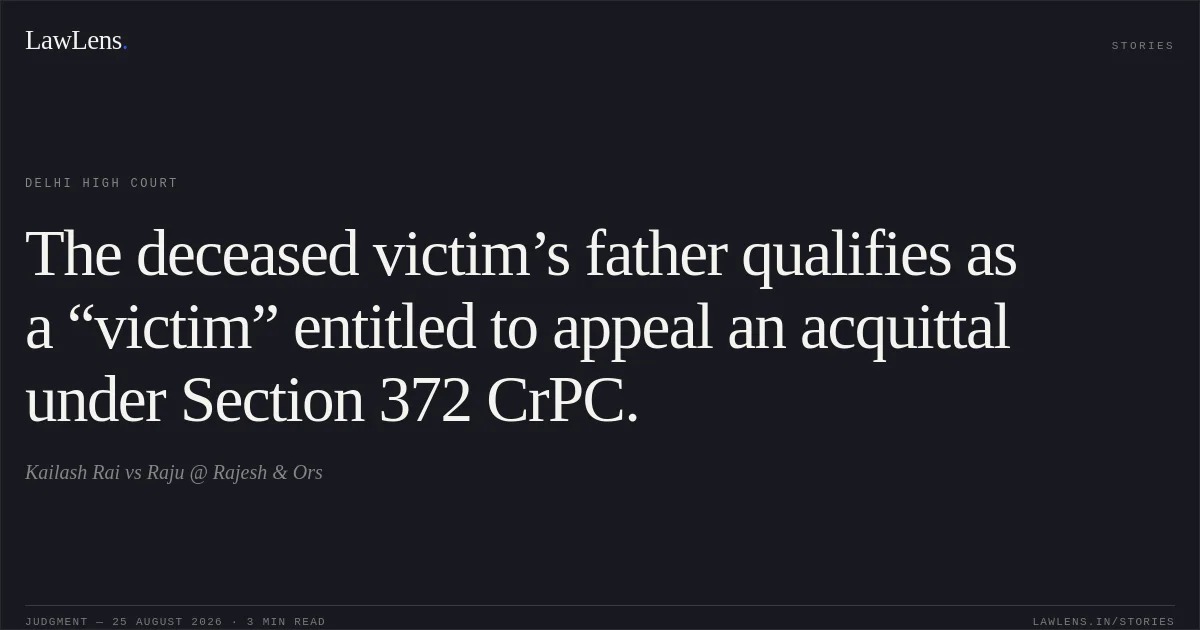
1. Whether the appellant, being the father and legal heir of the deceased, qualified as a “victim” entitled to maintain an appeal against acquittal under the proviso to Section 372 read with Section 2(wa) CrPC.
Source reference: paras. 11–142. Whether, notwithstanding the appellant’s stated unwillingness to pursue the appeal, the Trial Court’s acquittal warranted interference in light of the contradictory and improved prosecution evidence.
Source reference: paras. 15–18Law Applied
The Court applied the proviso to Section 372 CrPC, which confers upon a victim a right to appeal against an order of acquittal to the court to which an appeal ordinarily lies against conviction.
Source reference: para. 12Section 2(wa) CrPC defines “victim” as a person suffering loss or injury by reason of the act or omission charged, and expressly includes the victim’s guardian or legal heir.
Source reference: para. 13Relying on Khem Singh (D) Through LRs v. State of Uttaranchal, 2025 INSC 1024, the Court held that “loss” and “injury” must receive a broad interpretation, encompassing physical, mental, financial and legal injury, and that the definition of victim is inclusive in nature.
Source reference: para. 14The prosecution was required to establish the respondents’ guilt under Sections 302/34 IPC beyond reasonable doubt; material contradictions, substantial improvements, unreliable eyewitness testimony and investigative defects entitle the accused to the benefit of doubt.
Source reference: paras. 7, 16–17Reasoning
The Court held that the appellant was the deceased’s father and legal heir and had suffered loss by reason of his son’s death. He therefore fell within the statutory definition of “victim,” making the appeal maintainable despite the respondents’ objection that the complainant was the deceased’s brother.
Source reference: para. 14On merits, however, PW-1 and PW-2 had initially categorically stated that they had not witnessed anyone assaulting the deceased and that the incident had not occurred in their presence.
Source reference: para. 15Their subsequent versions, attributing the earlier testimony to threats, contained numerous contradictions and improvements. The Trial Court found that no contemporaneous complaint regarding the alleged threats had been made to the Court, police, prosecutor or any other authority, and that the prosecution had no other reliable eyewitness or developed circumstantial case.
Source reference: paras. 16–17The High Court also noted the Trial Court’s findings concerning doubtful recoveries, failure to associate public witnesses, inconsistencies in the preparation of the site plan and investigation documents, and medical evidence suggesting that one injury could have resulted from a vehicle accident or other blunt-force impact.
Source reference: para. 7These circumstances created reasonable doubt, and the appellant’s repeated statement that he did not wish to pursue the appeal further reinforced the absence of grounds for interference.
Source reference: para. 18Holding
The appeal was held maintainable because the appellant, as the deceased’s father and legal heir, was a “victim” under Sections 372 and 2(wa) CrPC.
Nevertheless, the Court found no basis to disturb the respondents’ acquittal, as the prosecution evidence was materially inconsistent and insufficient to establish guilt beyond reasonable doubt.
Source reference: para. 19In view of the unreliable testimony, investigative deficiencies and the appellant’s express unwillingness to press the appeal, the appeal and all pending applications were dismissed.
Source reference: para. 19Acts & Sections Cited
9 provisions across 2 statutes referred to in this judgment. Each provision opens on LawLens.
Indian Penal Code, 18603
Code of Criminal Procedure, 19736
Original Court PDF
Kailash RaivsRaju @ Rajesh & Ors
Click to open original judgment
Original judgment, available to read, download and summarize on LawLens.in
![Courts will not interfere with transfers absent mala fides or violation of statutory rules.. M Ramya vs EMPLOYEES STATE INSURANCE CORPORATION (ESIC). CAT - ['Chennai']. LawLens](/stories/thumbnails/courts-will-not-interfere-with-transfers-absent-mala-fides-or-violation-of-statutory-rules-a6845e9ca6f548fca284c51c8351957f.webp)
![Courts cannot direct one-time recruitment age relaxation absent authority in the governing rules or advertisement.. UT OF PUDUCHERRY vs M ANDAL. CAT - ['Chennai']. LawLens](/stories/thumbnails/courts-cannot-direct-one-time-recruitment-age-relaxation-absent-authority-in-the-governing-895d78fde47143e2a8ed0207c4b6a44f.webp)
![A review cannot correct an allegedly erroneous decision absent an error apparent on the record.. Ajit Kumar Jha vs RAILWAY BOARD. CAT - ['Delhi']. LawLens](/stories/thumbnails/a-review-cannot-correct-an-allegedly-erroneous-decision-absent-an-error-apparent-on-the-re-8ac952fd4eba470c92f7da20af72a220.webp)