Facts
The petitioners, power-generating companies, draw electricity from TNPDCL intermittently to start their generating units.
Source reference: no citationTNPDCL’s circular dated 1 August 2026 directed that start-up power be billed under the two-part HT-I tariff from July 2025, with arrears to be recovered after adjustment of amounts already paid under a single-part tariff.
Source reference: pp. 11–12The tariff issue remained pending before TNERC following appellate remands, and earlier writ proceedings had permitted payment at 125% of temporary-supply energy charges pending TNERC’s decision.
Source reference: pp. 12–13, 18–20The petitioners challenged the circular and related bills, seeking interim protection against recovery under the two-part tariff.
Source reference: pp. 7–10Issues
Whether TNPDCL could enforce the two-part tariff under its 1 August 2026 circular while the applicable start-up-power tariff remained pending determination by TNERC.
Source reference: pp. 29–30, 33–34Whether interim protection should be granted against coercive recovery, and, if so, on what payment conditions pending TNERC’s decision.
Source reference: pp. 30–35Law Applied
Sections 62 and 64 of the Electricity Act, 2003, place tariff determination within the regulatory framework administered by the appropriate Electricity Regulatory Commission; the parties accepted that the start-up-power tariff was for TNERC/APTEL to determine.
Source reference: p. 29The Court also considered the operative tariff framework, including TNERC’s Tariff Order No. 7 of 2022, which TNPDCL relied on to support a two-part tariff, and the subsequent tariff orders and appellate remands that left the issue pending.
Source reference: pp. 22–23, 26–27, 33–34The Court did not finally decide which tariff was legally applicable; it fashioned interim payment and recovery arrangements pending regulatory determination.
Source reference: pp. 30–35Reasoning
The Court noted that repeated remands had left the tariff dispute unresolved and that the competing positions—TNPDCL’s reliance on the 2022 tariff order and the generators’ reliance on the single-part approach—required determination by TNERC and, where appropriate, APTEL.
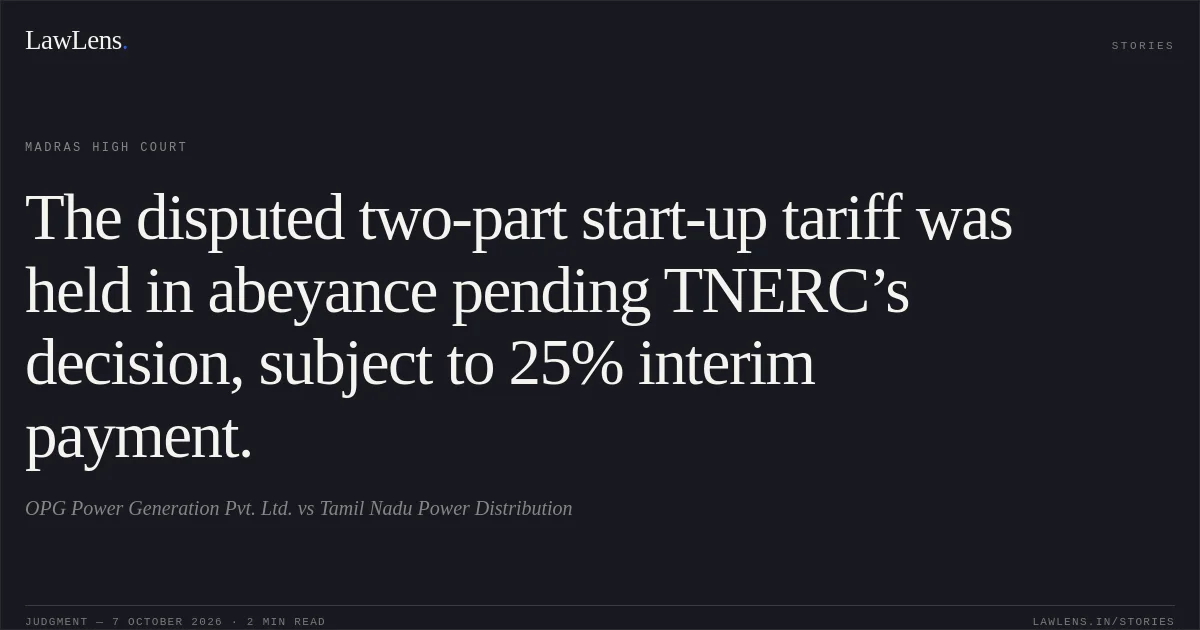
Source reference: pp. 29–30, 33–34Rather than finally quash the circular or determine the tariff itself, the Court kept it in abeyance and balanced the parties’ interests through interim payment conditions.
Source reference: pp. 32–35It also directed TNERC to hear the connected matters together and decide them on merits, observing that the dispute should not continue to be prolonged through further remands.
Source reference: pp. 32–35Holding
The writ petitions were ordered in part.
TNERC was directed to take up the connected start-up-power matters together, hear the parties, and decide them on merits within eight weeks of receiving the web copy of the order.
Source reference: pp. 34–35Pending that decision, no coercive steps, adjustment, or retention of dues may be taken if the petitioners have paid 50% of the demand for the period from 2013 through December 2023, the single-part tariff at 125% of temporary-supply energy charges from January 2024 through July 2026, and 25% of the two-part tariff demanded from August 2026 onward.
Source reference: p. 35The circular dated 1 August 2026 was kept in abeyance until TNERC’s decision; connected miscellaneous petitions were closed, with no order as to costs.
Source reference: p. 35Acts & Sections Cited
5 provisions across 1 statute referred to in this judgment. Each provision opens on LawLens.
Electricity Act, 20035
Original Court PDF
OPG Power Generation Pvt. Ltd.vsTamil Nadu Power Distribution
Click to open original judgment
Original judgment, available to read, download and summarize on LawLens.in