Facts
The petitioners, manufacturers and managers of "Tapan Milk Products," were prosecuted under Sections 7(i), 7(ii), and 7(v) of the Prevention of Food Adulteration Act (PFA), 1954.
Source reference: p. 3-4On December 1, 2010, food inspectors seized samples of "Deep Classic Mild Fat," which were later analyzed and found to contain prohibited flavoring substances and vegetable fat admixtures, leading the respondent to file complaints alleging food was "adulterated" and "misbranded".
Source reference: p. 4, para 6The Trial Court (Special Judicial Mobile Magistrate, Jammu) took cognizance and issued process against the petitioners in early 2011.
Source reference: p. 3, para 1The petitioners challenged these proceedings, arguing that since the Food Safety and Standards Act (FSSA), 2006 had been fully notified on July 29, 2010, the older PFA was no longer applicable to the alleged offense.
Source reference: p. 3-4Issues
1. Whether the proceedings initiated under the PFA, 1954 were legally sustainable given the notification and overriding effect of the FSSA, 2006 at the time of the alleged offense.
Source reference: p. 4, para 3; p. 5, para 82. Whether Section 89 of the FSSA, 2006 overrides the penal provisions of the PFA, 1954 in cases of inconsistency, specifically regarding "sub-standard" or "misbranded" food.
Source reference: p. 8, para 14-15Law Applied
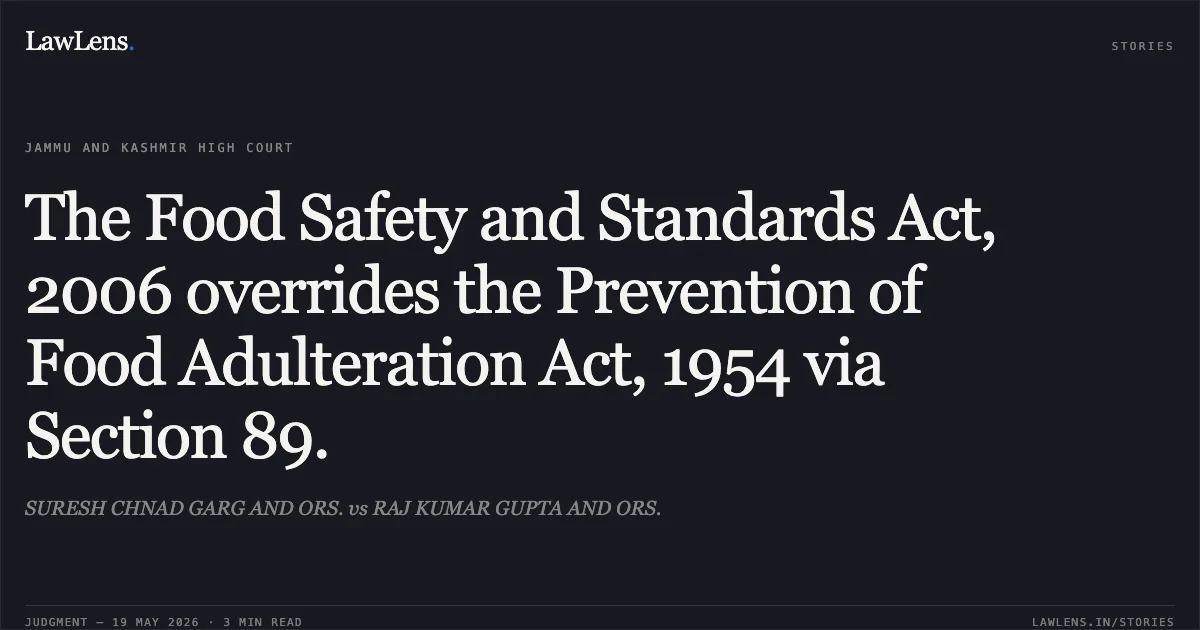
The court primarily applied Section 89 of the Food Safety and Standards Act (FSSA), 2006, which contains an overriding clause stating the Act prevails over any inconsistent laws for the time being in force.
Source reference: p. 5, para 7It relied on the definitions of "sub-standard" food under Section 3(1)(zx) and "misbranded" food under Section 3(i)(zf) of the FSSA.
Source reference: p. 7, para 10-12The court applied Sections 51 and 52 of the FSSA, which prescribe civil penalties for such violations rather than the criminal imprisonment mandated by Section 16 of the PFA.
Source reference: p. 8, para 13The court followed the precedent in Manik Hiru Jhangiani v. State of M.P. (2023 INSC 1078), which established that FSSA provisions override PFA to avoid double jeopardy under Article 20(2) of the Constitution.
Source reference: p. 8, para 14Reasoning
The court determined that while the PFA was formally repealed only on August 5, 2011, Section 89 (overriding effect) and the penalty provisions (Sections 51 and 52) of the FSSA were notified and operational on July 29, 2010—prior to the date of the alleged offense (December 1, 2010).
Source reference: p. 4, 8The court noted that the allegations regarding flavoring substances and admixtures fell under the "sub-standard" category of the FSSA, as the analyst's report did not suggest the product was injurious to health.
Source reference: p. 7, para 10Since the PFA mandates imprisonment (Section 16) while the FSSA mandates only a monetary penalty (Sections 51-52) for the same conduct, an irreconcilable inconsistency exists.
Source reference: p. 8-9Applying the Manik Hiru Jhangiani precedent, the court reasoned that the FSSA must prevail; therefore, the petitioners could not be prosecuted under the criminal provisions of the PFA when the FSSA provided a specific statutory framework for penalties at the time of the incident.
Source reference: p. 9, para 14-15Holding
The court answered that prosecution under the PFA, 1954 was legally impermissible because the FSSA, 2006 had overriding effect at the time of the offense.
The court held that where an act constitutes an offense under both statutes but results in inconsistent punishments (imprisonment vs. penalty), Section 89 of the FSSA dictates that the FSSA prevails.
Source reference: p. 9, para 18The High Court allowed both petitions and quashed the criminal complaints and the Trial Court orders dated January 29, 2011 and December 28, 2010, effectively dismissing the proceedings.
Source reference: p. 9-10Acts & Sections Cited
6 provisions across 1 statute referred to in this judgment. Each provision opens on LawLens.
Food Safety and Standards Act, 20066
Original Court PDF
SURESH CHNAD GARG AND ORS.vsRAJ KUMAR GUPTA AND ORS.
Click to open original judgment
Original judgment, available to read, download and summarize on LawLens.in