01Facts
The petitioner sought to quash proceedings in C.C. No. 58/2026, arising from Crime No. 4/2026 of the CEN Police Station, Bagalkot, for alleged offences under Sections 66(d) and 67 of the Information Technology Act, 2000, and Sections 78(2), 294 and 238 of the Bharatiya Nyaya Sanhita, 2023.
p. 2The complaint alleged that vulgar messages had been sent from three Instagram accounts allegedly operated by the petitioner; the joint memo disputed that the petitioner was the user or sender.
p. 3After the parties reached a voluntary settlement, they jointly sought compounding and quashing, supported by affidavits; the State was represented before the Court.
pp. 2–502Issues
i.Whether the High Court could quash the criminal proceedings for alleged non-compoundable offences in exercise of its inherent jurisdiction, given the parties’ settlement.
p. 2, 4ii.Whether, in the circumstances of this case, continuation of the prosecution would amount to an abuse of process or would be unnecessary in the interests of justice.
pp. 4, 11–1203Law Applied
The Court considered its inherent jurisdiction under Section 482 of the Code of Criminal Procedure, corresponding to Section 528 of the Bharatiya Nagarik Suraksha Sanhita, 2023, and distinguished that power from the statutory power to compound offences under Section 359 of the BNSS.
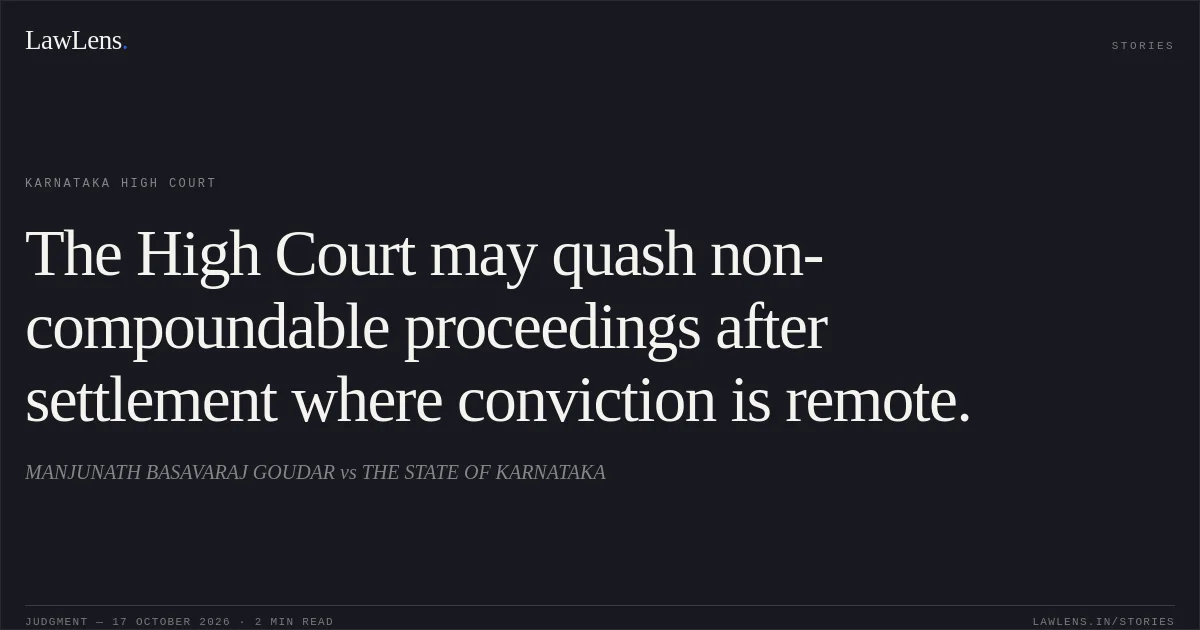
p. 2, 4, 6Relying on Narinder Singh v. State of Punjab, (2014) 6 SCC 466, the Court applied the principle that non-compoundable proceedings may nevertheless be quashed on settlement where doing so would secure the ends of justice or prevent abuse of process; the power must be exercised cautiously, with attention to the nature of the offence, the likelihood of conviction, and the stage of proceedings.
pp. 6–11Provisions in the judgment · 13 · Linked ones open on LawLens
Code of Criminal Procedure, 1973 Section 482Section 320
Bharatiya Nagarik Suraksha Sanhita, 2023 Section 528Section 359
Information Technology Act, 2000 Section 66Section 67
Bharatiya Nyaya Sanhita, 2023 Section 78Section 294Section 238
Indian Penal Code, 1860 Section 307Section 324Section 323Section 34
04Reasoning
The Court accepted that the dispute had been amicably resolved through a voluntary settlement, supported by the parties’ joint application and affidavits.
pp. 3–5, 11It considered the parties’ intention to live peacefully, the unclear role attributed to the petitioner, and the apparent lack of a clear direct nexus between him and the alleged messages. It concluded that the likelihood of conviction was remote and that continuing the prosecution would be unnecessary and an abuse of process.
pp. 4, 11–12Although the offences were non-compoundable, the Court held that the circumstances justified invoking its inherent jurisdiction to quash the proceedings.
p. 405Holding
The Court allowed the criminal petition, accepted the compromise, and quashed the entire proceedings in C.C. No. 58/2026, arising from Crime No. 4/2026, for the offences under Sections 66(d) and 67 of the Information Technology Act, 2000, and Sections 78(2), 294 and 238 of the BNS, 2023.
pp. 12–13Pending interlocutory applications were disposed of.
p. 13Original Court PDF
MANJUNATH BASAVARAJ GOUDARvsTHE STATE OF KARNATAKA
Click to open original judgment
Original judgment, available to read, download and summarize on LawLens.in