Facts
The appellants and respondents 6-8 are the children of the deceased, Mary, who died on 23/02/2026
Source reference: p. 3Following her death, respondents 5 to 7 (son-in-law and two daughters) delivered Mary’s body to Government Medical College, Kalamassery, for anatomical purposes, claiming it was her wish
Source reference: p. 3The appellants, asserting they had not consented, sought a writ of mandamus for the release of the body to perform religious last rites
Source reference: p. 4Respondents 5 to 7 produced a written consent letter, Ext.R5(a), executed by the deceased under Section 4A of the Kerala Anatomy Act, 1957
Source reference: p. 4The learned Single Judge dismissed the writ petition, holding that the explicit intention of the deceased superseded the desires of the other legal heirs
Source reference: p. 4-5The appellants challenged this via the present Writ Appeal.
Source reference: no citationIssues
1. Whether the expressed wish of a deceased person to donate their body for medical education under the Kerala Anatomy Act overrides the rights of legal heirs to claim the body for religious burial.
Source reference: p. 5 / para. 3Law Applied
Section 4A of the Kerala Anatomy Act, 1957, which provides for the donation of a body if a person has expressed an unequivocal request during their lifetime for anatomical dissection
Source reference: p. 7The jurisprudential principle of "posthumous bodily integrity," as discussed in Salmond on Jurisprudence, which recognizes that the law takes account of a person's desires regarding their own body after death
Source reference: p. 5-6The statutory framework for organ and body donation, such as the Transplantation of Human Organs Act, 1994, which prioritizes the deceased’s autonomy
Source reference: p. 6Reasoning
The Court balanced two competing interests: the posthumous bodily integrity of the deceased and the family’s right to closure
Source reference: p. 5Drawing from Salmond, the Court noted that while a person’s personality ceases at death, the law recognizes their pre-death interests in their body, reputation, and estate
Source reference: p. 6The Court reasoned that the right of a living person to decide the fate of her body is a facet of bodily integrity that must be honored
Source reference: p. 6Since the appellants did not challenge the genuineness of the consent letter (Ext.R5(a)) executed by the mother under Section 4A of the Kerala Anatomy Act, the Court found that the hospital and the contesting respondents acted legally in honoring those wishes
Source reference: p. 7The Court held that the "mere desire" of the children cannot overcome the "explicit expression of intention" by the deceased during her lifetime
Source reference: p. 4, 7Holding
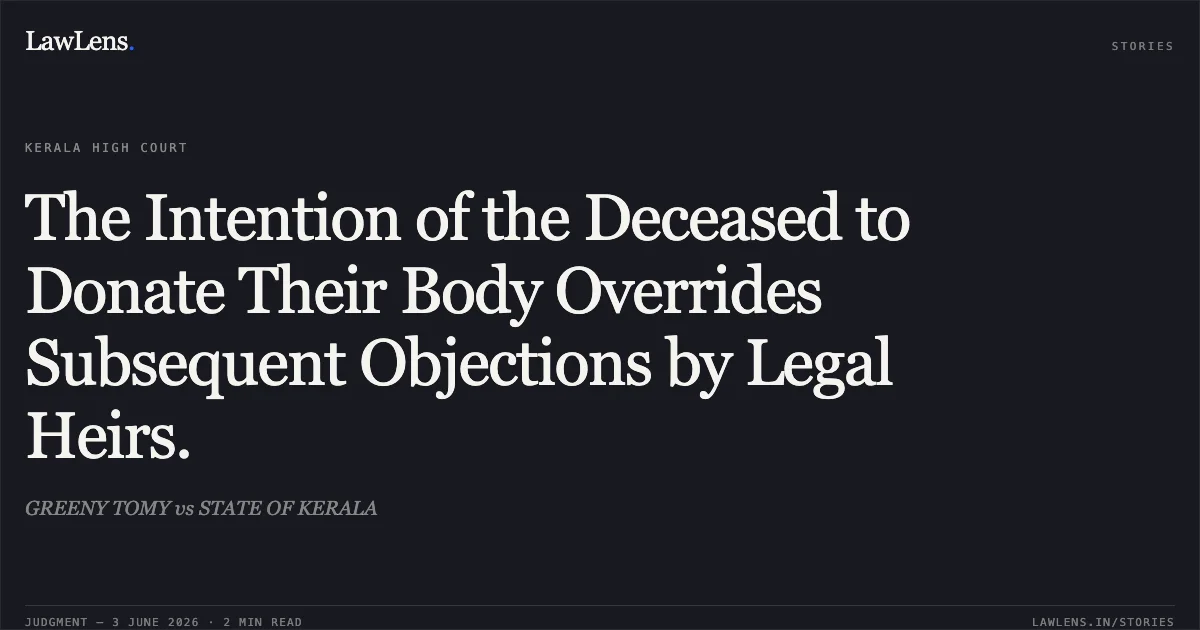
The Court answered the issue in the affirmative, holding that the deceased's unequivocal request to donate her body for anatomical purposes under Section 4A of the Kerala Anatomy Act must be respected over the contrary wishes of her legal heirs
The Division Bench found no illegality in the dismissal of the writ petition and dismissed the Writ Appeal, confirming that the donation to the Government Medical College was valid to honor the wishes of the deceased. No costs were awarded
Source reference: p. 7Acts & Sections Cited
1 provisions across 1 statute referred to in this judgment. Linked provisions open on LawLens.
Kerala Anatomy Act, 19571
Original Court PDF
GREENY TOMYvsSTATE OF KERALA
Click to open original judgment
Original judgment, available to read, download and summarize on LawLens.in