Facts
Six petitioners, tenants of shops in Dalmandi Market, Varanasi, filed a writ petition seeking a mandamus to prevent their dispossession and the demolition of six ancient mosques (constructed prior to August 15, 1947).
Source reference: para. 1, 7, 12The displacement is part of a State project for widening and beautifying Dalmandi Street to facilitate pilgrim movement toward the Kashi Vishwanath Dham Corridor, for which a budget of ₹21,588.24 lakhs was allocated.
Source reference: para. 9, 10The petitioners alleged that the respondents were using police force and manufactured "dilapidated building" reports to execute evictions without following the Land Acquisition Act, 2013.
Source reference: para. 14, 15They further contended that the acquisition of mosques violates the Places of Worship Act, 1991.
Source reference: para. 13, 19Issues
1. Whether the tenants of premises under acquisition have the locus standi to challenge the State's sovereign power of eminent domain or the road-widening project
Source reference: para. 33, 472. Whether the Places of Worship (Special Provisions) Act, 1991, prohibits the State from acquiring religious properties for a secular public purpose under its power of eminent domain
Source reference: para. 37, 42Law Applied
The Court applied the doctrine of eminent domain, affirming the State's status as the paramount owner of all lands within its territory.
Source reference: para. 42It interpreted Sections 3 and 4 of the Places of Worship (Special Provisions) Act, 1991, which prohibits the "conversion" of the religious character of a place of worship from one denomination to another, but does not bar acquisition for public infrastructure.
Source reference: para. 37, 42The Court further relied on Section 51(1A) and Section 91 of the Waqf Act, 1995 (as amended), which expressly permits the acquisition of Waqf properties for public purposes through the Right to Fair Compensation and Transparency in Land Acquisition, Rehabilitation and Resettlement Act, 2013.
Source reference: para. 38, 44Finally, the Court relied on the Supreme Court precedent of Dr. M. Ismail Faruqui v. Union of India, which established that a mosque is not immune from acquisition and its status in secular India is equal to any other place of worship.
Source reference: para. 45Reasoning
The Court first determined that as tenants, the petitioners possess limited rights compared to title holders; once land vests in the State via acquisition, it is free from all encumbrances, including tenancies.
Source reference: para. 31, 33On the religious aspect, the Court harmoniously construed Sections 3 and 4 of the Act of 1991, holding that the statute only prevents "conversion" (e.g., turning a mosque into a temple) and was never intended to derogate the State’s sovereign power to acquire land for public welfare, such as infrastructure.
Source reference: para. 42, 43The Court noted that even Waqf properties can be acquired for public purposes as per the second proviso to Section 51(1A) of the Waqf Act, provided there is consultation with the Board.
Source reference: para. 44Citing Ismail Faruqui, the Court reasoned that since a mosque is not an "essential part" of the practice of Islam (as prayers can be offered anywhere), it enjoys no special immunity from acquisition for larger national purposes.
Source reference: para. 45Holding
The Court answered both issues in the negative, holding that the petitioners lacked the right to the reliefs sought.
The Court dismissed the writ petition, stating that the proprietary rights and acquisition proceedings are primarily matters between the State, the landlords, the Mutawallis, and the Waqf Board.
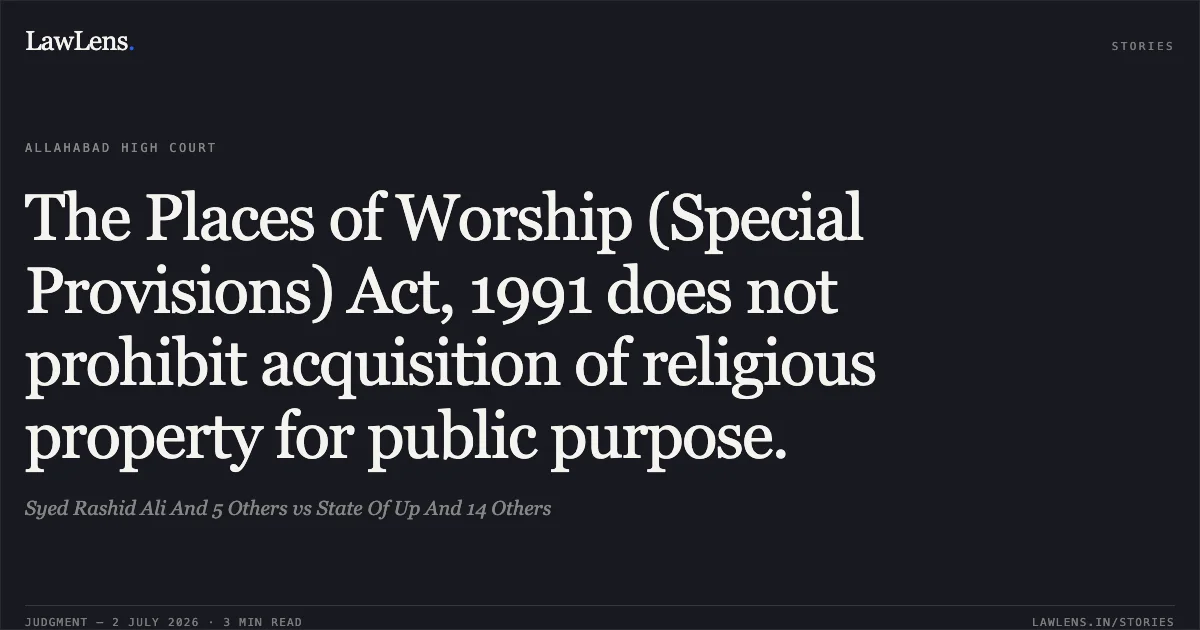
Source reference: para. 36, 48The Court ruled that the Places of Worship Act, 1991, does not bar the acquisition of religious sites for secular public purposes like road widening.
Source reference: para. 46No order was made as to costs.
Source reference: para. 49Acts & Sections Cited
13 provisions across 4 statutes referred to in this judgment. Each provision opens on LawLens.
General Clauses Act, 18971
Right to Fair Compensation and Transparency in Land Acquisition, Rehabilitation and Resettlement Act, 20135
Technology Development Board Act, 19952
Original Court PDF
Syed Rashid Ali And 5 OthersvsState Of Up And 14 Others
Click to open original judgment
Original judgment, available to read, download and summarize on LawLens.in