Facts
The Revenue filed appeals against orders of the CESTAT concerning the consequences of alleged defaults in payment of central excise duty and the applicability of Rule 8(3A) of the Central Excise Rules, 2002.
Source reference: no citationIn Tax Appeal No. 170 of 2012, the Tribunal reduced the penalty imposed under Rule 25 from ₹11,05,439 to ₹5,000. In Tax Appeal No. 289 of 2013, it reduced a penalty of ₹69,14,103 to ₹60,000.
Source reference: p.3–4The later appeals challenged the Tribunal’s reliance on the Gujarat High Court’s decision in Indsur Global Ltd. v. Union of India, which had declared unconstitutional the portion of Rule 8(3A) requiring payment of duty without utilisation of CENVAT credit.
Source reference: p.4–5, p.35–38The parties informed the Court that the Revenue’s appeal against Indsur Global before the Supreme Court had been withdrawn and disposed of on the ground of low tax effect under the CBIC Circular dated 22 August 2019.
Source reference: p.2Issues
Whether the CESTAT was justified in reducing the penalty imposed under Rule 25 of the Central Excise Rules, 2002 from ₹11,05,439 to ₹5,000 in Tax Appeal No. 170 of 2012?
Source reference: p.3–4; para. 3Whether the CESTAT was justified in reducing the penalty of ₹69,14,103, equivalent to the central excise duty confirmed, to ₹60,000 in Tax Appeal No. 289 of 2013?
Source reference: p.4; para. 3Whether the CESTAT could rely upon Indsur Global while considering the validity and operation of Rule 8(3A) of the Central Excise Rules, 2002, including the consequences and penal provisions applicable to an assessee in default?
Source reference: p.4–5; para. 3Whether any substantial question of law arose from the impugned CESTAT orders in view of the finality of the legal position declared in Indsur Global?
Source reference: p.2–3, p.38; paras. 2–5Law Applied
Rule 8(1) and (3) of the Central Excise Rules, 2002 governed the time and manner of payment of excise duty and imposed interest on delayed payment.
Source reference: p.8–13The then-prevailing Rule 8(3A) required an assessee whose default continued beyond thirty days to pay duty consignment-wise and, among other things, prohibited utilisation of CENVAT credit until the outstanding duty and interest were paid.
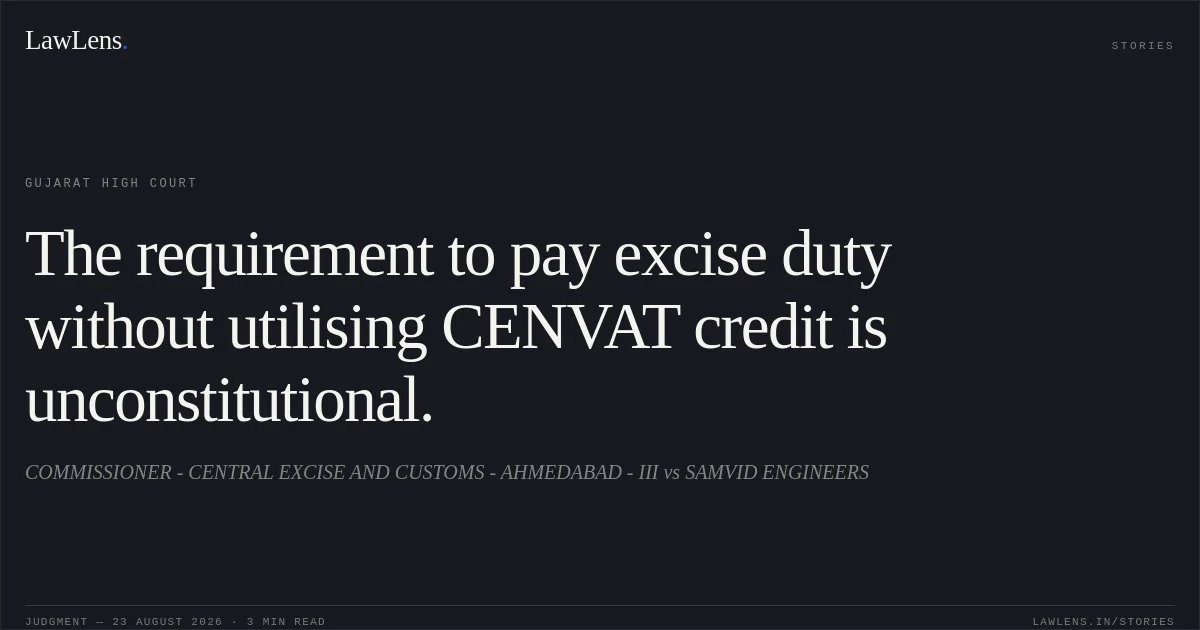
Source reference: p.10–12In Indsur Global Ltd. v. Union of India, the Gujarat High Court held that the requirement to pay duty “without utilizing the CENVAT credit” was arbitrary, disproportionate and violative of Articles 14 and 19(1)(g) of the Constitution, and declared that portion invalid.
Source reference: p.25–35The decision further held that Rule 8(3A) was a collection mechanism framed under the Central Excise Act, 1944, particularly Section 37(1) and Section 37(2)(ib), but that its restriction on CENVAT utilisation exceeded constitutional limits.
Source reference: p.20–24, p.35–36Since the Revenue’s challenge to Indsur Global had been withdrawn before the Supreme Court and disposed of on the ground of low tax effect, the High Court treated that decision as having achieved finality.
Source reference: p.2–3Reasoning
The Court observed that the central legal issue in the appeals—whether an assessee in default could be compelled under Rule 8(3A) to pay excise duty without utilising available CENVAT credit—was directly governed by Indsur Global.
Source reference: p.2–3That decision had invalidated the relevant restriction because it imposed an excessive and disproportionate burden on assessees, including those whose defaults resulted from temporary financial difficulties rather than an intention to evade duty.
Source reference: p.28–35The Court further noted that the Revenue’s challenge to that ruling was no longer pending on merits, having been withdrawn and disposed of for low tax effect.
Source reference: p.2Consequently, the Tribunal’s reliance on Indsur Global could not be characterised as legally erroneous, and the proposed questions concerning Rule 8(3A), the withdrawal of CENVAT credit facility and the related penalties did not give rise to any substantial question of law.
Source reference: p.38; para. 5Holding
The Gujarat High Court held that, in view of the finality of Indsur Global, the legal position concerning the invalidity of the phrase “without utilizing the CENVAT credit” in Rule 8(3A) was settled.
No substantial question of law arose from the impugned CESTAT orders.
Source reference: p.38; paras. 5–6Accordingly, Tax Appeal Nos. 170 of 2012, 289 of 2013, 167 of 2025 and 671 of 2025 were dismissed.
Source reference: p.38; paras. 5–6Acts & Sections Cited
3 provisions across 1 statute referred to in this judgment. Each provision opens on LawLens.
Central Excise Act, 19443
Original Court PDF
COMMISSIONER - CENTRAL EXCISE AND CUSTOMS - AHMEDABAD - IIIvsSAMVID ENGINEERS
Click to open original judgment
Original judgment, available to read, download and summarize on LawLens.in