Facts
This batch of 38 writ petitions was filed by various individuals seeking the "Right to be Forgotten" (RTBF).
Source reference: para. 1-3The petitioners, including persons acquitted of criminal charges, parties to concluded matrimonial/civil disputes, and victims of sexual offences, sought the de-indexing of judicial records from search engines like Google and the masking of their personal identifiers in digital court records.
Source reference: para. 1-3They argued that the perpetual digital accessibility of their past legal involvements caused disproportionate harm to their reputation and life prospects.
Source reference: para. 2Respondents (Google, Indian Kanoon, and Media Houses) raised preliminary objections regarding maintainability against private entities and argued that judicial records are public documents protected by the principle of "Open Justice".
Source reference: para. 78-83, 94-96Issues
1. Whether the "Right to be Forgotten" is a fundamental right included within the Right to Privacy under Article 21 of the Constitution.
Source reference: para. 1412. Whether various reliefs like de-indexing and masking can be granted against private intermediaries by a Writ Court.
Source reference: para. 124-1273. How the conflict between an individual’s right to informational privacy and the principle of "Open Justice" or the public’s "Right to Know" is to be resolved.
Source reference: para. 147, 178Law Applied
The Court primarily relied on K.S. Puttaswamy v. Union of India, which recognized the right to privacy as a fundamental right under Article 21, specifically identifying "informational privacy" as a facet that allows individuals control over the dissemination of personal material.
Source reference: para. 122, 137It applied the "three-fold test" of legality, legitimate aim, and proportionality for any encroachment on privacy.
Source reference: para. 179The Court also considered R. Rajagopal v. State of Tamil Nadu, which initially held that privacy does not subsist in public records but carved out exceptions for victims of sexual assault.
Source reference: para. 130Statutory obligations for intermediaries under Rule 3(1)(d) of the IT Rules, 2021, and the prohibition of disclosing identities of sexual offence victims under Section 228A IPC (now Section 72 BNS) were also fundamental.
Source reference: para. 125, 275Reasoning
The Court reasoned that while "Open Justice" requires judicial records to be accessible, it does not mandate that an individual's name must function as a permanent, unlimited retrieval key and "searchable key" via commercial search engines.
Source reference: para. 156, 212The Court found that search engines are "active processors of personal data" rather than passive conduits, as their algorithms rank and highlight information often based on sensationalism rather than accuracy.
Source reference: para. 172-173, 193In applying the proportionality test, the Court distinguished between "the existence" of a record and its "name-based digital searchability".
Source reference: para. 189It determined that in cases of acquittal, discharge, or quashing, the "Presumption of Innocence" requires that the digital identity of the person reflects the legal outcome.
Source reference: para. 199, 224However, it held that the RTBF cannot be used to "efface serious criminal culpability" in cases of conviction for serious crimes (e.g., fraud, sexual offences) or to shield the public conduct of public figures.
Source reference: para. 206, 279-280Holding
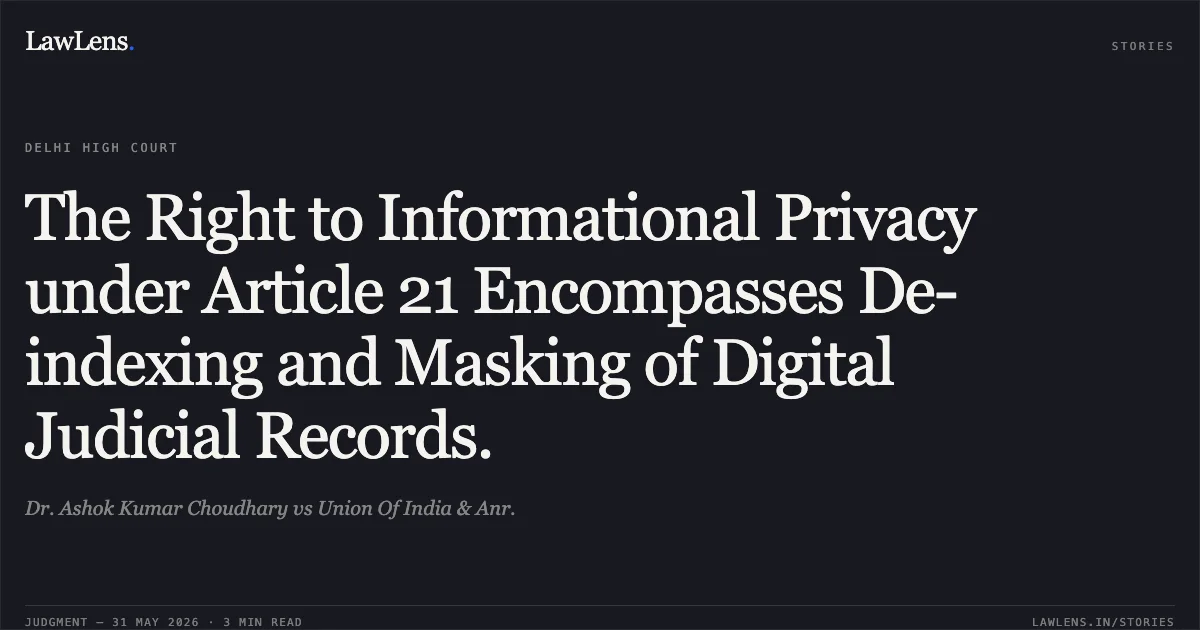
The Court held that the Right to be Forgotten is an intrinsic part of the Right to Privacy under Article 21.
It granted relief in the majority of cases involving acquittals, discharges, and matrimonial/private disputes, directing Google and other search engines to de-index specified URLs from name-based searches.
Source reference: para. 284Legal databases like Indian Kanoon were directed to disable name-based search functionality for the relevant judgments.
Source reference: para. 285For victims of sexual offences (W.P.(C) 9929/2025), the Court held that masking of identity was a statutory mandate under Section 228A IPC.
Source reference: para. 275-276However, the Court dismissed petitions by public figures seeking to erase depictions of public behavior (W.P.(C) 6790/2021) and those involving serious criminal convictions (W.P.(C) 12620/2021).
Source reference: para. 279-280Compliance was ordered within two weeks.
Source reference: para. 284Acts & Sections Cited
7 provisions across 7 statutes referred to in this judgment. Each provision opens on LawLens.
Bharatiya Nyaya Sanhita, 20231
Code of Criminal Procedure, 19731
Digital Personal Data Protection Act, 2023.1
Protection of Children from Sexual Offences Act, 20121
Juvenile Justice (Care and Protection of Children) Act, 2015.1
Negotiable Instruments Act, 18811
Right to Information Act, 20051
Original Court PDF
Dr. Ashok Kumar ChoudharyvsUnion Of India & Anr.
Click to open original judgment
Original judgment, available to read, download and summarize on LawLens.in