Facts
The complainant alleged that, on 16 June 2026, the appellant and another accused confronted her son, abused and threatened him, and that the appellant held the injured man while the co-accused struck him with a stone, causing an injury to his left eye.
Source reference: p. 2–4The complaint was registered as Crime No. 132/2026 for offences under the Bharatiya Nyaya Sanhita, 2023, and the Scheduled Castes and the Scheduled Tribes (Prevention of Atrocities) Act, 1989. The Sessions Court dismissed the appellant’s anticipatory-bail application. The appellant appealed under Section 14A(2) of the SC/ST (POA) Act; by the time of the appeal, the investigation was complete and the charge-sheet had been filed. The co-accused alleged to have inflicted the injury had separately been granted anticipatory bail.
Source reference: p. 2–4, 6Issues
1. Whether the bar on anticipatory bail under Sections 18 and 18-A of the SC/ST (POA) Act applied, having regard to the allegations and the appellant’s attributed role.
Source reference: p. 5–62. Whether the appellant was entitled to anticipatory bail in light of the co-accused’s grant of bail, the appellant’s alleged role, and completion of the investigation.
Source reference: p. 4–6Law Applied
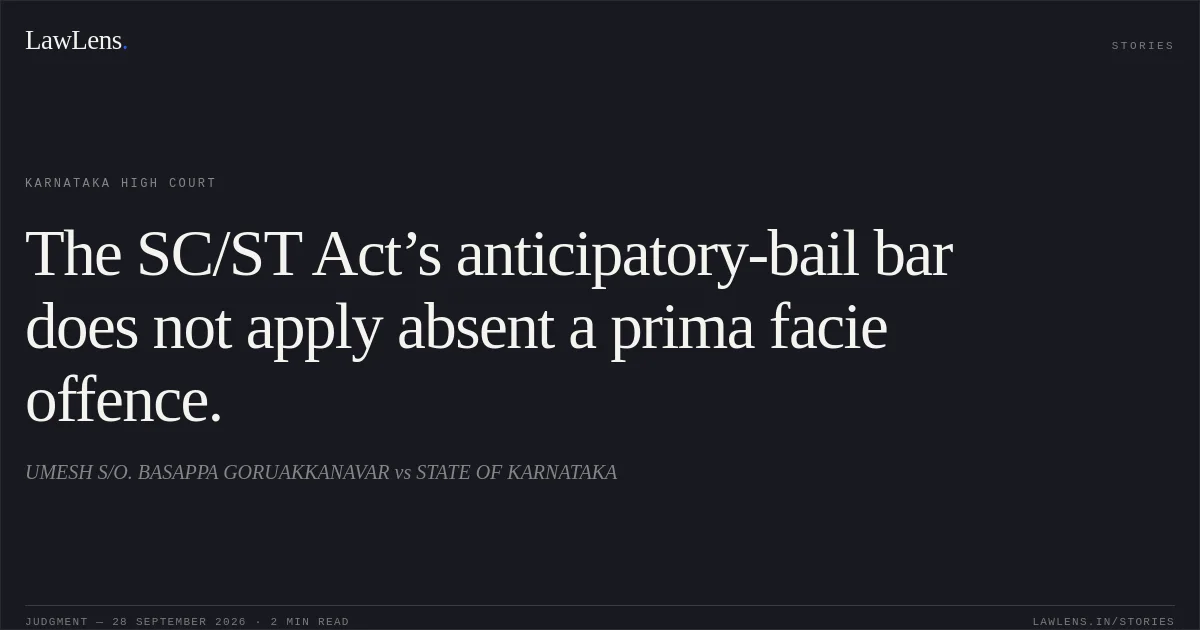
Section 14A(2) of the SC/ST (POA) Act provides for an appeal against an order concerning bail. Sections 18 and 18-A of that Act bar anticipatory bail in cases under the Act; however, relying on Prathvi Raj Chauhan v. Union of India, (2020) 4 SCC 727, the Court stated that the bar does not apply where the complaint does not make out a prima facie case under the Act.
Source reference: p. 5The Court also considered the alleged offences under Sections 126(2), 351(3), 118(2), 115(2), and 352 read with Section 3(5) of the BNS, and Sections 3(2)(va) and 3(1)(r) and (s) of the SC/ST (POA) Act.
Source reference: p. 2–3Reasoning
The Court distinguished the appellant’s alleged conduct from that of the co-accused: the appellant was alleged to have held the injured man’s hands, whereas the allegation of striking him with a stone and causing injury was directed at the co-accused, who had already received anticipatory bail.
Source reference: p. 5–6The Court also took account of the completed investigation and filed charge-sheet, and applied Prathvi Raj Chauhan in considering whether the statutory bar was attracted. On those circumstances, it concluded that the appellant was entitled to anticipatory bail.
Source reference: p. 5–6Holding
The Court allowed the appeal, set aside the Sessions Court’s order dismissing the bail application, and directed that the appellant be released on anticipatory bail in the event of arrest in Crime No. 132/2026.
Bail was subject to a personal bond of ₹2,00,000 with two solvent sureties for the like sum, cooperation with the investigation or inquiry, non-interference with witnesses or evidence, prior information to the jurisdictional police before leaving the police-station jurisdiction, and not committing further offences. The Court clarified that its observations were confined to the bail matter and did not reflect on the merits of the case.
Source reference: p. 6–8Acts & Sections Cited
7 provisions across 2 statutes referred to in this judgment. Each provision opens on LawLens.
Scheduled Castes and the Scheduled Tribes (Prevention of Atrocities) Act, 19891
Bharatiya Nyaya Sanhita, 20236
Original Court PDF
UMESH S/O. BASAPPA GORUAKKANAVARvsSTATE OF KARNATAKA
Click to open original judgment
Original judgment, available to read, download and summarize on LawLens.in