Facts
The applicant, an Examiner/S.S.Q.C. at the Ordnance Factory, Kanpur, was suspended on 27.10.2014 after allegedly being caught at the factory gate with 16 copper rings (approx. 12kg) concealed in his motorcycle and on his person
Source reference: para. 3, 5A charge sheet was issued under Rule 14 of the CCS (CC) Rules, 1965
Source reference: para. 5Following a departmental inquiry where the applicant participated with a defense assistant, the Inquiry Officer (IO) found the charges proved on 09.11.2015
Source reference: para. 3, 7The applicant requested extensions to respond to the IO's report citing medical reasons (chronic hepatitis), which were partially granted, but he failed to submit a final representation
Source reference: para. 3, 5The Disciplinary Authority (DA) subsequently passed an ex-parte order of "Dismissal from Service" on 18.01.2016
Source reference: para. 3An appeal against this order was rejected by the Appellate Authority on 01.10.2016
Source reference: para. 3The applicant filed this O.A. seeking to set aside both orders
Source reference: para. 2Issues
1. Whether the disciplinary and appellate proceedings were conducted in violation of the principles of natural justice and the procedure prescribed under CCS (CC) Rules, 1965?
Source reference: para. 2, 72. Whether the findings of the inquiry and the subsequent orders of dismissal warrant judicial interference under the scope of judicial review?
Source reference: para. 4, 8Law Applied
The court primarily applied the CCS (Conduct) Rules, 1964, specifically Rule 3(1)(i) and (iii) regarding absolute integrity and conduct unbecoming of a government servant
Source reference: para. 7It relied on the procedural framework of Rule 14 and Rule 15 of the CCS (CC) Rules, 1965
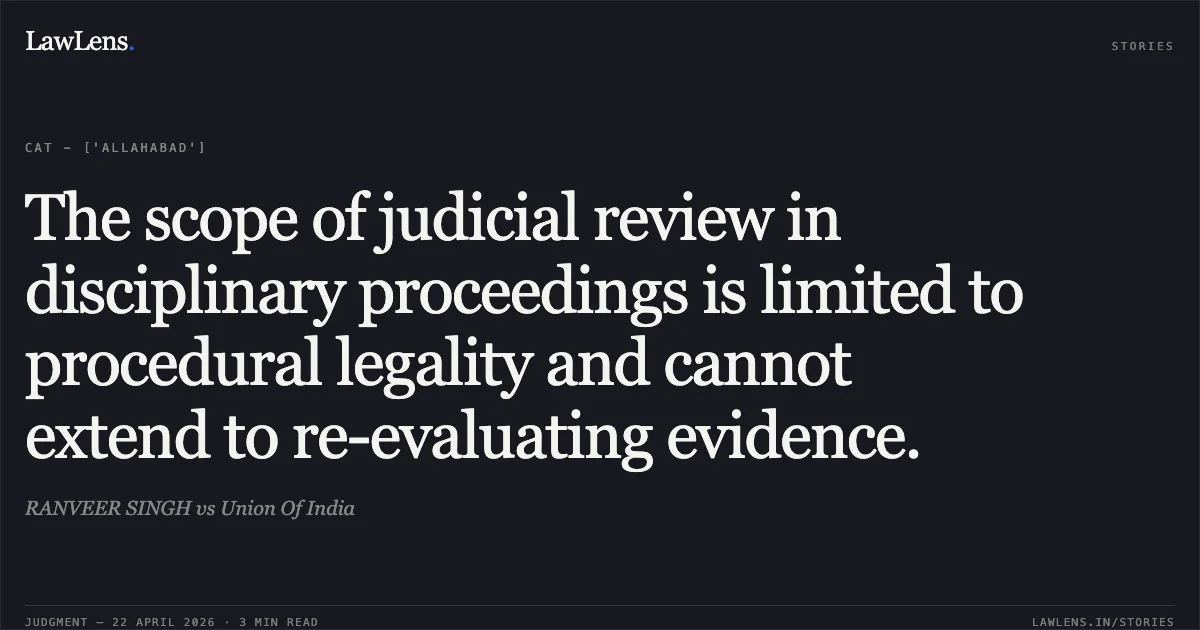
Source reference: para. 5, 7Regarding the scope of judicial review, the Tribunal followed the precedents set by the Hon’ble Supreme Court in B.C. Chaturvedi v. Union of India (1995), which limits judicial review to the process rather than the merits of the evidence
Source reference: para. 8Union of India v. Upendra Singh (1994), which establishes that Tribunals cannot take over the functions of the disciplinary authority or look into the truth of the charges unless no misconduct is legally made out
Source reference: para. 8Reasoning
The Tribunal observed that the charges involved a direct allegation of theft of government property, supported by recovery witnesses and a confessional statement made at the time of the incident
Source reference: para. 5, 7It found that the respondents followed the prescribed legal procedure: a charge sheet was served, witnesses were examined/cross-examined, and the applicant was provided with an inquiry report
Source reference: para. 7The Tribunal noted that although the applicant claimed medical reasons for not responding to the inquiry report, he had been granted extensions and failed to utilize them
Source reference: para. 5, 7Applying the principles from B.C. Chaturvedi, the Tribunal held that it cannot re-appreciate evidence or act as an appellate body over the findings of fact unless there is a clear violation of law or mala fides, neither of which were substantiated here
Source reference: para. 8, 9The Tribunal concluded that the integrity of a government employee is paramount, particularly in a position of trust involving government property
Source reference: para. 9Holding
The Tribunal answered the issues in the negative, holding that there was no procedural infirmity or violation of natural justice in the inquiry
It ruled that the orders passed by the Disciplinary and Appellate Authorities were reasoned and based on material evidence
Source reference: para. 9Consequently, the Tribunal declined to interfere with the punishment of dismissal. The Original Application was dismissed as being devoid of merit
Source reference: para. 10Original Court PDF
RANVEER SINGHvsUnion Of India
Click to open original judgment
Original judgment, available to read, download and summarize on LawLens.in