Facts
The petitioner and respondent were married on 9 February 2023 at Bhopal according to Hindu rites and ceremonies. Owing to incompatible behaviour, conduct and temperament, they began living separately in 2023 and were unable to resume cohabitation.
Source reference: p.1, para.2The parties jointly instituted proceedings for divorce by mutual consent under Section 13-B of the Hindu Marriage Act, 1955, before the Family Court, Gwalior. Their First Motion statements were recorded on 17 April 2026, and the matter was fixed for recording final statements on 22 October 2026.
Source reference: p.2, para.3The parties thereafter jointly sought waiver of the statutory cooling-off period, asserting that they had lived separately for more than three years, reconciliation efforts had failed, and there was no possibility of reunion. The Additional Family Court, Gwalior, rejected the application on 3 August 2026, leading to the present petition under Article 227 of the Constitution.
Source reference: p.1, para.1; p.2, para.3Issues
Whether the statutory six-month waiting period under Section 13-B(2) of the Hindu Marriage Act, 1955, is mandatory or may be waived in appropriate circumstances?
Source reference: p.3, para.5; p.4, para.6Whether, on the facts of the case, the Family Court erred in rejecting the parties’ joint application for waiver where the parties had lived separately for more than three years and reconciliation was not possible?
Source reference: p.5, para.7Whether the impugned order dated 3 August 2026 was liable to be set aside and the Family Court directed to reconsider the application expeditiously?
Source reference: p.5, paras.8–9Law Applied
The Court exercised supervisory jurisdiction under Article 227 of the Constitution of India.
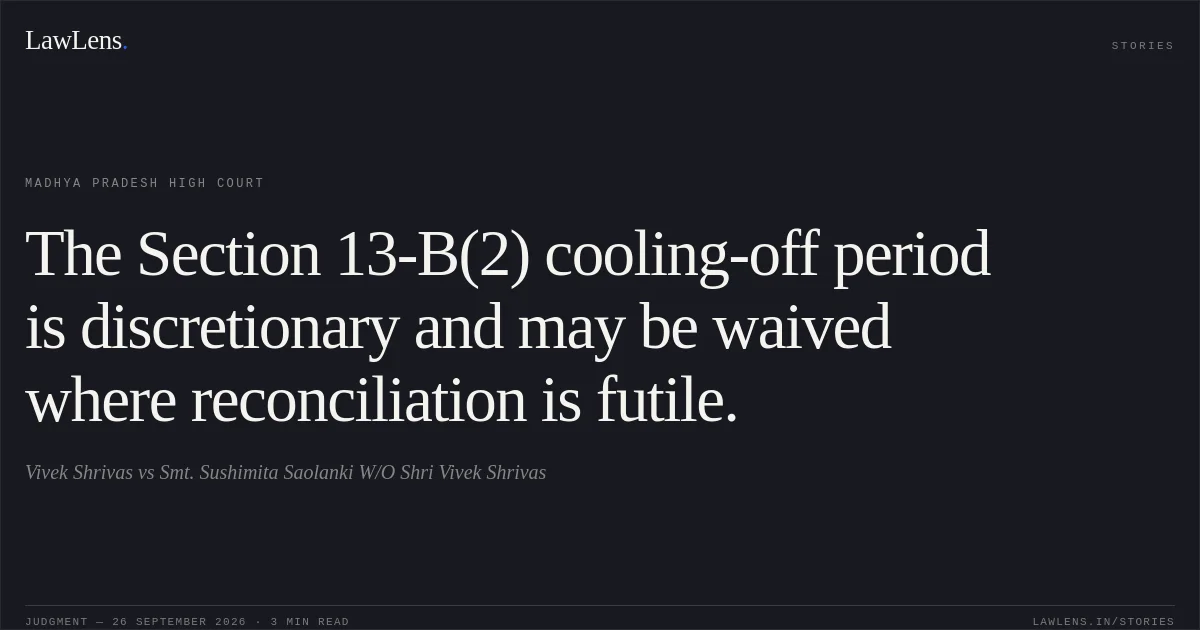
Source reference: p.1, para.1Under Section 13-B(2) of the Hindu Marriage Act, 1955, the six-month period between the First Motion and the Second Motion is not mandatory and may be waived in the Court’s discretion in suitable cases.
Source reference: p.3, para.5Relying on Amardeep Singh v. Harveen Kaur, (2017) 8 SCC 746, the Court considered whether the parties had already undergone the requisite period of separation, whether reconciliation and mediation efforts had failed, whether their disputes had been genuinely settled, and whether further waiting would merely prolong their agony.
Source reference: p.3, para.5The Court also relied on Amit Kumar v. Suman Beniwal, 2021 SCC OnLine SC 1270, which clarified that the factors in Amardeep Singh are guiding considerations rather than inflexible mandatory conditions; relevant factors include the duration of the marriage, the period of cohabitation and separation, pending litigation, the possibility of reconciliation, children, and the voluntariness and completeness of the settlement.
Source reference: p.4, para.6Reasoning
The Court found that the parties had mutually decided to dissolve the marriage, had jointly sought waiver, and had already recorded their First Motion statements.
Source reference: p.5, para.7Their separation had continued for more than three years, and both parties maintained that reconciliation was impossible. Applying Amardeep Singh and Amit Kumar, the Court held that insistence on completion of the waiting period would serve no useful purpose and would only prolong the parties’ matrimonial agony.
Source reference: p.5, para.7The Family Court had failed to apply the discretionary nature of Section 13-B(2) and had therefore erred in rejecting the joint waiver application.
Source reference: p.5, paras.7–8Holding
The High Court allowed the miscellaneous petition and set aside the Additional Family Court’s order dated 3 August 2026 rejecting the waiver application.
It held that the period prescribed under Section 13-B(2) is discretionary and not mandatory.
Source reference: p.5, para.8The concerned Family Court was directed to decide the parties’ application under Section 13-B of the Hindu Marriage Act as expeditiously as possible, keeping in view the principles laid down in Amit Kumar v. Suman Beniwal.
Source reference: p.5, para.8The petition was accordingly disposed of, with a direction for issuance of a certified copy in accordance with the rules.
Source reference: p.6, paras.9–10Acts & Sections Cited
2 provisions across 2 statutes referred to in this judgment. Each provision opens on LawLens.
Hindu Marriage Act, 19551
Family Courts Act, 19841
Original Court PDF
Vivek ShrivasvsSmt. Sushimita Saolanki W/O Shri Vivek Shrivas
Click to open original judgment
Original judgment, available to read, download and summarize on LawLens.in