Facts
The petitioner and respondent were married in 2019 and had been living separately since July 2020 due to matrimonial differences.
Source reference: para. 2They jointly filed a petition for divorce by mutual consent under Section 13-B of the Hindu Marriage Act, 1955, before the Family Court, Mahasamund, registered as Civil Suit No. 58-A/2026, on 4 August 2026.
Source reference: para. 2Along with the divorce petition, they sought waiver of the six-month waiting period under Section 13-B(2). The Family Court rejected the waiver application by order dated 12 August 2026 and fixed the matter for mediation on 5 September 2026.
Source reference: para. 2The husband challenged that order under Article 227 of the Constitution. The wife consented to the request for waiver before the High Court.
Source reference: paras. 3–4Issues
Whether the Family Court was justified in rejecting the parties’ application for waiver of the six-month waiting period under Section 13-B(2) of the Hindu Marriage Act, 1955?
Source reference: paras. 1–2, 9Whether, in view of the parties’ prolonged separation and settled decision to dissolve the marriage, the statutory cooling-off period could be waived in exercise of the principles laid down in Amardeep Singh v. Harveen Kaur?
Source reference: paras. 3, 7, 9Law Applied
The Court applied Section 13-B(1) of the Hindu Marriage Act, 1955, which permits a joint petition for divorce where the parties have lived separately for at least one year, have been unable to live together, and mutually agree to dissolve the marriage.
Source reference: para. 6Section 13-B(2) ordinarily requires the parties to make the second motion not earlier than six months and not later than eighteen months after presentation of the petition.
Source reference: para. 6Relying on Amardeep Singh v. Harveen Kaur, (2017) 8 SCC 746, the Court held that the six-month period is directory and may be waived where the period of separation, including the one-year period under Section 13-B(1), has already elapsed; reconciliation and mediation efforts have failed; the parties have genuinely settled issues such as alimony, custody and other claims; and continuation of the waiting period would merely prolong their agony.
Source reference: para. 7The Court also relied on Smt. Pooja Purohit v. Sumer Purohit, WP227 No. 353 of 2018, decided on 9 May 2018, where waiver was granted in circumstances showing a firm and genuine decision by the parties to separate.
Source reference: para. 8Reasoning
The Court found that the parties had been living separately since July 2020—more than six years before filing the mutual-consent petition—and had jointly expressed their intention to end the marriage.
Source reference: para. 9Since the statutory one-year separation requirement under Section 13-B(1) had long been satisfied, and both parties remained agreed that they could not resume cohabitation, the Court considered the continuation of the six-month waiting period unnecessary.
Source reference: para. 9The respondent’s absence of objection further demonstrated that the decision to dissolve the marriage was mutual and settled.
Source reference: paras. 3–5, 9Applying Amardeep Singh and Pooja Purohit, the Court concluded that the Family Court ought to have considered waiver of the cooling-off period rather than rejecting the application outright.
Source reference: paras. 7–9Holding
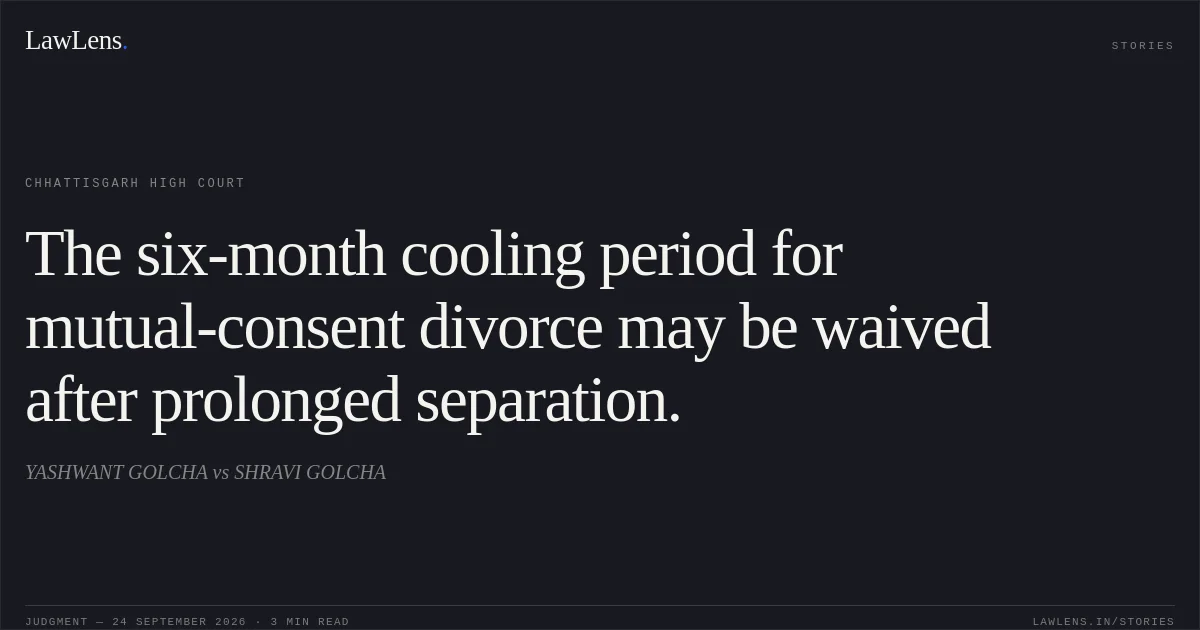
The High Court allowed the petition and set aside the Family Court’s order dated 12 August 2026 insofar as it rejected the application for waiver of the six-month cooling-off period.
The six-month period under Section 13-B(2) was waived.
Source reference: para. 10The Family Court was directed to proceed with the parties’ mutual-consent divorce petition under Section 13-B on its own merits and in accordance with law.
Source reference: para. 10Acts & Sections Cited
2 provisions across 2 statutes referred to in this judgment. Each provision opens on LawLens.
Hindu Marriage Act, 19551
Family Courts Act, 19841
Original Court PDF
YASHWANT GOLCHAvsSHRAVI GOLCHA
Click to open original judgment
Original judgment, available to read, download and summarize on LawLens.in