Facts
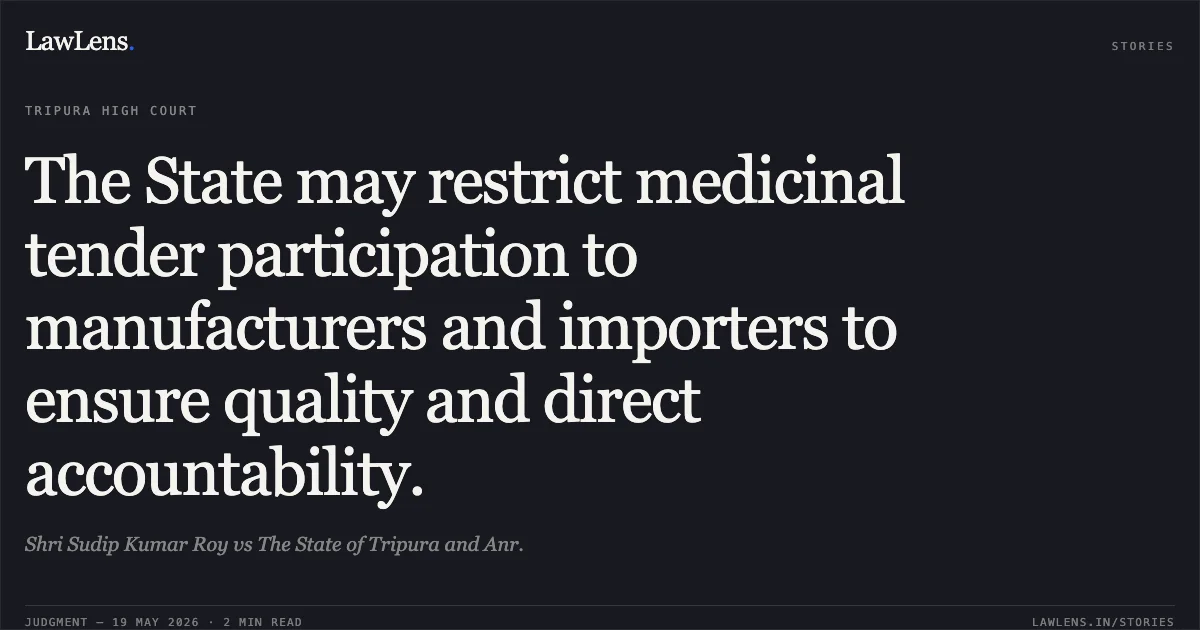
The Petitioner, a proprietor of "Shree Guru Bandhu Drugs" and a local distributor in Agartala, challenged specific eligibility conditions in an e-tender (No.5-II(1)/Store/Med/DHS/2026-27) issued by the Department of Health and Family Welfare, Tripura.
Source reference: p. 1-2The tender restricted bidding eligibility to manufacturers or importers only (Condition A) and mandated that even if an authorized distributor was engaged for supply, the payments and supply orders would remain in the name of the manufacturer/importer (Condition B).
Source reference: p. 2The Petitioner contended these conditions were arbitrary, favored large-scale manufacturers, and violated Articles 14 and 19(1)(g) of the Constitution.
Source reference: p. 2The State justified the conditions as necessary to ensure medicine quality, cost-benefit, and direct accountability.
Source reference: p. 3Issues
1. Whether the tender conditions restricting participation to manufacturers/importers and regulating payment structures are arbitrary, discriminatory, or violative of fundamental rights.
Source reference: p. 2-32. Whether the Court should exercise its power of judicial review to interfere with the administrative discretion of the State in formulating tender qualifications.
Source reference: p. 3-4Law Applied
The Court applied the principles of judicial review in contractual matters established in M/s Michigan Rubber (India) Ltd. v. State of Karnataka, which held that State authorities must be granted "greater latitude" in formulating tender conditions unless the action is malicious or a misuse of statutory power.
Source reference: p. 3It further relied on Union of India v. Bharat Forge Limited, which mandates that tender terms are not open to judicial scrutiny unless they are wholly arbitrary, discriminatory, or actuated by malice, as no person has a fundamental right to carry on business with the Government.
Source reference: p. 4Reasoning
The Court analyzed the respondents' justification—public health safety, quality control, and direct accountability—and found it to be a reasonable objective in the public interest.
Source reference: p. 5Applying the Michigan Rubber test, the Court found no evidence of mala fides or intent to favor a specific party.
Source reference: p. 4The Court reasoned that the State’s decision to deal directly with manufacturers/importers to ensure uncompromising quality was neither whimsical nor irrational.
Source reference: p. 5Since the Petitioner was a distributor and thus ineligible under the valid primary condition (Condition A), the Court deemed it unnecessary to examine the validity of the secondary condition regarding payment structures (Condition B).
Source reference: p. 5Holding
The Court held that the impugned tender conditions were not arbitrary or illegal as they were rooted in public interest and health safety.
The Court answered the issues in the negative, finding no merit for judicial interference under Article 226.
Source reference: p. 5Consequently, the Writ Petition was dismissed, and no costs were awarded.
Source reference: p. 5Original Court PDF
Shri Sudip Kumar RoyvsThe State of Tripura and Anr.
Click to open original judgment
Original judgment, available to read, download and summarize on LawLens.in