Facts
The petitioner held two limestone mining leases, granted in 1994 and 1995 for 20 years, and had applied for renewal before their respective expiry dates.
Source reference: p. 2–6Mining operations stopped in January 2016 because the petitioner lacked environmental clearance.
Source reference: p. 2–6After the State initiated proceedings under Section 4A(4) of the Mines and Minerals (Development and Regulation) Act, 1957 (“MMDR Act”), the petitioner obtained environmental clearances and, on 22 January 2025, applied for orders treating both leases as not having lapsed.
Source reference: p. 2–6The State nevertheless declared the leases lapsed by G.O. Ms. Nos. 78 and 79 dated 31 October 2025, principally on the ground that the non-lapse applications were not made within the time prescribed by Rule 20(3) of the Minerals (Other than Atomic and Hydrocarbon Energy Minerals) Concession Rules, 2016 (“MC Rules”).
Source reference: p. 2–6The petitioner challenged both orders.
Source reference: p. 2–6Issues
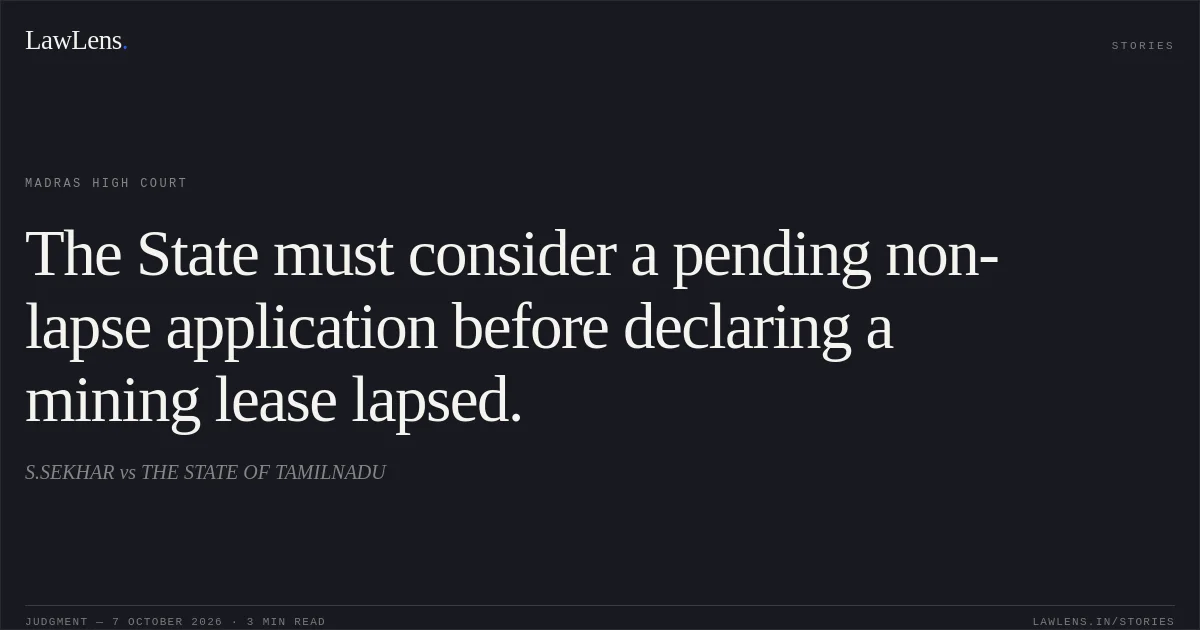
Whether the State could declare the leases lapsed without considering the petitioner’s applications dated 22 January 2025 under the proviso to Rule 20(3) of the MC Rules.
Source reference: p. 16–19Whether the petitioner was entitled to have the delay condoned and the leases treated as not having lapsed because the mining stoppage was beyond his control.
Source reference: p. 15–19Law Applied
Section 4A(4) of the MMDR Act provides for a mining lease to lapse after two years of discontinued operations, subject to the Government’s power to prevent or revive the lapse in the circumstances specified by the provision.
Source reference: p. 15–16Rule 28(1) of the MC Rules requires the State Government to make and communicate an order declaring a lease lapsed; relying on Common Cause v. Union of India, (2016) 11 SCC 455, the Court held that a lease does not stand declared lapsed under Section 4A(4) until that order is made and communicated.
Source reference: p. 16Rule 20(3) ordinarily requires an application explaining the non-commencement or discontinuance of production and dispatch at least three months before the two-year period expires.
Source reference: p. 17–18Its proviso permits the State Government to condone delay where the lessee, for reasons beyond its control, failed to apply within time but applied before the lease lapsed; the Government must then consider the application under the applicable provisions.
Source reference: p. 17–18Reasoning
The Court accepted that the two-year period following the cessation of operations expired in January 2018 and that the petitioner had not applied within the ordinary timeframe under Rule 20(3).
Source reference: p. 16–19However, the State had not made the orders declaring the leases lapsed until 31 October 2025, while the petitioner had submitted his non-lapse applications on 22 January 2025.
Source reference: p. 16–19The applications were therefore made before the State’s lapse orders.
Source reference: p. 16–19The Government’s orders did not consider whether the delay could be condoned under the proviso or assess the petitioner’s reasons for ceasing operations; they relied instead on the applications’ untimeliness and the authorities’ recommendations.
Source reference: p. 16–19The Court held that the Government was required to consider both the request for condonation and, if appropriate, the reasons for discontinuance.
Source reference: p. 16–19It expressed no view on whether the petitioner’s explanations justified condonation or established that the stoppage was beyond his control.
Source reference: p. 16–19Holding
The writ petitions were allowed, and G.O. Ms. Nos. 78 and 79 dated 31 October 2025 were quashed.
The matters were remanded to the State Government to consider the petitioner’s applications dated 22 January 2025 under the proviso to Rule 20(3), decide them in accordance with law within three months, and thereafter pass consequential orders on whether the leases had lapsed.
Source reference: p. 19–20Acts & Sections Cited
1 provisions across 1 statute referred to in this judgment. Each provision opens on LawLens.
Mines and Minerals (Development and Regulation) Act, 19571
Original Court PDF
S.SEKHARvsTHE STATE OF TAMILNADU
Click to open original judgment
Original judgment, available to read, download and summarize on LawLens.in