01Facts
In a pending suit, O.S. No. 734/2007, the petitioner filed I.A. No. 34 under Section 151 of the Code of Civil Procedure, 1908 (CPC), seeking a direction that the Special Land Acquisition Officer and Competent Authority, National Highways Authority of India, deposit in court compensation awarded for acquisition of part of land in Survey No. 4/1, Shetterahalli Village.
pp. 7–8The trial court kept the application in abeyance by order dated 8 September 2026. The petitioner challenged that order under Article 227 of the Constitution.
pp. 7–802Issues
i.Whether the trial court should be directed to consider and dispose of I.A. No. 34, which sought deposit of the land-acquisition compensation, rather than keeping it in abeyance.
pp. 7–8ii.Whether the High Court should determine at this stage that the compensation must be deposited in court.
pp. 8–903Law Applied
Section 151 CPC preserves the civil court’s inherent power to make orders necessary for the ends of justice or to prevent abuse of its process.
pp. 7–9Article 227 of the Constitution empowers the High Court to supervise subordinate courts.
pp. 7–9The judgment states no further statutory test or precedent; it directs the trial court to examine the application’s prayer and supporting reasons in light of the relief sought in the suit.
pp. 7–9Provisions in the judgment · 1 · Linked ones open on LawLens
Code of Civil Procedure, 1908 Section 151
04Reasoning
The High Court treated the grievance as limited to the trial court’s deferral of the application, rather than as requiring the High Court to decide whether the compensation must be deposited.
pp. 7–9Since the application sought a direction concerning compensation for acquired land and the trial court had kept it in abeyance, the trial court should consider its scope and supporting reasons in the context of the suit.
pp. 7–9The High Court therefore ordered a decision on the application but did not determine its merits.
pp. 7–905Holding
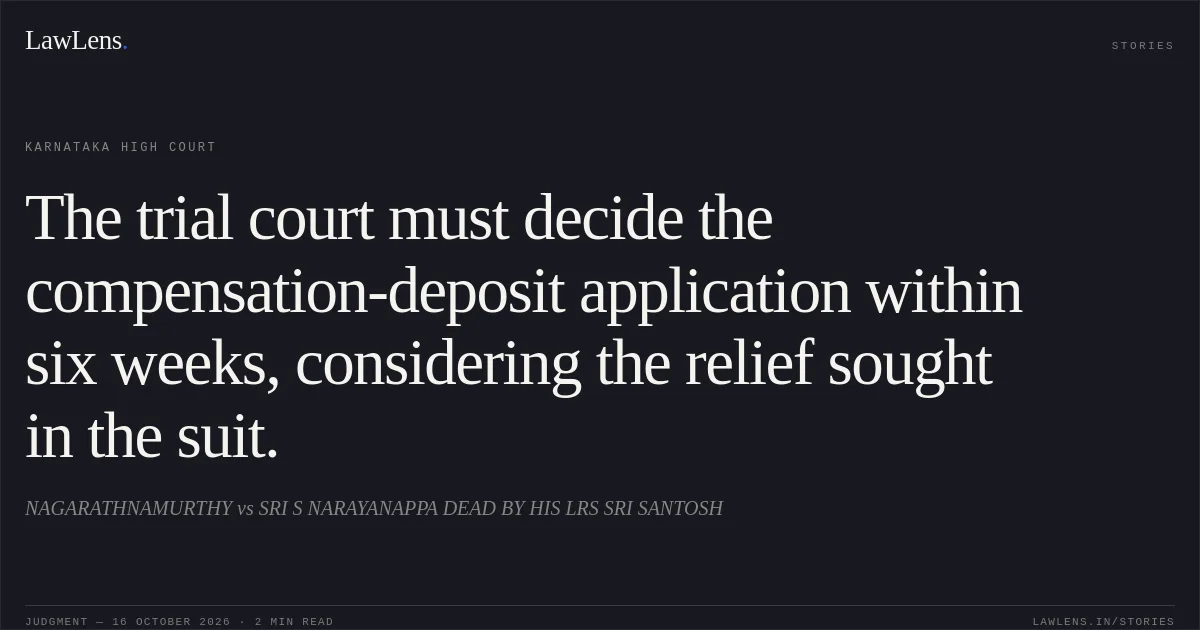
The writ petition was disposed of with a direction to the trial court to dispose of I.A. No. 34 within six weeks, after examining the prayer and reasons in light of the relief sought in the suit.
p. 9The petitioner was permitted to place the High Court’s order before the trial court and, if necessary, seek advancement of the suit hearing.
p. 9No direction was made requiring deposit of the compensation.
p. 9Original Court PDF
NAGARATHNAMURTHYvsSRI S NARAYANAPPA DEAD BY HIS LRS SRI SANTOSH
Click to open original judgment
Original judgment, available to read, download and summarize on LawLens.in