Facts
The Baish Hajari Estate, Malda and Dinajpur, was managed under a scheme framed in a suit instituted by the Collector in 1916.
Source reference: para. 14–17In 2006, the scheme court appointed the petitioners as joint Mutawallis.
Source reference: para. 14–17By Order No. 794 dated 24 March 2010, the District Judge directed the Board of Auqaf to administer the estate under the Waqf Act, 1995, and directed the petitioners not to act as Mutawallis; disputes were to be taken to the Waqf Tribunal.
Source reference: para. 14–17The petitioners challenged that order, alleging denial of natural justice and excess of jurisdiction.
Source reference: para. 3–6Issues
Whether the impugned order was made in breach of natural justice by removing the petitioners as joint Mutawallis without giving them an opportunity to be heard.
Source reference: para. 4–5, 18–20Whether the scheme court exceeded its jurisdiction by transferring administration of the waqf estate to the Board of Auqaf under the Waqf Act, 1995.
Source reference: para. 21–25, 28–29Law Applied
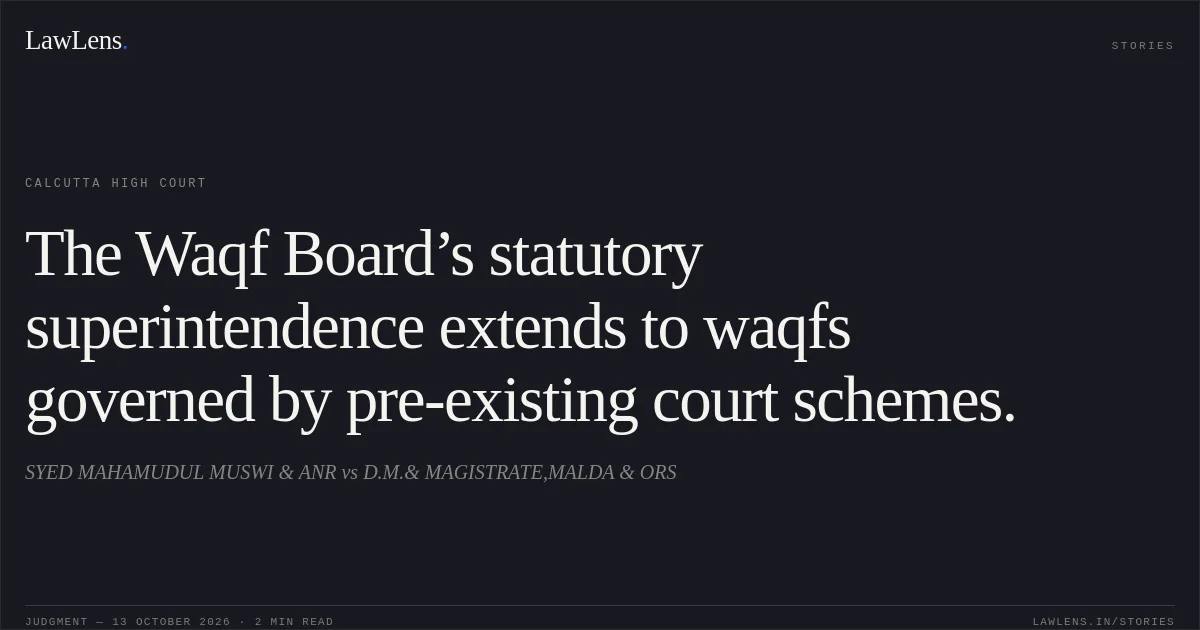
Section 32 of the Waqf Act, 1995 vests the Board with general superintendence over auqaf and empowers it, among other things, to appoint and remove Mutawallis and settle schemes of management; the provision also includes waqfs governed by schemes made by courts.
Source reference: para. 22Section 66 provides that, where a waqf deed, decree, order or scheme gives a court or authority other than the Board powers concerning appointment or removal of a Mutawalli or management of the waqf, those powers are exercisable by the State Government, which must consult the Board where one has been established.
Source reference: para. 25The Court also referred to Section 69 concerning the Board’s scheme-making powers.
Source reference: para. 24Under Bhanwar Lal v. Rajasthan Board of Muslim Waqf, the Tribunal has exclusive jurisdiction over matters assigned to it by the Act, subject to the statutory exception for matters already pending before a civil court.
Source reference: para. 26Natural justice requires an opportunity to be heard where an order entails civil consequences.
Source reference: para. 18–19The supervisory jurisdiction discussed in Radhey Shyam v. Chhabi Nath is exercised to keep subordinate courts within the bounds of their authority, including where jurisdiction is assumed, not exercised, or exceeded.
Source reference: para. 27Reasoning
The Court rejected the natural-justice challenge because the impugned order recorded that the petitioners’ advocate was present and heard, and the record did not show that permission to file written objections had been sought.
Source reference: para. 20On jurisdiction, it held that although the estate had been managed under a court-framed scheme, Section 32 expressly brings court-scheme waqfs within the Board’s superintendence and authorises the Board to manage and administer auqaf under the Act.
Source reference: para. 21–24The Court therefore treated the order as referring administration to the statutory authority, rather than finally determining the parties’ rights; those rights remained for the Board to decide consistently with the dedication and the wakif’s intentions.
Source reference: para. 28Holding
The Court held that the petitioners established neither a breach of natural justice nor a basis to interfere with the District Judge’s order.
It affirmed the impugned order and dismissed the revisional application, without an order as to costs.
Source reference: para. 29–30Acts & Sections Cited
1 provisions across 1 statute referred to in this judgment. Each provision opens on LawLens.
Code of Civil Procedure, 19081
Original Court PDF
SYED MAHAMUDUL MUSWI & ANRvsD.M.& MAGISTRATE,MALDA & ORS
Click to open original judgment
Original judgment, available to read, download and summarize on LawLens.in
![Higher-post pay under FR 49 requires appointment; performing the duties alone does not confer entitlement.. M SUBBA RAO vs Comptroller And Auditor-general Of India. CAT - ['Hyderabad']. LawLens](/stories/thumbnails/higher-post-pay-under-fr-49-requires-appointment-performing-the-duties-alone-does-not-conf-d680f3ed2bbe47a5ac4b36f310e6adcc.webp)
![Incorrect OMR bubbling cannot justify rejection after the answer sheet has been evaluated.. Diksha Mathur vs Delhi Subordinate Services Selection Board. CAT - ['Delhi']. LawLens](/stories/thumbnails/incorrect-omr-bubbling-cannot-justify-rejection-after-the-answer-sheet-has-been-evaluated-8aaaf281b9554255b48062e842c86777.webp)