Facts
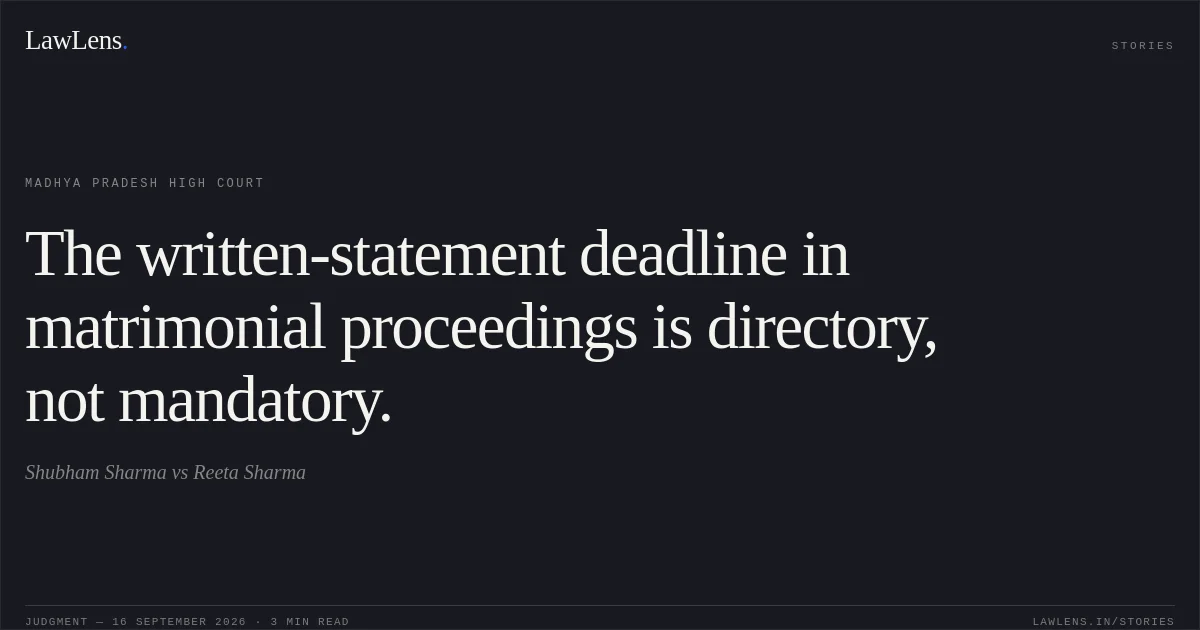
The petitioner-husband challenged the order dated 16 June 2026 by which the Additional Judge, District and Additional Sessions Court, Tarana, District Ujjain, closed his right to file a written statement in RCS HM No. 52/2025.
Source reference: p.1The petitioner contended that, as the parties had initiated proceedings under Section 13B of the Hindu Marriage Act and there was a possibility of mediation, he believed that filing the written statement could be deferred; he stated that the written statement was ready and sought one further opportunity.
Source reference: p.1The respondent opposed the petition, submitting that the petitioner had been granted seven opportunities, including two opportunities subject to token costs of ₹600, but still failed to file the written statement.
Source reference: p.2By then, issues had been framed, the respondent’s evidence had been recorded, and the matter had reached the stage of cross-examination of the petitioner.
Source reference: p.2Issues
Whether the petitioner’s right to file a written statement, already closed after repeated opportunities, should be restored in the matrimonial proceedings.
Source reference: pp.1–2Whether, in the interests of substantial justice, the procedural time limit under Order VIII Rule 1 CPC could be treated as directory and a final opportunity granted, subject to costs and safeguards against further delay.
Source reference: pp.3–4Law Applied
The Court considered Section 13 of the Hindu Marriage Act, 1955, which provides the statutory grounds and framework for matrimonial proceedings, and Order VIII Rule 1 CPC, under which a defendant is ordinarily required to file a written statement within thirty days of service and, for recorded reasons, within the extended period prescribed by the provision.
Source reference: pp.3–4Relying on the Supreme Court’s principle that, except in commercial litigation, the time requirement for filing a written statement is generally directory rather than mandatory, the Court held that procedural rules may be relaxed in appropriate cases to advance substantial justice.
Source reference: p.4The Court also considered the authorities cited by the parties, including Smt. Ratna v. Sudarshan, Kamal Gupta v. Amrendra Kumar Gupta, Smt. Shama Bano v. Afzal Khan, Simrit Gulani v. Anil Gulani, and Jayant v. Charuletha.
Source reference: pp.1–3Reasoning
Although the petitioner had failed to file the written statement despite seven opportunities and imposition of token costs, the Court noted that the dispute was between spouses and that the record reflected a prior possibility of settlement through mediation.
Source reference: p.4Ordinarily, the repeated default and the advanced stage of the trial would justify rejection of the request, particularly because reopening the pleadings could prejudice the respondent and delay the proceedings.
Source reference: pp.2, 4However, applying the directory nature of Order VIII Rule 1 CPC in non-commercial proceedings and considering the larger matrimonial dispute, the Court preferred adjudication on merits over shutting out the petitioner’s defence altogether.
Source reference: p.4It balanced the respondent’s prejudice and the petitioner’s default by imposing substantial costs, prescribing strict timelines, and directing that no unnecessary adjournments be sought.
Source reference: p.4Holding
The petition was allowed and disposed of subject to conditions.
The petitioner was directed to pay ₹40,000 to the respondent within seven days and file his written statement within the same seven-day period.
Source reference: p.4The trial court was permitted to recast the issues, if necessary, as expeditiously as possible and preferably within one month thereafter, and to proceed in accordance with law while granting proper opportunity to both parties.
Source reference: p.4The parties were directed to cooperate and avoid unnecessary adjournments, with liberty to the trial court to pass appropriate orders in case of non-cooperation.
Source reference: p.4Acts & Sections Cited
1 provisions across 1 statute referred to in this judgment. Each provision opens on LawLens.
Hindu Marriage Act, 19551
Original Court PDF
Shubham SharmavsReeta Sharma
Click to open original judgment
Original judgment, available to read, download and summarize on LawLens.in